








 Seven Reasons for Hope on October 8







How a group of Yiddish-speaking women forced monopolists to lower beef prices.
Over a century ago, The New York Times cautioned its readers about a “dangerous class” of women who were “very ignorant,” who “mostly speak a foreign language,” and who were stirring up trouble in the city, protesting the status quo.
These “dangerous” women were Yiddish-speaking, penniless Jews who lived in cramped tenements in New York’s Lower East Side and other poor quarters. They were desperate and staged one of the United States most effective – and least well-known – boycotts, protesting companies gouging the price of kosher meat in 1902. Before long, their efforts spread across the country. The resulting “Great Kosher Meat Boycott” of 1902 was one of the most colorful episodes of American Jewish history, and an early example of the power of Jewish women.
Precarious Jewish Life in the Early 1900s
Facing violent pogroms and wretched poverty in eastern Europe in the 1800s, Jews began leaving in massive numbers in the late 1800s. A wave of pogroms, in particular, targeted Jews in southern and western Russia following the assassination of Czar Alexander II in 1881 and convinced many Jews that they had no future in Europe.
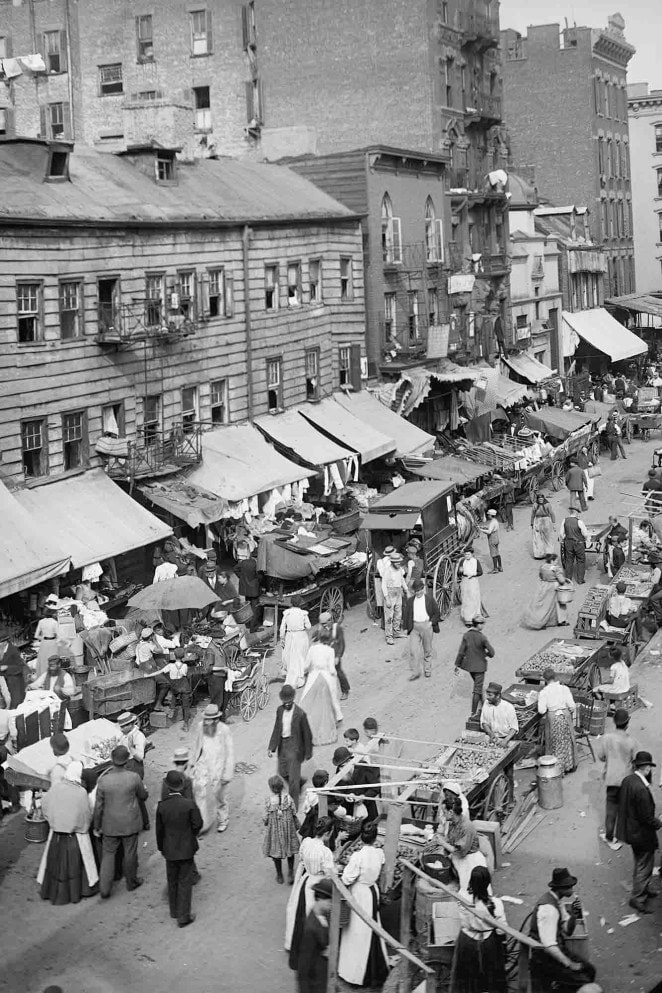
Some Jews dubbed the United States the goldina medina, the “golden land;” hopeful would-be immigrants said the streets in America were paved with gold. Jewish immigrants poured into American cities, transforming cities such as Baltimore, Chicago, Boston, and Philadelphia. New York received the most Jewish immigrants. Numbering just 80,000 in 1880, by 1920 New York was home to a million and a half Jews.
The epicenter of Jewish New York at the turn of the last century was the Lower East Side. The US Library of Congress describes daily life there in the late 1800s and early 1900s:
When a new Jewish immigrant first set foot on the Lower East Side, he or she stepped into a Jewish world. The earliest Eastern European Jews to settle there had quickly established synagogues, mutual-aid societies, libraries, and stores. Every major institution, from the bank to the grocery store to the social club to the neighborhood bookmaker, was Jewish-owned or Jewish-run, and everyone a Jewish immigrant might speak to in the course of daily business would likely be Jewish.
Conditions for most of these immigrants were wretched. Families crammed into tiny tenement apartments with no running water and few latrines for thousands of people. Disease was rampant. Immigrants worked in sweatshops or spent all day working at home, sewing “piece work” orders for the larger factories. Many mothers and fathers stayed up all night, sewing by the light of a flickering candle as their children slept nearly. In the early 1900s, fully half of all fires reported in New York City broke out on the Lower East Side. In 1900, the social reformer Jacob Riis described his visit to a Jewish family’s home on the Lower East Side: “I have found in three rooms: father, mother, 12 children, and six boarders. They sleep on the half-made clothing for beds. I found that several people slept in a subcellar four feet by six, on a pile of clothing that was being made.”

Though many families could barely afford to feed their families, impoverished immigrants tried to save each week to buy food for Shabbat. While they might subsist on bread and potatoes all week long, many bought enough beef to make cholent, the classic Shabbat lunch stew, kreplach (stuffed dumplings), tzimmes (a traditional dish of carrots, prunes and beef), or other Yiddish meat dishes. At the beginning of 1902, beef in New York City cost 12 cents a pound. (For a rough comparison to today’s prices: 12 cents in 1913 was equal to $3.82 today.)
At the turn of the 20th century, the price of beef - as well as many other foods - was controlled by a small handful of Trusts, which set the price of many of the most commonly used household items. In 1902, America’s Beef Trusts decided to radically raise the price of beef.
Beef Trusts and Kosher Housewives
In 1888, the largest beef companies in the country entered into a secret arrangement, fixing the price of beef and preventing competition. Though they denied the very existence of a “Beef Trust,” as the arrangement was known, a series of muckraking articles investigated the Beef Trust’s horrendous safety standards, terrible worker relations, and price fixing and gouging. Journalists Charles Edward Russell, who wrote The Greatest Trust in the World in 1905 and Upton Sinclair, who wrote The Jungle in 1906, lifted the lid on the Beef Trusts’ terrible practices. Together, the beef companies in the Beef Trust controlled over three quarters of all beef - and also chicken and pork - in America, and kept prices artificially high. Representatives met weekly in Chicago to set each week’s new inflated price.
Kosher consumers faced even higher prices. Some cattle and chickens were slaughtered by kosher slaughterers - called shochets - in Chicago, the heart of the Beef Trust; this kosher meat was sold in Chicago and other Midwestern cities. Yet the bulk of America’s Jewish population lived in New York and elsewhere on the East Coast. Cattle and chickens were purchased from the Beef Trust and brought to New York, where they were slaughtered according to Jewish law and distributed to the city’s kosher butchers, adding to the cost. In 1902, the majority of the estimated nearly 600,000 Jews who lived in New York City kept kosher: each of these often-penniless families faced exorbitant prices

“The conscience of an Orthodox Jew is absolute when it comes to meat,” explained a kosher butcher on First Avenue in New York to the New York Tribune. Kosher chicken cost between 18 and 25 cents a pound in 1902, out of the reach of most families, who reserved it as a special treat on Shabbat and Jewish holidays. (Quoted in The Great Kosher Meat War of 1902: Immigrant Housewives and the Riots That Shook New York City, by Scott D. Seligman. Potomac Books: 2020.)
Kosher Butchers Resisting Price Gouging
In April 1902, the Beef Trust began raising prices. As consumers turned to eggs for much-needed protein, beef companies began buying up eggs, as well, in order to create an artificial shortage and raise prices on this alternative protein source. (The price of a dozen eggs rose from 15 cents a dozen - over $4 in today’s prices - to 18 cents a dozen: over $5 today.) The Trust also sold animals destined for the kosher market to speculators, refusing to deal with kosher butchers or slaughterhouses on the East Coast directly, thus driving up costs still further.

Passover in 1902 began on April 21, and the steep rise in meat, chicken, and egg prices hit Jews hard. Women who hoped to bake and cook holiday meals for their families found themselves struggling. The New York Tribune described scenes of desperation in Jewish areas of the Lower East Side: “The sights to be seen at some of the small butcher shops are pathetic. Women whose husbands allow them 30 or 40 cents a day to provide the family food for the day wistfully price the different scraps of meat and bone, trying to find some piece so undesirable that their scanty funds can secure it. The refuse in the shops is greedily snapped up at from ten to fifteen cents a pound. Women hasten back to the tenements closely grasping the few ounces of meat they have secured.”
At first, kosher butchers in New York tried to resist the Beef Trust’s price gouging by themselves. Most boycotted the Beef Trust and remained closed for a week during the busy pre-Passover season, trying to force the Trust to lower prices. After a week of doing no business, however, kosher butcher shops began to reopen. Kosher beef sales in April 1902 were fully half of what they had been during the same period in 1901. “When the holidays of the feast of Passover have ended next week, 150 to 200 meat markets on the East Side will go out of business, estimated the president of the East Side Hebrew Retail Butcher’s Kosher Guarantee and Benevolent Association, a group of New York City kosher butchers, on April 17, 1902.
Enter Jewish Women
After a kosher butcher boycott and subsequent negotiations with the Beef Trust, kosher butchers in New York City gained a few tiny concessions. Declaring “victory,” they reopened for business on May 14, 1902. Jewish housewives were outraged: the price of kosher meat continued to be prohibitive.
Three middle aged women from a Lower East Side tenement decided to take matters into their own hands. Sarah Edelman, Paulina Wachs Finkel, and Fanny Levy were all recent immigrants and mothers of large families. They lived in the same tenement building and all struggled to feed their children. They placed an ad in a Yiddish newspaper calling on women in the neighborhood to come to a meeting in a restaurant Sarah’s family operated. They hoped as many as 50 local women might attend to discuss what they could do about the price of kosher beef. Over 500 women showed up. The crowd was so large that women waited outside on Monroe Street, straining to listen to the speakers inside. Many were angry that the kosher butchers had ended their boycott: if their butchers couldn’t stand up to the Beef Trust, the women declared, they would.
The Yiddish language Yidishes Tageblat newspaper described the scene. Here is an excerpt, translated into English by Paula Hyman:
We will not give away our last few cents to the butchers - we want to eat meat at 12 cents and not 16 cents a pound.’ This is the cry taken up yesterday by women from Houston to Cherry Streets, from Christie to Norich Streets - the voices of housewives who are ready to fight. Mrs. Edelson became chairlady of the assembly. New York has never seen such a huge convocation of women before. The women this time let the men play at home with the children while they went to attend the meeting. They cried, ‘Our husbands work hard. They try their best to bring a few cents into the house. And we must manage to spend as little as possible.’ Others responded, ‘We will not be silent - we will overturn the world.’ They said, ‘The strike of the butchers was a trick. When they wanted something for themselves, they didn’t sell meat. We’ll show them that we know our business, too.
Each woman at that first meeting contributed ten cents to a central fund. They divided into committees of five women each and planned to patrol the streets of the Lower East Side the following day, Thursday, May 15, to enforce a neighborhood-wide boycott on kosher meat. They used the funds they’d raised to print 5,000 copies of a flyer in Yiddish, reading:
Dear Sisters, The time has arrived when we must take a hand in this meat fight. With our money, the butchers buy diamonds and wear diamonds… Now, what shall we say, dear sisters, when they give us stone and bone and charge us five cents more? We therefore ask and demand that all our dear sisters in Greater New York that they refuse to pay more than 12 cents a pound….do not buy meat at all…. Buy no meat yourselves and let no one else buy!
“Eat no meat!”
On May 15, 1902, at 3 AM, between 20,000 and 30,000 Jewish women began to assemble in the streets, many small children. They held picket signs demanding that women buy no meat until the Meat Trust relaxed its prices. Most of their neighbors heeded them, but some women did venture out to the local kosher markets to buy meat for Shabbat. Picketing women tore the packages of meat out of women’s hands and threw them on the ground. Some women burst into kosher butcher shops, and even private homes, arguing with customers and cajoling them to join the meat boycott. Flyers bearing a skull and crossbones were distributed throughout New York warning customers in Yiddish: “Eat no meat while the Trust is taking meat from the bones of your women and children.”

With altercations between women in the street, police moved in. The World newspaper described scenes of police cruelty: ”Some of the policemen were rough to the point of brutality in enforcing the general order to ‘move on.’” But the sight of women being beaten by police inflamed passions further. “A shower of bricks, china, utensils, flat irons and all sorts of missiles” rained down on the police from tenement windows, the World reported. 85 people were arrested, the vast majority of them local Jewish women. The boycott organizers continued to fundraise and used donations to bail their neighbors out of jail.
Instead of breaking the protests, the police’s heavy-handed approach sparked even more Jewish women to demand a boycott until the Beef Trust lowered prices. Jewish women in the Bronx, Brooklyn, Harlem, Newark, and as far away as Boston and Philadelphia began copying the tactics of the Lower East Side, and organizing kosher meat boycotts in their own neighborhoods. Women went door to door, explaining to their impoverished neighbors why it was important not to break ranks. Not all the protests were benign: women fought in the streets, often armed with sticks. Passions ran high; though most women believed in and abided by the boycott, there were weeks of fighting, arguing, and property destruction as the boycott enforcers ensured that nobody bought or consumed kosher meat.
The riots paused on May 17, for Shabbat. Instead of picketing in the streets on the Jewish day of rest, several women took their calls for boycotts to the neighborhood synagogues, announcing the boycotts to startled congregations and urging their neighbors to stand strong and cooperate with the boycott until their goals were met. Some rabbis were aghast that women were interrupting services to talk about commerce; others let the women have their say.
By the end of the boycott, it is estimated that over a hundred thousand Jewish women had taken part.
Local press outlets generally applauded the Yiddish-speaking women. “Bravo, Bravo, Bravo, Jewish women!” said the Forverts, a local Yiddish-language newspaper. Others viewed the Jewish women as a grave threat. The New York Times railed against what they called this “dangerous class…especially the women (who) are very ignorant (and)...mostly speak a foreign language” and somehow threatened the well-being of New York citizens.
Gaining Allies
The Kosher Meat Boycott lasted for three long weeks. It was a master class in political organizing. History writer Scott D. Seligman estimates that by the end of the boycott, over a hundred thousand Jewish women had taken part. It spawned several consumer organizations, which eventually came together in a broad group called the Allied Conference for Cheap Kosher Meat. The Conference issued its own fliers, declaring in Yiddish:
Women! Victory is near!... Do not buy any meat. All the organizations fighting against the Jewish Meat Trust have now united under the name of the Allied Conference for Cheap Kosher Meat. Brave and honest men are now aiding the women… The Trust must be downed. For the present, do not buy any meat. Patience will win the battle….
On May 22, New York’s Retail Butchers Association signed onto the boycott, refusing to sell any kosher meat in its affiliate stores. On May 27, Orthodox rabbis in New York formally endorsed the boycott.
Triumphing over the Beef Trust
By late May, the Beef Trust was showing signs of weakness. They were in negotiations with different groups of kosher consumers and - in a separate development - were facing a major antitrust lawsuit. They began offering more and more concessions. There was never any one moment when the Beef Trust gave in, but as weeks went by, it became clear that the boycotters were winning in this massive David-and-Goliath battle.

By June 9, 1902, the price of kosher meat had finally gone back to 14 cents a pound. The boycott ceased, though the political experience of the thousands of women involved would soon find new causes. In 1904, Jewish women on the Lower East Side organized a rent boycott to protest ruinous rents charged by slum landlords. Women organized another, smaller kosher meat boycott to protest price gouging in 1910. Many of the women who took part in the Kosher Meat Boycott went on to become leaders in labor negotiations.
Perhaps one of the most lasting effects of the beef boycott was a kosher cooperative butcher shop at 245 Stanton Street. With community support, a local boycott organizer named Sarah Cohen opened the more affordable shop and gained a loyal following among local kosher-keeping activists. “Housewives with their baskets stood in line a block away,” the New York Tribune reported; “Men left their work and waited for hours to get the first meat the family had tasted for weeks. People rose before daylight to be the first at the door.”
The consumers of the Lower East Side had a new appreciation of affordable kosher food prices - and a greater sense of community as well.











I can't explain the pride I felt reading this article. Jewish women are strong in so many ways. We experience adversity and have done so for centuries, but we don't scream and shout we find solutions...It is our sense of who we are, our strong faith in God and each other that will never be broken.
BRAVO!
Maravilhosa história um contexto espetacular resiliência
An uplifting article about the power of mothers.
Well, NYT hasn’t changed a bit.
I actually read about this protest in the lower east side of new york by jewish women a long time ago
The power of Jewish women!
Fascinating!