
Click here to buy
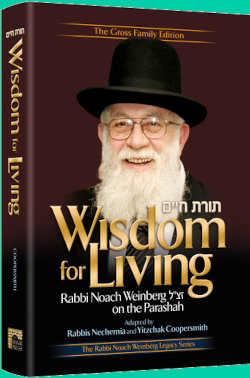
Wisdom for Living
Rabbi Noah Weinberg on the Parashah


7 min read


This week's Torah portion contains the mitzvah of kiddush Hashem, sanctifying God’s Name. "You shall not desecrate My holy Name, rather I should be sanctified among the Children of Israel; I am Hashem Who sanctifies you" (Vayikra 22:32).
The Mishnah says, "All that the Holy One, Blessed is He, created in His world, He created solely for His honor, as it is said (Yeshayahu 43:7), ‘All that is called by My Name, indeed, it is for My honor that I have created it’" (Ethics of the Fathers 6:11).
There is only one point to all of creation: kevod Shamayim – giving honor to God.
But the classic work by the Ramchal, Rabbi Moshe Chaim Luzzatto, The Path of the Just seemingly contradicts this statement. He explains that "man was not created except for the sole purpose of rejoicing in God and deriving pleasure from the splendor of His Presence; for this is… the greatest pleasure that can be found." There is nothing we can do for God. All of creation is an expression of His kindness: "Olam chesed yibaneh – the world is built on kindness." And the ultimate kindness is the pleasure of forging a relationship with Him. How do we reconcile this explanation of our purpose with "All that the Holy One, Blessed is He, created in His world, He created solely for His honor”?
There really is no contradiction; these are two sides of the same coin. The Almighty obviously does not need us to honor Him. By appreciating God’s greatness, which is conveyed through every aspect of creation, we experience the ultimate pleasure of ahavas Hashem, loving the Almighty. Making the world for God’s honor is for us, not God. Everything in the world is a vehicle to honoring Him so we can constantly appreciate His awesomeness, and, by attaching ourselves to His infinite existence, attain the greatest source of meaning and pleasure.
The Rambam writes in Sefer Hamitzvos, on the mitzvah of kiddush Hashem (Positive Mitzvah #9):
This mitzvah requires us to publicize the true religion to the masses. This must be done without fear of retribution, to the extent that even if a powerful tyrant tries to force us to deny God, we may not obey him. We must rather unquestioningly submit to death, not even allowing him to think that we have denied God, even if we still maintain belief in Him in our hearts. This is the mitzvah of sanctifying God's Name in which all Jews are obligated.
In the Shemoneh Esrei of Rosh Hashanah that describes the utopian vision that the Jewish people yearns for, we daven, "Let everything that has been made know that You are its Maker… and let everything with a life's breath in its nostrils proclaim, 'Hashem, the God of Israel, is King, and His Kingship rules over everything.'" We are beseeching Hashem to enable all of humanity to recognize God so they, too, can bask in the ultimate pleasure of ahavas Hashem.
The Mishnah states, "There were ten generations from Adam to Noach – to show the degree of His patience; for all those generations angered Him increasingly, until He brought upon them the waters of the Flood. There were ten generations from Noach to Avraham – to show the degree of His patience; for all those generations angered Him increasingly, until our forefather Avraham came and received the reward of them all" (Ethics of the Fathers 5:2, 3).
Why did only Abraham receive the reward of them all? What about Noach, who was an "ish tzaddik tamim – a righteous, perfect man"? Furthermore, Shem and Ever lived during this time. They had a great yeshiva; Jacob spent 14 years learning there! Why was it only Abraham who saved mankind?
In The Laws of Idolatry (1:2-3), the Rambam describes the world’s downward spiral from monotheism to idolatry, starting with Enosh, Adam’s grandson, who mistakenly honored Hashem's celestial servants as a way of honoring God. This mistake eventually led the entire world to worshiping false gods.
The Rambam then describes the reversal of this trend:
The Eternal Rock was not recognized or known by anyone in the world, with the exception of a few individuals, such as Chanoch, Mesushelach, Noach, Shem, and Ever. The world continued in this fashion until the pillar of the world – the Patriarch Avraham – was born…
[Avraham] knew that the entire world was making a mistake. What caused them to err was their service of the stars and images, which made them lose awareness of the truth.
Abraham was forty years old when he became aware of his Creator. When he recognized and knew Him… he began to call in a loud voice to all people and inform them that there is one God in the entire world and it is proper to serve Him. He would go out and call to the people, gathering them in city after city and country after country, until he came to the land of Canaan – proclaiming [God's existence] – as it states (Bereishis 21:33): "And there he proclaimed in the Name of Hashem, God of the universe." When the people would gather around him and ask him about his statements, he would explain to each one of them according to their understanding, until they turned to the path of truth.
The Rambam explains that after Abraham discovered God, he undertook the mission of teaching monotheism to the entire world. The Raavad asks: Where were Shem and Ever? They knew the truth; why did they not protest against the rampant idolatry?
The Kesef Mishneh answers that of course Shem and Ever were great, righteous men, prophets who taught Torah to their students in their great yeshiva. But they fell short in one crucial area: they did not "call out in the name of God" – they taught only those students who came to them. They did not proactively undertake to draw people away from idolatry and back to the Almighty.
This was Noach’s failing as well. Indeed, he was a tzaddik who perfected himself and "found grace in the eyes of God." But he did not take the initiative to teach humanity the ways of Hashem. Therefore, he managed to save only himself and his immediate family.
Only Abraham traveled around teaching everyone he encountered about the reality of God's existence. It was Avraham who shattered his father’s idols and told their followers, "You are mistaken! There is only one God Who created all mankind. Worshipping rocks and trees is nonsense." Abraham dedicated his life to kiddush Hashem, to bringing the reality of Hashem to the world. Therefore, only Abraham received the reward of his predecessors, and, in doing so, merited to become the father of the Jewish people, whose mission is to partner with Hashem in making Him known to the entire world.
Today, the vast majority of the Jewish people are not undertaking the mission of bringing the awareness of God into the world and serving as His ambassadors, for they themselves unfortunately do not understand His existence and the truth of His Torah. Can there be any greater desecration of God’s Name than this? The messenger has forgotten his message!
Reaching out to our lost brothers and sisters involves many Torah obligations. The most far-reaching of them all is kiddush Hashem – to fight the desecration and fill this aching vacuum with the recognition of Hashem and His everlasting love for His people – because this is Hashem’s purpose in creating the world and our purpose as the Jewish people.
Today there is a terrible famine, as the prophet says, "Behold, days are coming – the word of the Lord Hashem/Elokim, when I will send hunger into the land; not a hunger for bread nor a thirst for water, but to hear the words of Hashem” (Amos 8:11). By making the effort to reconnect your fellow Jews to their heritage, you are helping to fulfill the purpose of creation.