






 What Two Hebrew Words Reveal About Israeli Democracy

7 min read
4 min read
6 min read
4 min read





Why two people can experience the same moment so differently, and how to build deeper understanding across emotional divides.
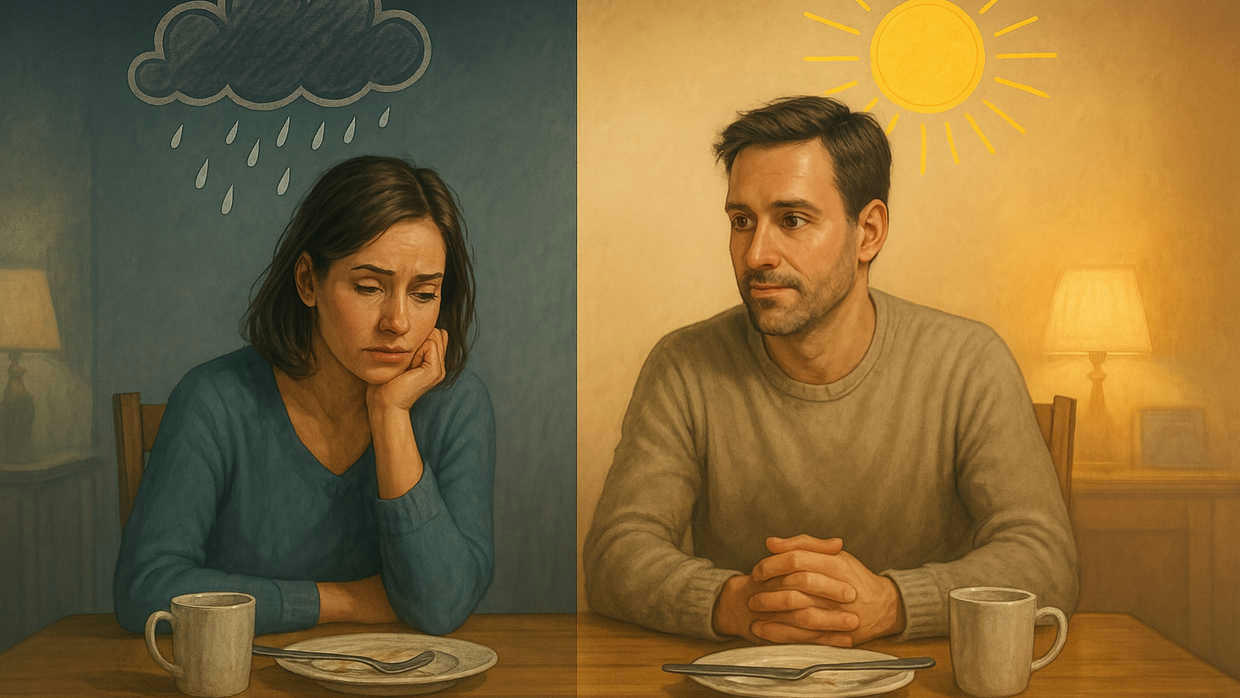
Picture this: It’s a quiet Tuesday night. The kids are asleep, the dishes are done, and a couple finally sits down together. She says, “I felt a little overwhelmed today.” He pauses, nods, and replies, “Well, that’s just life, isn’t it?”
And suddenly, something shifts.
To her, it sounds dismissive.
To him, it feels like he offered calm, steady support.
One couple, one sentence—and very different experiences.
She sits in silence, feeling unseen. I opened up, and he brushed me off.
He’s confused. Why does everything become a problem? I’m just trying to keep things normal.
This disconnect isn’t unusual—it’s deeply human. Every person experiences life through a lens shaped by personality, history, emotions, and expectations.
In relationships, this truth shows up constantly. Not just in dramatic moments, but in the ordinary, everyday exchanges that either build connection—or create distance.
Let’s walk through a few real-life examples.
He says, “You look nice today.”
She might hear:
Or she might smile, feeling appreciated.
The same sentence can land very differently, depending on her past, her mood, or her beliefs about herself. Maybe compliments were rare or manipulative in her childhood. Maybe she’s feeling confident today—or fragile.
Meanwhile, he may simply be trying to connect, act on advice, or offer love. The impact depends less on the words, and more on the internal world they land in.
She calls. He doesn’t answer.
Her reaction: He’s ignoring me. He always prioritizes work over me.
His reality: I was in a meeting. I planned to call back after.
The disconnect? Maybe she’s been hurt in the past or told herself a story about being unimportant. That story fills in the blanks faster than logic ever could.
He buys a thoughtful necklace she once admired. She opens it, smiles politely, but something feels off.
He’s hurt: I tried. She barely reacted.
She’s disappointed: This doesn’t feel like me. Doesn’t he know me better by now?
They both walk away feeling unappreciated—while each tried, in their own way, to connect.
Every interaction is shaped by deeper factors:
And perhaps most powerfully: mood.
If someone’s tired, anxious, or hurt, even a well-meaning comment can sting. If they’re relaxed or content, the same words can feel warm and loving. It’s not always what was said—it’s how and when it was heard.
Which is why one of the most powerful questions in any relationship is:
“Is this really about what just happened—or is something deeper coloring this moment?”
The Talmud says, “Just as no two faces are alike, no two minds are alike” (Berachot 58a).
We’re not meant to think or feel the same. That’s not a flaw—it’s Divine design.
Marriage isn’t about merging into one shared truth, but honoring two unique realities. And it’s in navigating those differences that real closeness is born.
When a couple embraces this idea, the entire relationship shifts.
You stop assuming bad intent and start asking real questions.
Instead of, “You’re overreacting,” you ask, “How did that feel to you?”
Instead of, “That’s not what I meant,” you say, “Tell me what you heard.”
When you feel dismissed or hurt, pause and say:
“Can I tell you what that felt like for me inside?”
You’re not accusing—you’re sharing. And when your partner seems upset, try:
“What might they be feeling right now that I’m missing?”
Curiosity builds bridges. Defensiveness builds walls.
You can validate your partner without agreeing.
When someone says, “That really hurt,” the best response isn’t, “But I didn’t mean it like that.”
It’s:
“Wow, I didn’t know it felt that way. Help me understand.”
Validation doesn’t require agreement—just respect.
You’ll still misread each other. That’s inevitable.
What matters is the return:
“I want to get better at understanding you.”
“Let’s figure this out together.”
When both people stay curious and committed, misunderstanding becomes an invitation to grow.
In Judaism, greatness lies not in perfection, but in growth. Real love isn’t found in having identical experiences—it’s found in honoring each other’s humanity, again and again.
If you can embrace the truth that your partner may never fully see the world as you do—and love them not in spite of that, but because of it—then you haven’t just built a marriage, you’ve built something eternal.














All true thanks for posting
Wonderful!
I think it's revealing that all the examples show women taking something well intentioned the wrong way, choosing to feel hurt where none was intended. It's true that miscommunications happen; it's true that one person will be more sensitive to hurts (perceived or intentional) than the other, but in my observation, it is much more common today for people (women, perhaps?) to have become extremely self-absorbed and lack the emotional maturity to first ask themselves the questions that might avoid the hurt: Yes, I know he's always busy on Monday at work. . . I had admired that necklace. . . How nice that he is noticing me today. . . etc.
Excellent article and insight for any relationship…