 Those Shameful Thoughts and What They Really Say about You





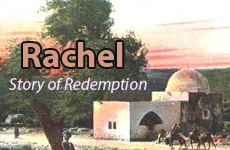
The Torah states that Jacob put up a monument on Rachel’s grave which stands till today (Genesis 35:20). Does that refer to the domed building which has always stood over her grave?
Actually, no. In general, when the Torah states “until today,” it refers to Moses’s time, when the Torah as we have it was first written down (Radak; see Talmud Yoma 54a). (Some alternatively explain that “until today” alludes to the fact that the location of her grave would never be forgotten or that it will eternally be a place of worship and pilgrimage for Jews.) There is a longstanding tradition that Rachel’s grave really is where we believe it is today – as the location has been revered by Jews, Christians, and Muslims throughout the ages. But whatever monument Jacob stood up there is surely long lost.
Incidentally, Jacob’s placement of a monument over Rachel’s grave is the earliest source of the universal Jewish custom of placing a headstone over a grave. In Hebrew it is called a matzeiva, from the root word yatzav – standing straight and erect – just as a matzeiva is vertically placed at the head of the grave. Some explain that this custom alludes to our belief that ultimately, the dead will stand up again – when they return to life at the Resurrection.
In terms of the building over Rachel’s tomb, it is definitely old but nowhere near Biblically old. Many structures have stood over the tomb over the millennia – as attested to by travelers throughout the ages, going as far back as the 4th century. The domed structure we are familiar with today is believed to have been constructed by Muslims in the 15th century. In 1841 and 1845, Sir Moses Montefiore financed its restoration and expansion, adding an antechamber before the domed area.
Up until 1948, Rachel’s Tomb was in an open area on the roadside, with a Muslim cemetery added alongside it. During the years from 1948-1967, under Jordanian control, Bethlehem expanded beyond the area of the tomb. From 1967, it again became a place of pilgrimage for Jews, who would enter the city of Bethlehem to reach it. However, once the Intifadas began, especially the Second Intifada of 2000, the location became dangerous for Jews, effectively excluding them from visiting it. One time in 2001, an attack trapped fifty Jews inside the building until the Israeli army was able to extricate them. But afterwards, Israel slightly extended the barrier between Israel and the West Bank in order to place Rachel’s Tomb on the Israeli side, and it subsequently safeguarded the area with further concrete barriers. Thus, it is a secure place to visit today, although its famous domed structure from over the centuries is hardly unrecognizable.
Rachel’s Tomb is one of the world’s most auspicious places for prayer. Jeremiah himself, considered one of the sterner prophets, describes how Mother Rachel cried out for her exiled children, and God heeded her cries, promising that the Jews would return to their land (Jeremiah 31:14-16). The Sages even more poignantly depict Rachel as coming out of her grave to stand alongside the Jews as they were on their way to the Babylonian Exile, beseeching God to have mercy on them (Midrash, cited in Rashi to Bereishis 48:7). My wife says that she personally finds Kever Rachel more deeply moving than the Western Wall itself. Further, since Rachel herself was barren for the first seven years of her marriage, until she was blessed with Joseph, her grave is considered an especially appropriate place to pray for children.
One final aspect of Rachel’s Tomb bears mention. On September 9, 2003, a Palestinian suicide bomber blew himself up outside Café Hillel in the German Colony in Jerusalem. It killed seven people and wounded fifty. Among the slain were Rabbi Dr. David Applebaum, chief physician of emergency care at Shaarei Tzedek Hospital, and his 20-year-old daughter Nava, who had gone out together the night before her wedding, murdering her on the eve of the new life she never lived to see. A part of her unused wedding gown was made into a covering for the ark at Rachel’s Tomb. It bears the inscription: “Nava Applebaum, a Bride for Eternity.” We can thus hardly imagine how much heartbreak and how many tears combine with the prayers of those who come to pray at Rachel’s Tomb today, surely transporting their prayers directly to Heaven.
→ Ask the Rabbi a Question ← Click here to comment on this article