






 In Poland, Even Winnie-the-Pooh Has a Holocaust Story




4 min read


Esther didn't feel ready. She wasn't especially brave. She took responsibility anyway — and changed history.
In the approximate year 483 BCE, the king of Persia issues a decree sealed with his signet ring, with the order:
“to destroy, kill, and annihilate all the Jews—young and old, women and children—on a single day, the thirteenth day of the twelfth month (the month of Adar), and to plunder their goods.”
State-sanctioned genocide, in today’s parlance. Some things never change.
A great wail winds its way through Shushan and every province where Jews reside. Tears, prayers, cries, and agonizing fear. Mordechai, uncle to Esther the Queen, tears his clothes and puts on sackcloth and ash, and is joined by Jews throughout Persia.
And Esther? She too becomes greatly agitated — not by the decree but because of Mordechai’s mourning attire, and sends him via a courier a proper set of clothes. Naturally, he refuses to put them on.
Does Esther not know about the imminent destruction of her people? Is she so buffered in the king’s palace that this news hasn’t reached her? Apparently so. Mordechai informs her of the genocidal decree, and urges her to plead before the king.
Esther’s response hardly sounds like heroism.
“I cannot do what you ask. Palace law requires the king to summon me. If I enter unsummoned, I risk my life.”
It is a legitimate fear, and yet she comes across as passive, insulated, unaware of her leverage as a queen—entirely average.
I imagine Mordechai pacing, nearly out of his mind. Is this the Esther who he raised and nurtured her inner strength? He has to wake her, shake her up—strip away her illusions of safety and compel her to act.
“Do not imagine that you, of all the Jews, will escape with your life by being in the king’s palace.”
Status will not save you.
“For if you keep silent in this crisis, relief and deliverance will come to the Jews from another quarter, while you and your father’s house will perish. And who knows, perhaps you have attained to royal position for just such a moment.”
Deliverance will come—but not necessarily through you. History will move. God will act. The question is whether you will step into your role or be written out of the story.
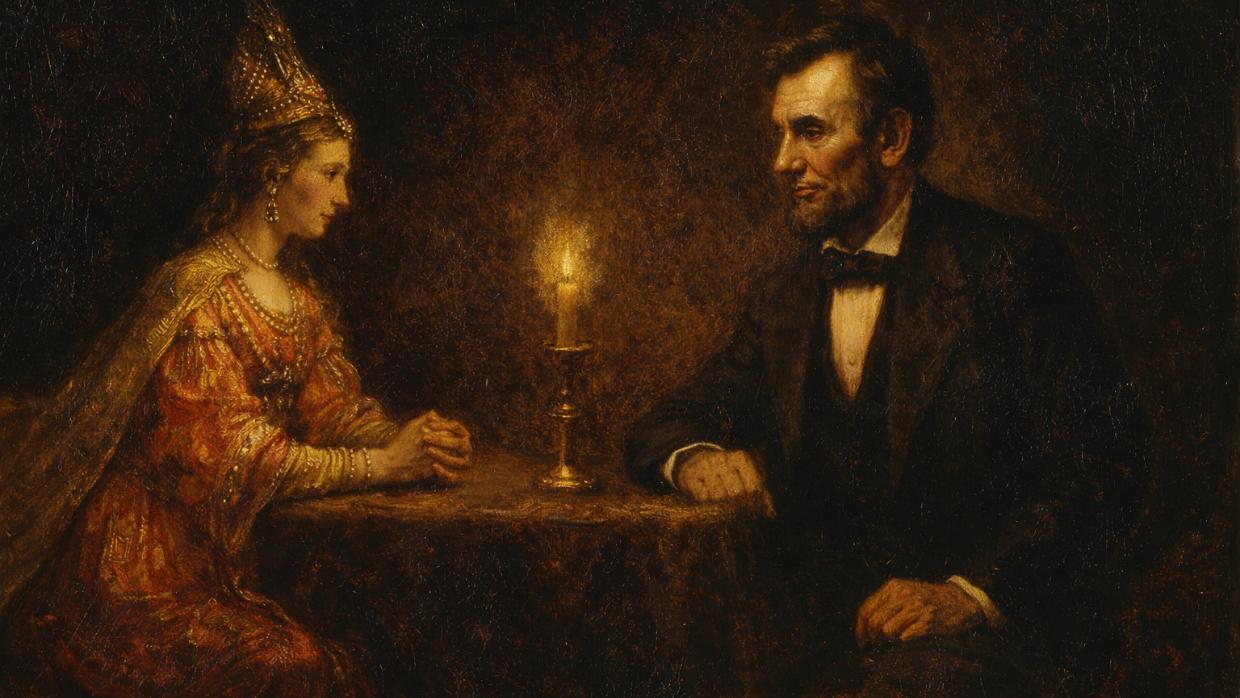
Centuries later, Esther’s story was invoked in the American Civil War. In 1862, abolitionist minister William Weston Patton compared President Abraham Lincoln to Queen Esther, quoting Mordechai’s words to urge him to act decisively against slavery. Patton framed Lincoln’s moment as one demanding moral clarity: a leader positioned at the hinge of history, called to exhibit personal risk and great moral courage.
Lincoln responded cautiously—“Whatever shall appear to be God’s will, I will do.”
A few days later, after the Battle of Antietam, he issued the preliminary Emancipation Proclamation.
The Book of Esther contains many dramatic scenes:
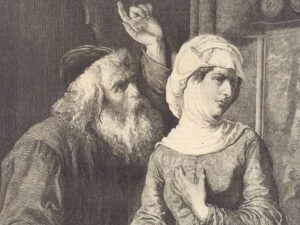
Rembrandt captured that tension in his great painting of Esther confronting Haman, and again in his pen-and-ink drawing of her approaching the king.
For me, the pivotal moment is quieter.
Even more powerful than Mordechai’s speech is Esther’s reply: “Go, gather the Jews” to pray and fast with her. She will approach the king. “And if I perish, I perish.”
Consider it. Esther has little knowledge of palace intrigue. She is an orphan, raised by her uncle, then taken captive to marry the most powerful ruler in the world. Where will she find the wits, the strategy to outmaneuver both Haman and the king?
With that first word—Go—she reenters her people’s fate and assumes leadership.
Many assume ability leads to responsibility. Charlie Harary explained that it is the reverse. Responsibility creates ability. Assume responsibility—and you grow into capacities you did not know you possessed.
It’s an old saw: The word Responsibility comes from—the ability to respond.
Purim reminds me I have an inner Queen Esther. The question isn’t whether I am brave. It’s this: Where am I avoiding responsibility because it feels beyond me? What trial am I dodging? Where could I step forward and become larger than I’ve allowed myself to be?
Lincoln took his place in history, forever known as the Great Emancipator. Esther took her place in Jewish history when she took to heart Mordechai's words: Perhaps the reason you are Queen is for just such a moment.
Ruchama's award-winning novel, In the Courtyard of the Kabbalist was just republished with a short story sequel.











Thanks for the correction. Figured it was a typo.
And liked the article. Yes, Lincoln was a "ruler", but he did give the ultimate sacrifice. Not even rulers are safe. He could have ignored those petitions, but he didn't. No one can deny the courage of Sojourner Truth and Harriet Tubman. Frederick Douglass was out there in the open, receiving accolades from many prominent people. Articulate, but still even though African American, a man. Women then and now are still the bravest.
Very Delightsome reading.
I know this article is well intentioned…..but I do have to object to the strange attempt at drawing some sort of parallel between Esther and Lincoln. If there are parallels to be drawn between Purim and America of the 1860s, then surely figures such as Harriet Tubman, Sojourner Truth, or even Frederick Douglas are just some of the many many African Americans whose bravery and determination matched that of Esther when it came to putting their lives at risk to fight for their people’s liberation. President Lincoln was in the position of a ruler receiving petitions as to which cause he should support; more a parallel to Ahashverut than to Esther.
Talk about a timely article! I loved its many messages. And it reminded me that in 17h century Netherlands, Purim (in general) and Queen Esther (specifically) was invoked and embraced as the Dutch established their republic (after 80 years of war) from Spain. We all need real, ethical models.
Wow! I will check it out.
Love Purim.
Me too! Queen Esther gives me hope that I can do better today than I did yesterday. Chag Purim Sameach!