 Purim and the War Against Iran



6 min read


As Jews prepare to celebrate Purim this year, the ancient story of the defeat of Haman who ordered a decree to annihilate the Jewish people feels less like history and more like a headline.
The Book of Esther tells the story of King Ahasuerus and his rise of his chief minister Haman, who uses royal favor to issue a decree of extermination against the Jewish people. Haman's hatred was rooted in a blood feud between his people, the Amalekites, and the Jews stretching back centuries.
The decree is reversed not through military genius or diplomatic triumph, but through something harder to explain: a string of seemingly random events, each one unremarkable on its own, that together add up to something that can only be called a miracle.
Look at the chain. Esther becomes queen — not because she sought power, but because the previous queen was deposed for refusing the king's command. Mordecai happens to overhear a plot to assassinate the king and reports it, a small act that gets recorded and then forgotten. Haman, consumed by rage at Mordecai's refusal to bow, builds a gallows and goes to the king at night to request Mordecai's execution. But the king can't sleep that same night, and orders his servants to read to him from the royal chronicles. They open, at random, to the exact passage about Mordecai saving the king's life — the favor that was never repaid. By morning, when Haman arrives to ask for Mordecai's death, the king is already asking how to honor him. Haman ends up leading Mordecai through the streets in royal celebration. The gallows he built for Mordecai becomes the instrument of his own execution.
No single event looks like salvation. Every step along the way could have gone the other way. Taken together, they form something unmistakable.
That is the hidden hand the Megillah is pointing to. God's name never appears in the Book of Esther. But the architecture of the story makes the presence undeniable. What looks like coincidence, read in sequence, is anything but. Venahafoch hu — "it was turned upside down." The condemned became the victors. Everything that was meant to destroy the Jews became the mechanism of their rescue.
We are in the midst of witnessing a moment of “venahafoch hu” – of things being turned over -- right now.
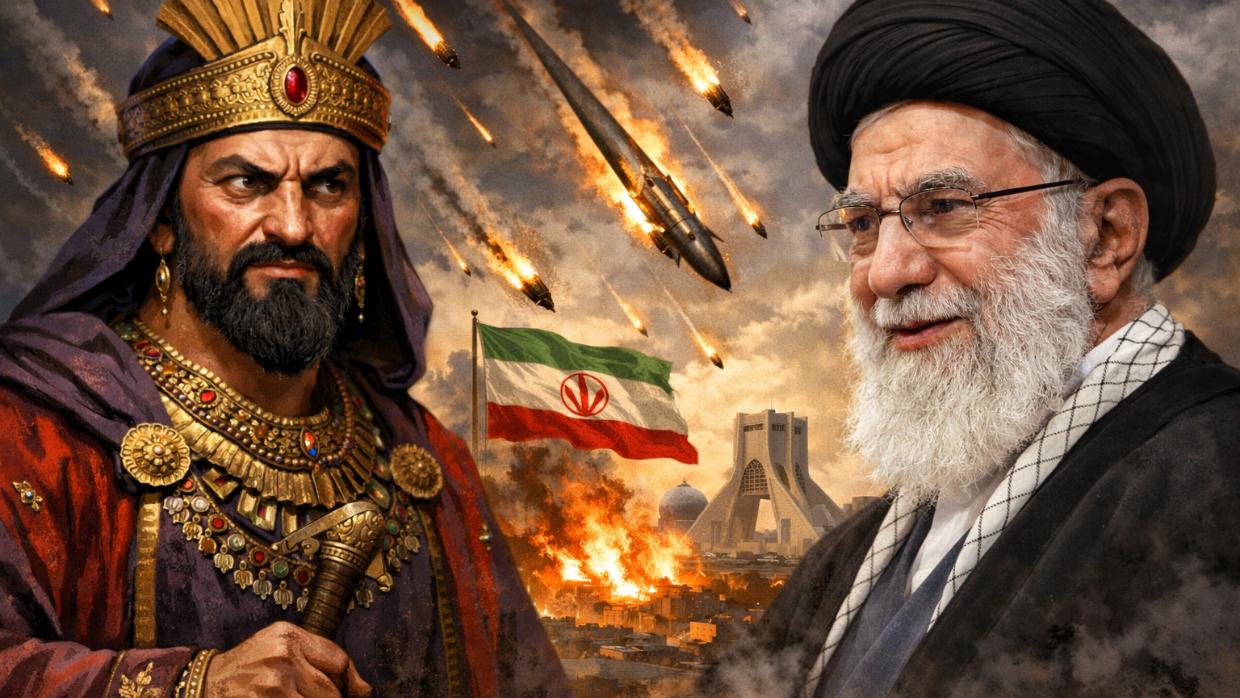
The Islamic Republic of Iran has been the world's leading state sponsor of terrorism, fueling proxy wars, arming terror groups, and spreading violence across the Middle East and beyond. For nearly four decades, its Supreme Leader positioned himself as the ideological heir to the annihilationist hatred the Jewish tradition names "Amalek." He openly and repeatedly called for the destruction of Israel and the death of the Jewish people. And like Haman, Khamenei did not survive to see those ambitions realized.
Khomeini, the leader of this murderous regime, died on Shabbat Zachor, the Sabbath immediately before Purim, when Jews around the world fulfill the Torah commandment to remember what Amalek did to the Jewish people. The timing is not something a novelist would dare invent.
And now Khamenei is gone too, struck down before the completion of his designs. His end carries the unmistakable resonance of venahafoch hu.
Khamenei spent decades declaring war on the Jewish people, on America, on Western civilization itself. He was taken down by the very forces he sought to destroy.
The Iranian regime's collapse, if it continues, would be one of the most significant geopolitical shifts in a generation. But we are not there yet. The situation is fluid and dangerous. Retaliation is already underway. The regime's proxies — Hezbollah, Hamas, the Houthis — still have weapons, funding, and intent. A weakened but cornered Iran may strike harder before it falls.
The Iranian regime has spent decades building nuclear infrastructure aimed at one purpose: a weapon capable of killing millions of Jews.
The Iranian regime has spent decades building nuclear infrastructure aimed at one purpose: a weapon capable of killing millions of Jews. It has funded every major terror organization targeting Israel and American interests in the region. It has murdered its own citizens for demanding basic rights. A regime this committed to destruction does not reform. It must be dismantled. Half-measures and negotiations have bought time, but time is running out. The window to act, before Iran crosses a nuclear threshold, is narrow. Israel and the United States share both the capability and the moral obligation to close it.
The closeness of all this to Purim demands our attention.
The story of Esther is, at its core, a story about what happens when people refuse to look away. Mordecai could have kept his head down. Esther could have stayed silent. Instead they acted, and their actions became the vessel through which something larger moved.
Modern-day Esthers and Mordecais are out there — the dissidents inside Iran risking their lives, the intelligence officers who moved in silence, the leaders who held lines others wanted to abandon, the journalists who refused to normalize evil. Human responsibility was not hidden in Esther's time, and it is not hidden now.
That is the call for Jews today, religious or not: come together and pray.
But there is something else the Purim story demands of ordinary Jews. Before Esther went to the king, she asked Mordecai to gather every Jew in the city to fast and pray together for three days. That communal gathering, that act of unity and serious prayer, was the foundation on which everything else rested.
That is the call for Jews today, religious or not: come together and pray. The act of showing up together as a people, across every difference, carries a weight the Purim story has already proven.
Throughout Jewish we have faced Hamans and Khameneis. Each believed he was writing the final chapter for the Jewish people. Each turned out to be a footnote.
We are watching something unfold in real time. How it ends is not yet clear. But the resonance with this season is too precise to ignore.
I look forward to Purim this year, and to the day Iran is finally free.