 An Open Letter to Mayor Zohran Mamdani




7 min read


The extraordinary story of Samuel Pallache, a Jewish privateer.
Jewish history after 1492 is often told as a story of lost communities shattered by expulsion, forced conversions, and silence and fear imposed by the Inquisition. Less often do we ask how Jews who survived that catastrophe learned how to endure and navigate power again.
At the beginning of the 17th century, one Sephardi Jew stood at the intersection of diplomacy, war, commerce, and memory. His life reveals a lesser-known dimension of post-expulsion Jewish history, a world in which Jews did not merely rebuild religious life but learned to operate within the political and military structures of a rapidly transforming Mediterranean.
That man was Samuel Pallache.
Pallache was not a hidden Jew. He belonged to a family of Iberian Jews who fled persecution after the expulsions from Spain and Portugal and rebuilt their lives openly as Jews in North Africa. His father, Joseph Pallache, was a learned rabbinic figure within the Sephardi refugee community of Morocco.¹
Pallache’s Judaism was forged in the open world of Sephardi exile and reconstruction. His Jewish identity was formed within a diaspora that connected North Africa and Europe through trade, diplomacy, language, and learning. Yet it was also shaped by the enduring trauma of an empire that had expelled his people and dismantled their communities.
By the early 17th century, Spain remained the dominant Catholic empire in Europe. At the same time, the Dutch Republic was fighting for independence after decades of war against Spanish rule. Morocco, positioned between the Atlantic and the Mediterranean, became an important political intermediary.
Amsterdam offered a rare political environment in which Jews could live openly and practice Judaism without fear of persecution.
Pallache’s arrival in the Netherlands was not accidental. According to Edward Kritzler, Amsterdam offered a rare political environment in which Jews could live openly and practice Judaism without fear of persecution. Pallache was drawn to the Dutch Republic precisely because of the promise of religious tolerance offered by the new Protestant state.²
This political openness proved decisive. As Mercedes García-Arenal and Gerard Wiegers have demonstrated, Pallache soon assumed a diplomatic role on behalf of the Moroccan sultan and participated in negotiations that led to a formal treaty between Morocco and the Dutch Republic in 1608.³ This treaty—one of the earliest formal agreements between a Muslim state and a Protestant European power—openly challenged Spanish commercial and political dominance.
Pallache moved fluently through Arabic, Spanish, Portuguese, and Dutch worlds, navigating Muslim courts, Protestant political circles, and Jewish communal networks. Cultural translation was not merely a talent; it was a survival strategy inherited from Sephardi exile.
Samuel Pallache grew up in Fez, one of the major political and commercial centers of Morocco, in a multilingual and highly cosmopolitan environment shaped by constant contact between Muslim, Jewish, and European actors. From an early age, he developed the linguistic and cultural skills that later allowed him to move easily between political, commercial, and diplomatic worlds connected to the Moroccan court.
It was therefore a natural progression that he had entered the service of Sultan Mulay Zidan of Morocco as an interpreter and diplomatic agent, operating at the intersection of trade, diplomacy, and intelligence.
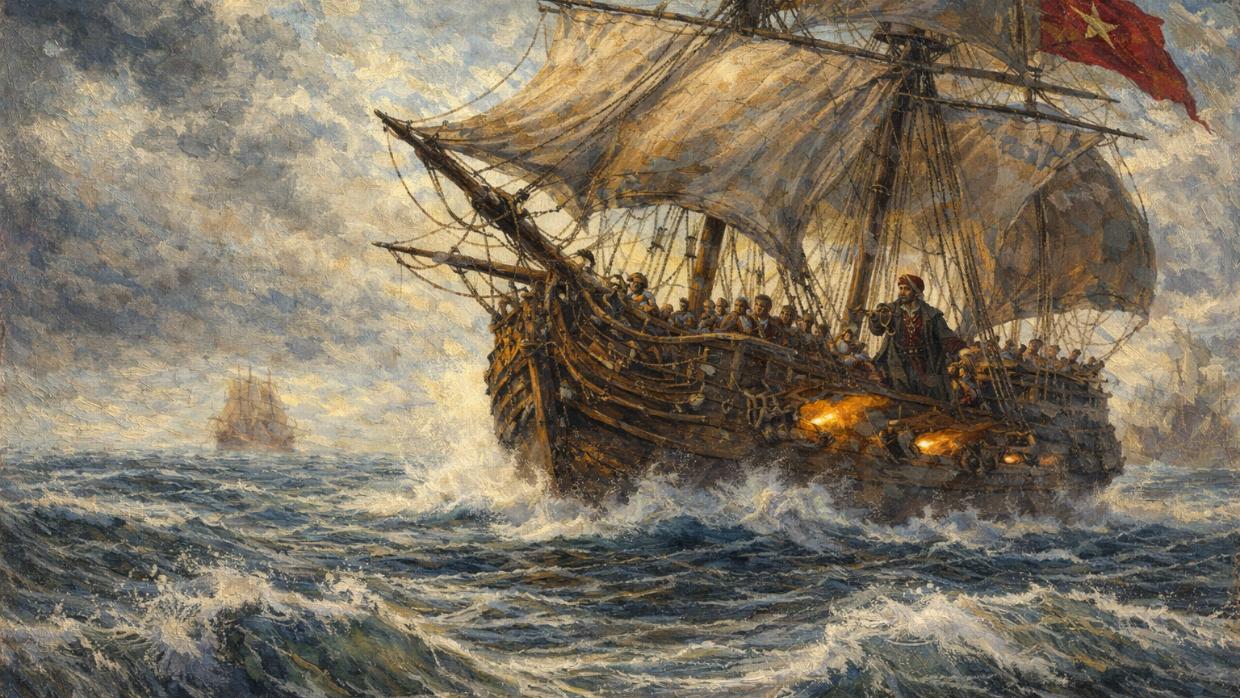
Pallache received authorization to engage in maritime warfare against Spanish shipping on behalf of Moroccan interests.
Within this political and diplomatic framework Pallache received authorization to engage in maritime warfare against Spanish shipping on behalf of Moroccan interests.
Pallache was not a pirate in the conventional sense; he was a privateer.
García-Arenal and Wiegers show that Pallache operated with formal authorization from the Moroccan ruler to engage in maritime warfare against Spanish shipping.⁴ His activity therefore functioned within a recognized early modern system of state-sanctioned private warfare rather than independent piracy.
This distinction is crucial because privateering was a legal and strategic instrument of international conflict, especially valuable for smaller powers that lacked large standing navies. It allowed states to weaken imperial rivals through licensed maritime operations. For Pallache, however, this legal category carried a deeper historical resonance.
Spain was not simply another geopolitical adversary. It was the empire that had expelled his people, dismantled Jewish communities, and driven generations of Jews into exile.
Naval warfare became a form of historical reversal.
Pallache never commanded a fleet capable of confronting Spanish power directly. But empires rarely collapse through spectacular defeats alone. More often, imperial power is weakened gradually and unevenly.
They erode through accumulation rather than through a single decisive blow, through disrupted trade, shifting alliances, and regional actors who weaken imperial monopolies over routes, markets, and diplomacy.
Pallache’s maritime and diplomatic activities formed part of that erosion. They reveal a Sephardi response through political and strategic agency to historical trauma that is rarely emphasized in Jewish historical memory.
One of the most historically significant dimensions of Pallache’s life unfolded in Amsterdam.
The Dutch Republic offered one of the earliest European environments in which former Iberian Jews could live openly and reconstruct Jewish communal life after more than a century of forced conversion and disappearance.⁵ Within this setting, Pallache lived publicly as a Jew and became part of the first generation of Sephardi refugees who helped establish an openly functioning Jewish community in the city.
His presence in Amsterdam marked the re-emergence of visible Jewish communal life in Western Europe after the Inquisition.
When Pallache died in 1616, he was buried in the Jewish cemetery of Amsterdam, a public affirmation of Jewish identity that would have been unthinkable for Iberian Jews only a generation earlier.
In addition to rabbis, merchants, and scholars, the Sephardi diaspora produced diplomats, translators, intelligence brokers, and naval commanders. This broader range of roles emerged directly from the conditions of exile.
Displacement taught them how to adapt to shifting alliances without surrendering identity, and how to build transnational networks upon which early modern states increasingly depended.
In Jewish collective memory, heroism is often associated with martyrdom or armed resistance. Samuel Pallache offers a different model. He represents the courage to move between civilizations without surrendering Jewish identity, the courage to transform vulnerability into political leverage, and the courage to engage power without becoming erased by it.
For people who had been expelled, dispossessed, and silenced, this was no small achievement. It marked a re-entry into history not only as victims of persecution, but as active participants in the political and strategic arenas of the early modern world.