





 Is It Proper to Rejoice Over Khamenei’s Death?





13 min read


Stripped of their citizenship overnight by the Vichy French government, Jews of Algeria formed a Resistance group, providing invaluable assistance to the Allied forces.
On the evening of November 7th, 1943, a motley crew was gathered around the radio in Dr. Henri Aboulker’s apartment in Algiers. Dr. Aboulker was a prominent surgeon and a leader of the Algerian Jewish community. He was joined by his 21-year-old son Jose and several of Jose’s friends, also Jews, who were leading the resistance against the Vichy French government. One of the few non-Jews in the room was Robert Daniel Murphy, U.S. representative in French North Africa.
Shortly before midnight, the radio broadcasted a coded message: “Allo, Robert. Franklin arrive.” While “Robert” was a reference to Murphy, “Franklin” was a reference to the U.S. president Franklin D. Roosevelt. The message signified that the invasion of North Africa by the allied forces was about to begin. At that, the group gathered at the Aboulkers’ apartment sprang into action.
Before World War II, Algeria was home to an ancient and vibrant Jewish community, numbering about 120,000. From the time of the Muslim conquest in early 8th century until 1830, Algeria was ruled by Muslims, and its Jews were second class citizens, as in every Muslim country. They were subjected to much abuse and violence, used as a scapegoat in any conflict, and massacred at whim. Dr. Henri Aboulker’s great-grandfather, the chief rabbi of Algiers, was beheaded in 1815.
The conditions of the Jews of Alegria were much improved by French colonization in 1830. The process of emancipation of Algerian Jewry had begun, following in the footsteps of mainland France.
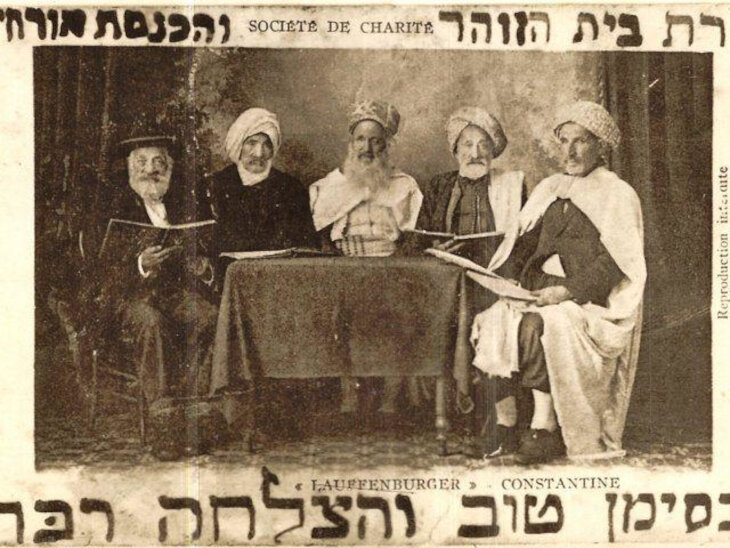 Rabbis of Algeria (Wikimedia)
In 1870, Algerian Jews became full citizens of France, with all the rights and privileges such citizenship entailed. For several generations, they had access to education and wide opportunities for employment. Jews worked as lawyers, doctors, and government employees. Full of patriotism towards France, many Jews served in the army and contributed to the military efforts of World War I. Though there had been incidents of antisemitism, overall, the Jews of Algeria did not experience any official discrimination from the French administration.
All that changed on October 7th, 1940 – another dark October 7th in Jewish history. Overnight, the Jews of Algeria were stripped of their French citizenship.
As a French colony, Algeria fell under the rule of the French Vichy government, formed as the result of the armistice treaty with Germany in June of 1940. Led by Marshal Philippe Pétain, the Vichy government was willing to collaborate with the Nazis in exchange for full sovereignty over southern France. Northern France came under German control as per the armistice.
Marshal Petain went along with the Nazi antisemitic policies, putting together a committee to reconsider the French citizenship of “foreigners,” many of whom were Jews.
On October 3rd, the Vichy government issued its first anti-Jewish law, which defined the expression “Jewish race” and listed the occupations forbidden to Jews from then on. The next day, they issued another law, authorizing internment of foreign Jews.
Marshal Petain ensured that his representatives throughout the French territories would enforce these laws by replacing many of France’s prefects and nominating new Governor Generals.
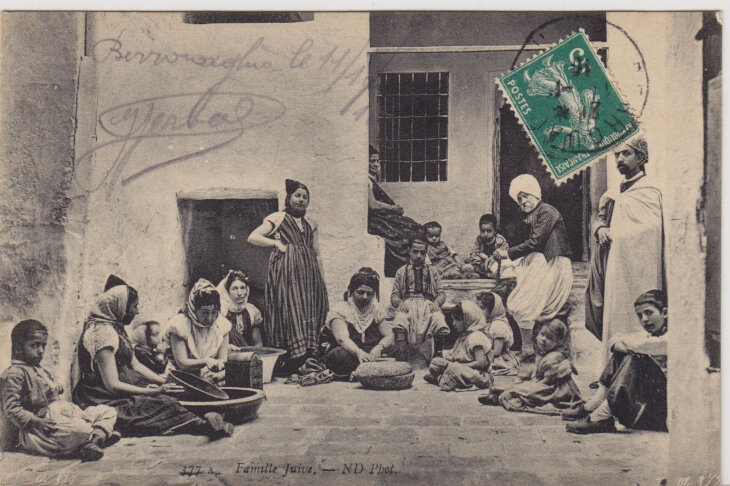 Postcard featuring an Algerian Jewish family (Wikimedia)
The new Governor General of Algeria, Admiral Jean Abrial, enforced Vichy’s anti-Jewish legislation. He was quick to note the Algerian Jews’ dissatisfaction with the new regime. In September, he wrote to his superiors that the Jews were “ferociously hostile to Marshal Pétain” and were placing their hope on Britain to defeat the Axis and restore France’s previous government.
On October 7th, after the law stripping Jews of their French citizenship was announced, Abrial commanded his troops to shoots Jews if they dared to demonstrate against their newly diminished status.
With the loss of citizenship, the loss of employment in municipal and administrative positions followed. By January 1941, Abrial reported that 423 Jews were removed from official positions. By October 1941, the number rose to over 2,000. The effect was noted by non-Jewish administrators. The Secretary of State Peyrouton warned his superiors, “A large proportion of clerks, attorneys, notaries, and bailiffs currently serving the Algerian departments are indeed of the Jewish race. So far, this situation raises a series of problems that must be addressed quickly1.”
One anti-Jewish law followed another. In June 1941, quotas were established on Jews practicing medicine and law, as well as Jews teaching in universities.
Jewish doctor J. Salama wrote in response to the law2, “[Y]esterday was a day of mourning at home. The new measure floored us because we hoped to see applied if not a more just measure, at least a more clement one. Our hopes are dashed…. Can we find a way to live, work, or we will be beaten by this fatality?”
In July 1941, General Maxime Weygand took over as Governor General of Algeria. A notorious antisemite, Weygand took persecution of Jews in Algeria to a new level, adapting an especially severe quota for Jewish students in public schools and universities.
More and more breadwinners were left without means of providing for their families, and more and more Jewish children were left without an education.
From the beginning of the anti-Jewish legislation, the leaders of the Algerian Jewish community devoted themselves to helping families who lost their sources of livelihood and organizing makeshift schools for Jewish children who were expelled from public schools.
In December 1941, Elie Gozlan, a community activist, wrote in a local Jewish publication3, “Our children must not remain ignorant and we have the responsibility to provide them with instruction for all degrees.”
The Jewish community came together to open and operate Jewish schools and vocational programs for all ages.
At the same time, Jewish individuals and community leaders attempted to appeal to the government. They cited their proven track records of dedicated service to the country, their contribution to the military effort in World War I, their patriotism and devotion. The appeals had no effect.
As the Jewish discontent with the Vichy administration grew, a group of Jews began contemplating armed resistance.
Three young Jews, André Temime, Émile Atlan, and Charles Bouchara, opened a sports club, ostensibly for recreation. They hired a non-Jewish boxing champion, Geo Gras, as its director. Gras was on good terms with the Vichy authorities, and the sports club did not arouse any suspicions. Unknown to Gras himself, the club was a front for resistance activities.
The resistance group, consisting exclusively of Jews, called itself the Geo Gras Group. Potential members had to be recommended by at least two people. After a successful interview, the new group member would appear in front of a committee of twelve members and take an oath “vowing to fight until the death in defense of Algerian Jewry, the liberation of France, and the defeat of the Third Reich4.”
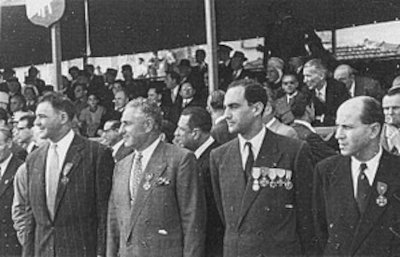 Croix de Guerre award ceremony in Algiers; from right to left: Charles Bouchara, Paul Sebaoun, Emile Atlan
Since January 1941, by decree of Governor General Abrial, Jews were forbidden to own weapons. The Geo Gras Group members illegally collected weapons and hid them in the sports club, unnoticed by Geo Gras himself.
In the beginning, the group trained in self-defense and responded to antisemitic attacks on local Jews. With time, they expanded their activities, committing acts of sabotage against the German supply lines and distributing anti-Vichy flyers.
Meanwhile, the U.S. and British leaders were discussing their first joint operation in their fight against the Axis. After several ideas were discarded as impractical, the leaders decided on what would become known as Operation Torch – an amphibian invasion of the North African coast in preparation on an attack on the Axis forces stationed in North Africa.
 North Africa, The Star of David drawn on a German Tank by soldiers of the Jewish Brigade Group (Yad Vashem)
The plan was favored in part because the U.S. diplomat Robert Murphy had done the groundwork, establishing contact with the French resistance and reassuring the Allies that they would receive much local support in the North African French colonies.
On October 21, a secret meeting took place in a beachfront villa in Algeria. Major General Mark Clark led the U.S. delegation, which reached the rendezvous location in a British submarine. The French Algerian delegation was headed by Major General Charles Mast, who opposed Nazi Germany and assured the Allies of his full cooperation.
Murphy facilitated the meeting. Members of the Resistance provided security and among them was Jose Aboulker.
It was agreed that the Allies would coordinate their invasion with the French resistance, which would arrange a coup on the same day, taking over local communication and control centers. Mast promised to do his best to prevent the French Algerian troops from resisting the Allies. In return, Clark promised to supply the resistance with weapons.
Afraid that word of the operation would leak to the Germans or their Vichy collaborators, the Allies did not inform the Resistance of the date of the operation until the day before.
That is how Henri Aboulker, his son Jose, and other leaders of the Resistance found themselves sitting around the radio on November 7th, waiting for the signal.
At the signal, the Resistance leaders distributed armbands inscribed with the initials “V.P.,” designating the Vichy militia. They also distributed false papers, as well as weapons stolen from the French army by its officers who supported the Resistance. The weapons promised by the Allies never arrived.
Even though the Resistance movement comprised over a thousand people, less than 400 were reached and activated on such short notice. Most of them were Jews.
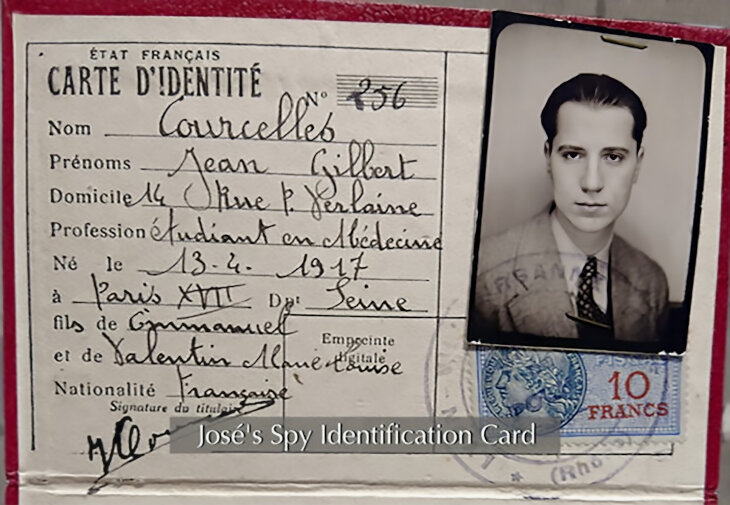 Jose Aboulker’s false identification papers
The Resistance split into groups and headed towards the strategic locations in Algiers.
Jose Aboulker led a group of 20 fighters to the central police station. Caught by surprise, the policemen on duty were arrested and the Resistance members took control of the station. They cut most phone lines. Aboulker used the one remaining phone line to pose as an operator, telling the policemen and officers who called in to appear at the police station. There, they were duly arrested by the Resistance.
Other Resistance fighters took over the telegraph office and the municipal power plant. They surrounded the quarters of the military commanders and essentially took them hostage. Among them was Admiral Jean-François Darlan, the supreme military commander of North Africa.
The Allies had not expected Admiral Darlan to be in Algiers. He returned from France to Algiers because his son had caught polio. Thus, he turned out to be the highest ranking French military commander in Algiers during the coup.
Darlan was a known Nazi sympathizer. However, he was a practical man and he wanted to stay on the winning side. Murphy conducted negotiations with Darlan while the Resistance fighters held the building under guard.
The Resistance was only meant to hold the strategic positions for two hours. The Allied invasion was scheduled to begin at 1 AM. However, the Allies had miscalculated. Due to many factors, including the weather and the troops’ inexperience in amphibian operations, the landing was delayed by several hours.
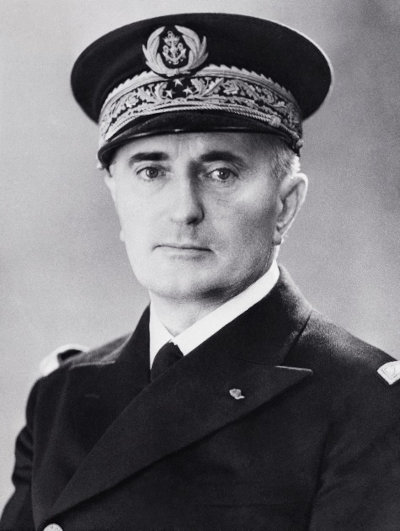 Admiral Jean-François Darlan
During those hours, Murphy tried to convince Darlan to order the French troops not to resist the invasion. Darlan, not hearing any evidence of the massive Allied invasion Murphy had spoken about and unable to reach his subordinates due to the cut off communication, doubted the prospects of a successful Allied operation.
Meanwhile, not hearing from their superiors, the French military began to come to their senses. They outnumbered the Resistance fighters and had more and better weapons. The Resistance struggled to hold on to the positions they captured as they waited for the Allied reinforcements. Two Resistance fighters were killed in battle. One of them, Jean Dreyfus, was Jewish.
Finally, early in the morning, the Allied forces arrived. Convinced of the futility of French resistance, Darlan finally signed a deal with the Allies and ordered the French military not to resist the invasion.
The first stage of Operation Torch was a success.
The Darlan deal was met with much outrage both in Algiers and outside of it. Murphy was criticized for signing a deal with a Nazi collaborator. In his defense, he claimed that he prevented the bloodshed that would have taken place without the deal with Darlan. Because of the deal, the Allies were able to capture Algiers and other areas of North Africa without much fighting.
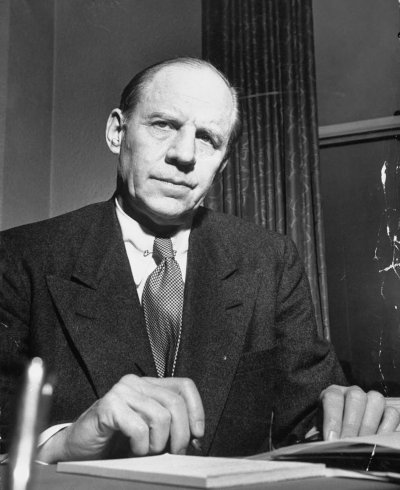 Robert Daniel Murphy
Whether the deal was justified under the circumstances can be debated, but the Resistance members felt betrayed. They had placed their lives on the line to overthrow the Vichy administration in Algiers, but after a successful coup the same administration remained in place.
American journalist A.J. Liebling visited Algiers shortly after the coup. He wrote5, “I found it difficult to distinguish at first, on walking through the climbing streets of the city, whether I was in a friendly place or an occupied enemy town.”
Liebling met with Dr. Aboulker and other Jewish Resistance fighters, who complained that they felt deserted by the Allies. Dr. Aboulker said6, “It is now almost impossible for one of us to see Mr. Murphy. He shuns us like a case of extremely contagious disease.”
A young resistance fighter told Liebling7:
The army brass hats and the people of the Prefecture whom we arrested hate us… because we know what cowards they are. You should have seen how miserably they acted when they saw the tommy guns, the brave Jew-baiters. The chief of the secret police, who has been of course restored to his position, kneeled on the floor and wept, begging one of my friends to spare his life. Imagine his feeling towards the man who spared him! Another friend, a doctor… is to be mobilized under the military jurisdiction of the general whom he arrested.
As bad as the Jews’ situation was after the coup, it only got worse when Admiral Darlan, hated and mistrusted by both sides, was assassinated a few weeks later. Though many secretly breathed with relief, the assassin was arrested and executed by the Vichy French authorities.
Moreover, the assassination gave the authorities an excuse to get back at the Resistance fighters. They stormed Dr. Aboulker’s apartment and arrested him, not giving him a chance to get dressed or grab his cane, without which he had trouble walking.
Dr Aboulker’s son Jose was also arrested, along with about a dozen others. For three months, they remained in prison, until Murphy finally intervened and advocated for their release.
Even after the Jewish Resistance fighters were released, the Algerian Jews remained without citizenship. It took President Roosevelt’s intervention to reinstate their French citizenship in October 1943, almost a year after the coup.
Sources:
Jews in Islamic Countries: Algeria, Jewish Virtual Library, available at https://www.jewishvirtuallibrary.org/jews-of-algeria
Chouraqui, André. Between East and West; a history of the Jews of North Africa. Jewish Publication Society of America, 1968.
Norman Gelb. Desperate Venture: The Story of Operation Torch, the Allied Invasion of North Africa. Sharpe Books, 2018.
Liebling, A. J. The Road Back to Paris. Doubleday, Doran and Co., 1944.
Sophie Beth Roberts. Jews, Citizenship, and Antisemitism in French Colonial Algeria, 1870-1943. Ph.D. thesis, History Department, University of Toronto, 2011.











according to the Jewish World Congress total Jewish population numbers 5 persons
Excellent article on a little known operation during the war.