Click here to buy
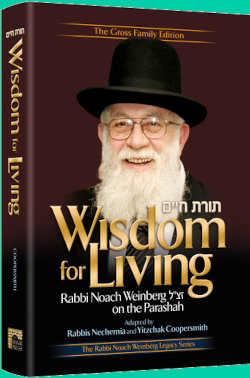
Wisdom for Living
Rabbi Noah Weinberg on the Parashah



6 min read


This week’s Torah portion ends with the construction of the Golden Altar, the Mizbeiach Hazahav, upon which ketores, incense, was burnt every morning and evening. The placement of this section is striking, for its rightful place seems to be four chapters earlier, in Parashas Terumah, where the details of all the other sacred vessels of the Tabernacle are explained. Why does the Torah leave the Golden Altar for the very end of the next Torah portion?
The burning of the incense represents the highest level of service to God; it is the pinnacle that can only come after all else is in place. (1) The Torah hints to the lofty status of the incense by describing the Golden Altar as “kodesh kodashim hu laShem – holy of holies to God” (Exodus 30:10), whereas the Copper Altar is referred to only as “holy of holies” (20:37).
The exalted status of the incense is reinforced by the fact that the primary sense involved in its burning is the sense of smell, the most spiritual of all the five senses. As the Talmud says, “Rav Zutra bar Toviyah said in the name of Rav: From where is it derived that we recite a blessing over a fragrance? As it is stated: ’Let every soul praise God.’ What is something from which the soul derives pleasure but the body does not? You must say that this is the pleasure of smell” (Berachos 43b). Smell is the sense of the soul.
The Maharsha explains that smell is more spiritual than our other senses since it was through Adam’s nose that Hashem invested mankind with a soul, as it says, “He blew into his nostrils the soul of life; and man became a living being” (Bereishis 2:7).
We find a unique halachah regarding the Golden Altar: Unlike the other services of the Holy Temple, the incense can still be offered even after if the altar was uprooted. (See Rambam, Hilchos Temidim U’Musafim 3:2, and Zevachim 59a.) Therefore, even without the altar, one can still burn it in its place. On a symbolic level, we can still access the power of the incense by applying this sacrifice to our daily lives.
The incense, that sublime spiritual offering, represents transcending one’s physical limitations and sense of self. Burning the incense is the ultimate sacrifice because it represents giving up the most important but least tangible part of who you are – namely, your sense of self-importance. It symbolizes transcending your subjective view of what is important and channeling this drive towards doing God’s will. It stems from recognizing that the only true meaning in life is attained through sacrificing your personal agenda to become a vehicle to express God’s eternal will. All else is really trivial and fleeting. Just as the incense becomes intermingled with the surrounding air, you, too, can become one with the Almighty by transcending your artificial sense of meaning and importance and embracing Hashem’s meaning and purpose.
The way to reach this sublime level is through humility.
Most people have a mistaken understanding of what humility is. By way of illustration, imagine a person who is the paragon of humility walking into your home. How do you picture him? Meek, slightly hunched over, self-effacing, someone who hides in the back of a room, too shy to engage in conversation. Yet who was the most humble of all people? The Torah tells us, "Now the man Moshe was exceedingly humble, more than any person on the face of the earth" (Bamidbar 12:3.) Can you imagine Moses walking into your home? The entire house would shake! He was the most powerful, charismatic leader in Jewish history, yet he is the paradigm of humility. Clearly, our concept of humility is wrong.
Humility does not mean denigrating your strengths and denying your inner greatness. It means recognizing that your strengths and inner greatness are a gift from Hashem. An arrogant person thinks it is all about him and all because of him. He has to work hard to keep up the façade that he has everything under control, when deep down he is consumed with doubt and insecurity.
In contrast, the humble person realizes it is all about God and all from God. He rises above petty concerns and does not care about gaining people's approval. He cares only about utilizing the gifts Hashem has given him to tackle the world's problems and make a real difference in people's lives. Humility actually generates charisma, because by nullifying your ego you attach yourself to God and become a conduit for His unlimited resources. No problem is unmanageable with God on your side.
The Chovos Halevavos teaches that the essence of humility is to live with the realization that you are a soul, not a body. The yetzer hara, the evil inclination, trips us up by getting us to identify with the physical, animalistic side of us that is a cauldron of raging desires and egotistical self-centeredness. When we live with the awareness that we are a lofty soul that yearns for meaning and connection to the Almighty, we gain the clarity to make the proper choices that create a deeply fulfilling life.
The battle for life is the battle for sanity. When we follow the dictates of the body we hurt ourselves and create a hollowed-out existence of degradation and shame. When we live as a soul we tap into the power of genuine meaning and pleasure. Every day, identify with the soul, not the body, by remembering that your body is a mass of bones, flesh, and skin that will one day be buried and disintegrate into nothing, whereas your soul is pure and stems from the Infinite Source of existence. It longs to return to its eternal source. All the pain and aggravation that your body feels, and all the sensations and physical pleasures it experiences, are fleeting and temporal. Your soul is eternal and the spiritual growth it attains in this world will last forever.
Like the incense’s sublime power to reach spiritual heights, the path of humility enables us to connect to the soul’s yearning for ultimate meaning.