





 American Bigots

6 min read
7 min read
7 min read



9 min read


While Hollywood cowered, the Three Stooges mocked Hitler to his face.
People either howl with delight at the Three Stooges or stare in bewilderment that anyone could. But spend even a few minutes with their classic shorts and something becomes impossible to miss: their antics and banter are soaked in Jewish identity. And at one of the most dangerous moments in modern history, that identity became a weapon.
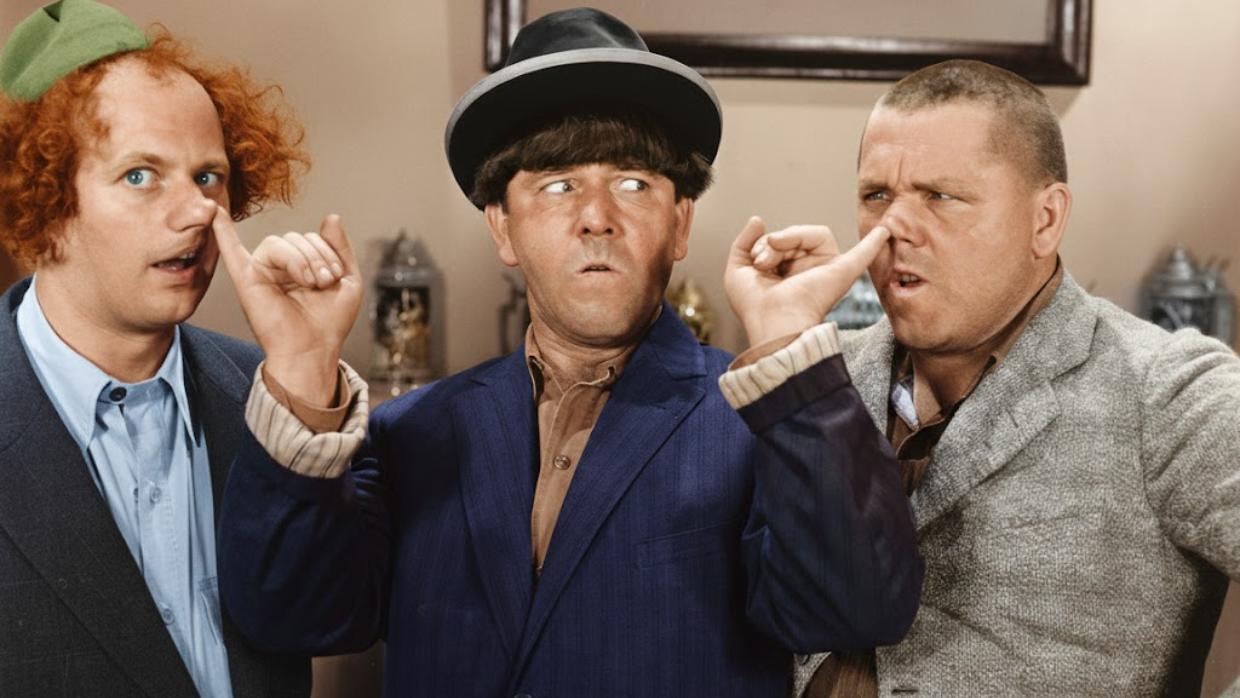
The classic Three Stooges lineup actually had four members — all Jewish.
Moses Horwitz (Moe Howard), his younger brother Jerome (Curly Howard), and his older brother Samuel (Shemp Howard) were born to Lithuanian Jewish immigrants. Louis Feinberg (Larry Fine) came from a Russian Jewish family. Moe and Larry were the constants; the third spot rotated between Curly and Shemp depending on contracts and health.
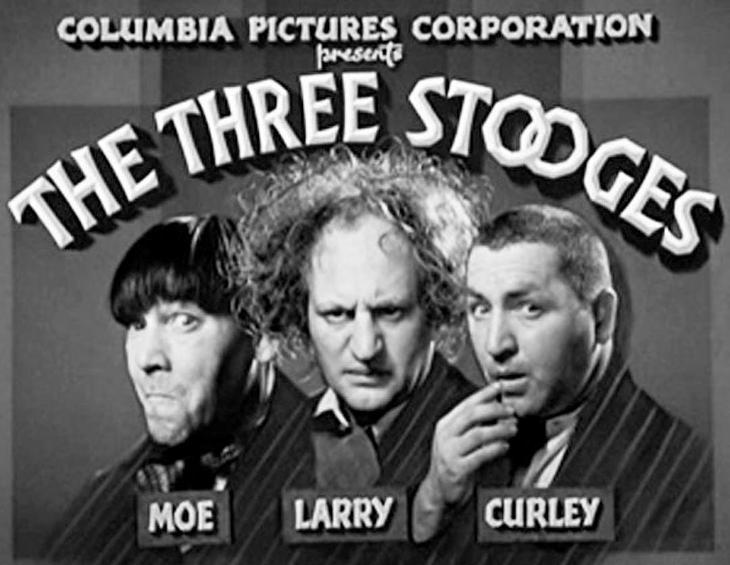
Moe, Curly, and Shemp were the sons of Solomon and Jennie Horwitz, Lithuanian Jewish immigrants who settled in Brooklyn. Jennie built a thriving real estate business despite barely speaking English; Solomon worked steadily as a fabric cutter. Larry was born in Philadelphia, the son of Russian Jewish immigrants Joseph and Fanny Feinberg, who ran a watch repair and jewelry shop.
All four came of age in the Yiddish-speaking world of early 20th century Jewish immigrant life — vaudeville circuits, crowded tenements, the bustling streets of New York's Lower East Side and Philadelphia. Their paths mirrored the broader Jewish immigrant journey in America. Moe (1897-1975), Shemp (1895-1955), Curly (1903-1952), and Larry (1902-1975) grew up in tight-knit Jewish communities where vaudeville was both livelihood and training ground, shaping their humor, hustle, and worldview.
As the act evolved, Joe Besser (1907-1988) and later Joseph Wardell, known as Curly Joe DeRita (1909-1993), each carried forward a comedy style rooted in that same cultural soil. Their overlapping lifespans stretch from the vaudeville era through Hollywood's golden age and into the dawn of television — but the sensibility never changed: the rhythms of Yiddish humor, the survival instincts of immigrant life, the irreverent wit forged on crowded urban streets.
The Three Stooges represent a fascinating chapter in American Jewish cultural history: immigrant kids who turned their community's humor into a universal language of chaos, timing, and physical comedy.
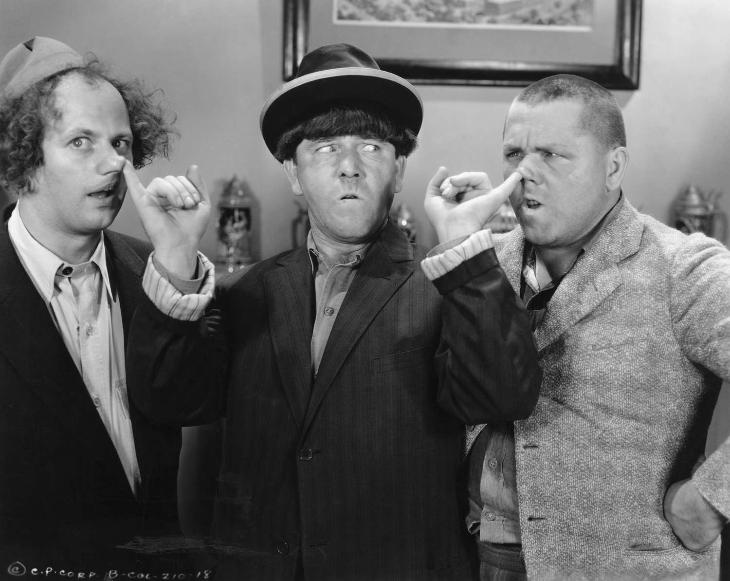
They carried a deeply Jewish comedic sensibility, even when it wasn't explicit on screen. Moe's bossy persona was modeled on the Lower East Side tough guy he grew up as. His heavy-handed bark, Curly's musical gibberish, and Larry's hapless charm all carried the cadence of immigrant Jewish neighborhoods. Even as Hollywood pressured Jewish artists to downplay their identity, their humor carried unmistakable Jewish DNA — their cultural background shaped their timing, their worldview, their entire comedic language.
Their timing, musicality, and bits came straight out of Jewish vaudeville, Borscht Belt comedy, and the Yiddish theater tradition. The rapid-fire banter, the mock authority figures, the exaggerated suffering — these were staples of Jewish stage comedy.
Yiddish words and accents slipped into their shorts constantly. Curly's nonsense syllables often had a Yiddish lilt. Gary Lassin — who heads The Three Stooges Fan Club, edits The Three Stooges Journal, and curates The Stoogeum museum in Ambler, Pennsylvania — has become a leading authority on all things Stooge. His research shows that about 40 percent of their 190 shorts include some Hebrew or Yiddish.
Watch their films and the Yiddish words come fast: "biblach," "salamkum," "plotz" (to faint or burst from emotion), and countless other Yiddish-inflected nonsense lines. In "Pardon My Scotch" (1935), they shout "Vehr-ge-hargit!" as a toast — Yiddish for "drop dead." In another short, Moe promises to hock some belongings and Larry shoots back: "Hey, hock a chynick for me too, willya?" The phrase literally means "bang on a teakettle" — idiomatically, to pester someone with nonstop chatter.
The Stooges' routines were pure slapstick — more punching, slapping, and eye-poking than talking — and their soundtracks did double duty as amplifiers and audience cues. Exaggerated sound effects — ukulele plinks, twittering birds, boings, bonks, thuds, buzzing saws, whining drills, hissing blowtorches, scraping sandpaper, popping corks, and ringing bells — turned every punch into a punchline.
Their body of work, 190 shorts over 25 consecutive years (1934-1959), embodied classic Jewish comedic archetypes: the bungling schlemiel (a hapless fool), the unlucky schlimazel (someone cursed with bad luck), and the pestering nudnik (an annoying, relentless bore). These hapless characters struggling against an indifferent world echoed the humor of immigrant Jewish life.
The Stooges knew their slapstick could be pointed and political. They took on the Nazis early with humor and ridicule.
This was a rare act in 1930s-40s Hollywood, where Jewish comedians working in a studio system that pressured them to hide their identity used that very identity as a weapon against fascism. Look closely, and their Jewishness isn't incidental to the jokes — it's the engine that powers them.
Jewish humor traditionally punches up at tyrants, pompous leaders, and anyone who demands obedience. The Stooges' entire act is built on puncturing authority figures. When Nazism emerged, it slotted perfectly into a pre-existing comedic framework: the bully who deserves to be taken down a peg.
Raised in Yiddish-speaking homes, in neighborhoods where Jewish humor — sharp, self-mocking, quick on its feet, and forever suspicious of authority — was the air everyone breathed, that sensibility shaped their comedic instincts long before Hitler appeared on their radar.
 Hollywood, meanwhile, was terrified of offending Germany. Studios tiptoed around anything that might upset the Nazi government. Working under the Hays Office, the industry's self-imposed moral watchdog, studios followed strict rules limiting sexual content, profanity, drug use, excessive violence, and ridicule of religion. But the Hays Office had another, quieter mission: avoiding conflict with Nazi Germany. Major studios, many led by Jewish executives, were especially cautious about provoking the regime.
Before WWII, Germany was a major foreign market for American films. The Nazi government threatened to ban studios entirely if movies portrayed Germany negatively or showed Jewish characters sympathetically. These restrictions held until Hitler's aggression escalated, and the tide began turning between 1939 and 1941.
This is exactly why the Stooges' shorts are so remarkable. They broke through the climate of fear and did what the major studios wouldn't: they mocked Hitler to his face.
The Stooges' most legendary act of anti-fascist humor is their 1940 classic, You Nazty Spy.
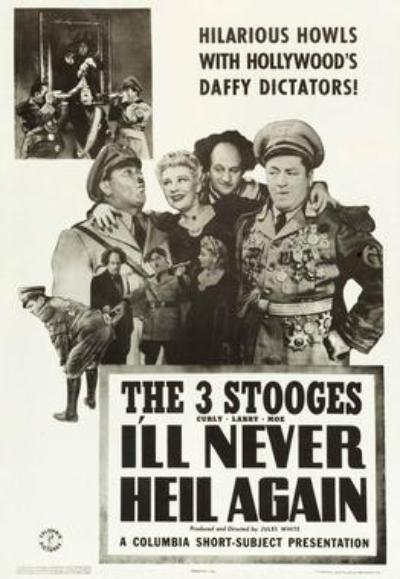
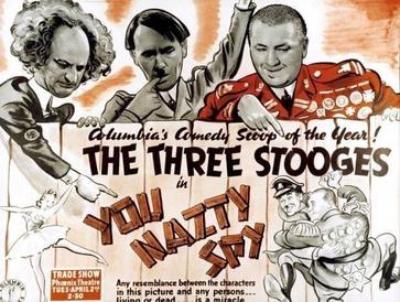 Over a year before the United States entered WWII, and nine months before Charlie Chaplin's The Great Dictator, the Stooges released You Nazty Spy, and followed it with a sequel, I'll Never Heil Again in 1941.
Film historians recognize You Nazty Spy as the first American film to openly mock Hitler, created by Jewish comedians who understood the threat early. It is now studied in film schools as a landmark in American political satire. Just 18 minutes long, the short is packed with political commentary disguised as slapstick, directly attacking fascism at a moment when isolationism was still running strong. Some theaters refused to show it. Others embraced it.
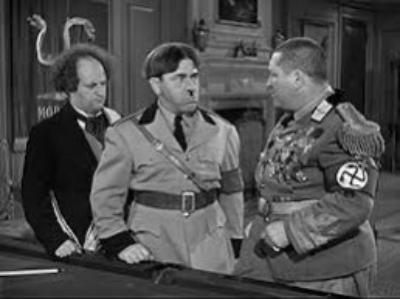
Moe based his Hitler impression partly on newsreels and partly on "a Jewish mother scolding her kids." His character, "Moe Hailstone" — a riff on "Heil" — is a razor-sharp Hitler parody: mock salute, blustering speeches, armband, military uniform, a mustache resembling a strip of black electrical tape, and the absurd dictatorship of the fictional nation of Moronica. Fascist imagery gets twisted into slapstick: Hitler as buffoon, propaganda ministers reduced to caricature, militaristic pomp punctured by eye pokes and pratfalls.
Curly took on a dual role as Mussolini and Hermann Göring. Larry played Joseph Goebbels, the Nazis' Minister of Propaganda.
As for the plot: once in power, the Stooges' first assignment was to launch a "beer putsch" which Curly helpfully explains as, "You putcher beer down and wait for the pretzels, Nyuk Nyuk." They seize control of the country, and Moe Hailstone delivers a blisteringly funny speech to his "Morons," parodying Hitler's bombast, facial contortions, and expansionist swagger.
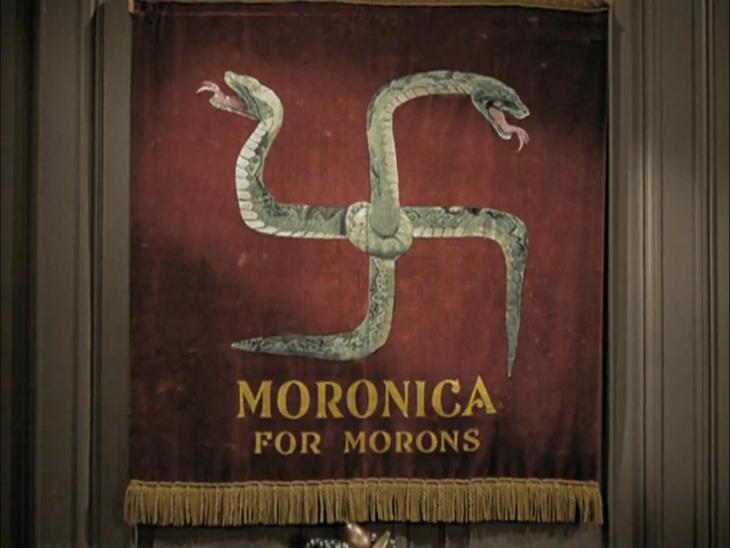
A swastika appears, formed from two snakes, emblazoned with the slogan "Moronika for Morons." Back in the office, Moe orders Curly to burn all the books because "there are too many bookmakers — the bookies are overrunning the country." Nearly every line lands, whether for its pointed political references or its avalanche of puns and Yiddish expressions.
When their Nazi overlords appear, the Stooges snap to attention and bark a cheerful "Shalom aleichem!" (Hebrew for "peace be upon you"). Moe calls for a blitzkrieg, and Curly eagerly chimes in, "I just love blintzes, especially with sour cream." A vamp named Maddy Herring slinks in with her temptations, and Curly sighs with relief when Moe resists: "You'd have been in some pickle with that Herring."
Their Jewish sensibility is unmistakable. Moe's rants slip into Yiddish rhythms, turning the dictator into a figure of ridicule. Curly and Larry spoof Nazi officials with broad, subversive humor. As sons of Jewish immigrants with family in Europe, they understood the stakes. Mockery became cultural resistance, using comedy to confront danger early, loudly, and fearlessly.
The film is loaded with subtext. Mocking Hitler was itself a Jewish act of defiance. Moe's Yiddish-inflected delivery was a nod to Jewish audiences who instantly recognized the cultural in-jokes — and a way of reclaiming power, a Jewish kid from Brooklyn openly ridiculing the dictator who wanted Jews erased.
One historian noted an interesting consequence: the Stooges — alongside Charlie Chaplin and Jack Benny — landed on Hitler's so-called "death list" because of their anti-Nazi propaganda films.
 The Stooges didn't stop Hitler but they refused to let fascism control the narrative. In a Hollywood that urged Jewish artists to blend in, they used their Jewishness as a weapon — creating some of the earliest and boldest American anti-Nazi satire and proving that laughter can be a form of defiance.









Amazing!
Indeed, they were and still are!
"I'll Never Heil Again" is also available for viewing on YouTube.
I taught English as a Second Language in Chicago at a time when Three Stooges shorts were ubiquitous on local tv. All my high school students loved the Stooges and would show off their new English skills and love of slapstick with Stooge routines. Walking into my classroom was like entering a Columbia movie.
Great comment! Those clowns really touched a lot of lives.
PSA: You van catch the stooges on one of the streaming services. Their humor is temporartily helping me forget about the pain of my broken left arm.
Refua shlema - wishing you a speedy recovery.
thank you.
Thanks for the PSA, wishing you a full and speedy recovery.
I rarely missed them on TV. Colorizing them is a nice touch, but I saw them in black/white. There are still some things friends say to each other like "slowly I turned, step by step...."
lots of great routines, great lines, great characters, great memories
Great! Bring em back!
I second that motion. All in favor say "aye"!!!!!!!!!!
Absolute spot on article . I was also one that "grew up"(😅) laughing my butt off but then they did the Hitler speil.woah that was powerful . I wasn't even a teen but I got it !! I still love these guys at 75. My wife doesn't get slapstick her loose . Shalom, Dan Shalom
Thanks, Mario!! They had a big impact on our generation, didn't they?
I got this from my best friend. Like most of you, I grew up laughing and trying to imitate these comic geniuses.. The idea that they were harpooning Nazism while creating great comedy never occurred to me. I am glad someone had the courage to do so. THANK YOU STOOGES!!!!
Thank you, Leif. You have a great friend to have shared this with you!
Heroism comes in all shapes and sizes: men, women, generals, teachers, visionaries, and comedians.
Purim Sameach!
So true, Avraham... their outrageous comedy included courage to pull this off.
Grew up watching them (reruns in the 70's) and spent much of my teen years imitating Curly. 🙂 These guys were awesome! Thank you for this fantastic article. No day is a bad day when The Three Stooges are part of it! Nyuk-Nyuk!
Everyone who grew up watching them became Curly imitators. Thanks for your kind words.
Wow I grew up on the 3 stooges. Watching this was awesome. The slapstick that I never realized as a kid. Kudos to them for standing up to the nazis!!!! I wish countries would have taken up on their example!!!
They sure did their part in the war effort, didn't they?
My husband z"l loved the Stoogi (ha!) Seeing the short on Aish reminded me just why he liked them so much. Gave a new appreciation to their humor - and their courage!
It's so amazing that of all people, the Stooges took on Der Fuehrer early
With all the discussion in recent years about gender unspecificity - a conclusive test for are you a boy or a girl might be to ask, "Do you love or hate the stoogi?" (Stoogi is the official plural of stooge)
Thanks so much for this appreciation of these pinnacles of comedy and social commentary. The Stooges are some of what's best about America!
Kevin, you win the Gold Medal for comments! Nicely done.
Thank you! Now I need to go back and watch again .
you Soitenly should!!
It’s too bad that postwar parents like mine didn’t understand the themes. As a child of the ‘60’s, my parents would not allow us to watch it because it encouraged misbehavior and disrespect.
Undoubtedly the best piece by Mr. Rich. I have great memories watching The Three Stooges, Curly being my favorite. I will now go back for a 100th time and watch, but this time looking for all the yiddish references.
They were a big piece of my childhood too Phillip. Thanks for the kind words!