 The Chain of Events That Killed Khamenei





8 min read


Alfred Nakache won 13 national titles and swam for France in two Olympics. His reward: deportation to Auschwitz, where his wife and daughter were murdered.
As Academy Awards judges evaluate this year's contenders, the short film Papillon (Butterfly), that tells the story of remarkable swimmer Alfred Nakache, stands out for both its beauty and the intensity of the story it tells. For celebrated French film illustrator Florence Miailhe, now 70, Papillon was a labor of love.
As a child, Miailhe took swimming lessons with a teacher named Bernard, who told her stories about his older brother Alfred, a champion swimmer who mastered the butterfly stroke and was, for years, the fastest in the world. It wasn't until adulthood that she grasped the full weight of what she'd heard. Her swimming teacher's brother was Alfred Nakache, one of the greatest swimmers of all time.
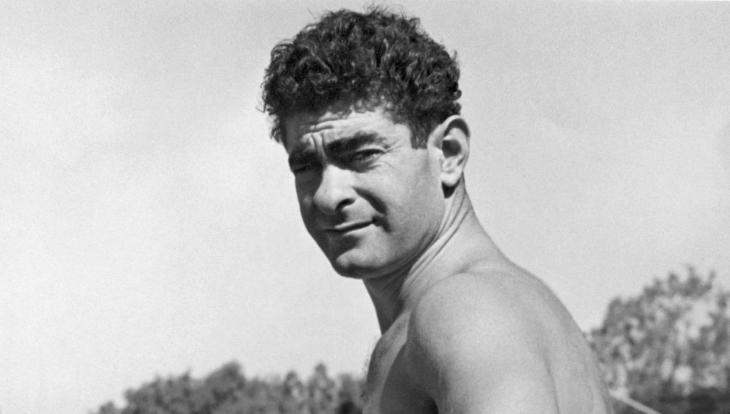
The stories were true. Alfred was a world-famous Jewish athlete who represented France in international competition before, during, and after World War II. He worked for the French Resistance, was betrayed by French friends, deported by the Nazis, and survived Auschwitz. Miailhe's own father had fought for the Resistance and confided that he'd met Alfred during the war. She knew she had to tell his story.
Alfred grew up in a close-knit Jewish family in Constantine, Algeria, one of ten children. Jews had called Constantine home since ancient times, but by Alfred's birth in 1917, things were beginning to shift.
France had captured the city in 1837 and worked steadily to reshape its inhabitants. Constantine was home to generations of Jewish scholars who spoke an ancient Judeo-Arabic dialect blending local Arabic with Hebrew. For generations, Jewish children had attended religious Torah schools. French authorities declared all Jews born in Constantine to be French citizens, while Muslims were not, and established the Alliance Israélite Universelle school to ensure Jewish children spoke and identified as French.
At the same time, French settlers imported a darker French export: antisemitism. Constantine's Muslims had periodically turned on Jews, but French settlers stoked that hostility, casting Jews as dangerous and suspect. In 1934, local Muslims attacked the Jewish community en masse, ransacking homes and businesses. Twenty-five Jews were murdered before Jewish self-defense leagues stopped the violence.
The film Papillon depicts Alfred's mother teaching him to swim to stand up to bullies who taunted him for being afraid of water. Alfred proved to be a natural. By 16, he had won first place in the North African Championships in the 100-meter freestyle. His true passion, though, was the butterfly stroke, a grueling style he would come to master and define.
He moved to France in 1934 and began sweeping national titles, winning 13 by 1942. The French press dubbed him "Artem" and he became a celebrity across France and beyond.

As anti-Jewish hatred spread across Europe, Alfred kept swimming, representing France in international competition as fewer and fewer Jews were allowed to participate. He also competed in the Maccabiah Games, sometimes called the "Jewish Olympics." In 1935, he traveled to Tel Aviv, representing France in freestyle and Morocco in water polo.
Jewish athletes were largely barred from the 1936 Berlin Olympics, presided over by Adolf Hitler. Even nations that permitted Jewish athletes faced internal pressure to exclude them. The United States barred Jewish sprinters Marty Glickman and Sam Stoller from competing on the U.S. track team.
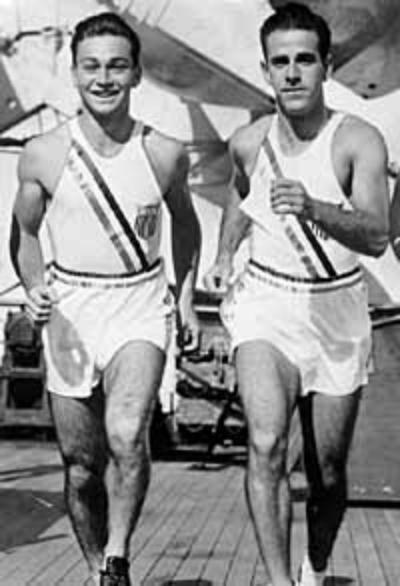 Marty Glickman and Sam Stoller
Alfred was one of the few Jewish athletes who competed. He helped France finish fourth in the 4x200-meter relay, beating Germany in the process. The Olympics amplified Alfred's fame and launched the happiest chapter of his life. In 1937, he married Paule Elbaze, a fellow Algerian Jewish swimmer. They had a daughter named Annie and settled in Paris.
That life came crashing down with World War II. After war was declared in 1939, Alfred stopped swimming and volunteered alongside his brothers to fight in the Free French Army. The Nakache brothers were sent to battle pro-Nazi forces in Algeria. Alfred returned to Paris just after Prime Minister Philippe Pétain signed an armistice with Germany, placing northern France under German control and establishing a pro-Nazi puppet regime in the south, centered in Vichy. Alfred and Paule took Annie and fled to Toulouse, in Vichy France.
Remarkably, Alfred's swimming career continued under the Vichy regime, despite its antisemitic, pro-Nazi stance. He took a position coaching at a top Olympic training pool and kept competing. In 1942 alone, he won five French national titles.
He was also secretly working for the French Resistance in Toulouse, distributing anti-Nazi propaganda and training new recruits.
Press coverage of Alfred's swimming turned uglier by the day. Le Pilori described him as "a supernatural man, this half-god with frizzy hair and wide nostrils... the Jew Artem Nakache, member of the Zionist association Maccabih, laureate of the Jewish Olympics." More and more French citizens demanded to know why a Jew was representing their country in sport.
Alfred's last appearance swimming for Vichy France came in late 1942, on a tour of Nazi-aligned North Africa, where he won races and even represented France in a flag-raising ceremony. After that, Vichy banned him from competing.
Even as Jews were being deported across Europe with virtually no protest, including 28,000 Parisian Jews rounded up in July 1942, held for five days without food or water, then shipped to Auschwitz, some Toulouse residents staged demonstrations against Alfred's ban from swimming. It spoke to just how beloved "Artem" had become.
#In 1943, Cartonnet reported Alfred and Paule to the authorities on fabricated charges.
What Alfred didn't know was that a far greater danger was closing in. His rivalry with French breaststroke champion Jacques Cartonnet, a fanatical pro-Nazi, would prove fatal to his family. In 1943, Cartonnet reported Alfred and Paule to the authorities on fabricated charges. They were arrested along with their daughter. Alfred later wrote that he was arrested for "anti-German propaganda because I continued to beat the records of German swimmers."
Their first stop was Drancy, a French concentration camp just outside Paris. Originally a police outpost, Drancy ultimately processed roughly 70,000 Jews before deportation to death camps. Prisoners survived on 600 to 800 calories a day. Despite the misery, they ran a makeshift school, held synagogue services, staged concerts, and marked holidays. Ninety-five percent of those held there were murdered.

From Drancy, Alfred, Paule, and two-year-old Annie were sent to Auschwitz. Shortly after arriving, Paule and Annie were murdered in the gas chambers. Alfred was put to work as a slave laborer. When guards discovered him swimming in a water tank, they forced him to swim daily, even in the dead of winter when ice formed on the surface, retrieving objects they threw in for sport.
In January 1945, as Soviet troops closed in, Auschwitz's guards forced thousands of prisoners on a death march to Buchenwald. Many died along the way, and early news reports listed Alfred among the dead. He had survived. He remained in Buchenwald until April 11, 1945, when Allied troops liberated the camp.
Journalist Edward R. Murrow was among the first to report from inside Buchenwald. "Many of the prisoners could not get out of bed," he wrote. "I was told this building had once stabled eighty horses. There were twelve hundred men in it, five to a bunk. The stink was beyond description. As we walked out into the courtyard a man fell dead. Two others, they must have been over sixty, were crawling towards the latrine. In another part of the camp they showed me the children, hundreds of them. Some were only six. One rolled up his sleeve, showed me his number. It was tattooed on his arm. I could see their ribs through their thin shirts."
In that hell, Alfred befriended Roger Foucher-Creteau, a fellow prisoner whose brother Alfred had known as a swimmer in Toulouse. Roger urged Alfred to write down what had happened to him, using scraps of paper they scrounged up in the camp. Alfred recorded his experiences in the Judeo-Arabic of his childhood. When he was liberated in April 1945, he weighed 88 pounds.
Alfred returned to Toulouse and began rebuilding. "Physically, I am back on top, but my spirits are still low," he told a journalist after the war. He began swimming for France again, setting a 3x100-meter relay world record in 1946. In 1948, he represented France at the Olympics, the only Holocaust survivor competing in those Games. (Ben Helfgott, a Polish Jewish weightlifting champion, competed for Britain at the 1956 Olympics.) Alfred was no longer the world-class swimmer he had once been, performed poorly, and retired from competition soon after.

He went on to coach other French athletes. The warmth and camaraderie he found among fellow athletes who welcomed him back and encouraged him to embrace life again is beautifully captured in Papillon. Alfred eventually remarried, though he never had more children. He retired to the southern French city of Cerbère, and in 1983, during his daily swim in the town's picturesque bay, suffered a heart attack and drowned.
Alfred Nakache's story is, above all, one of hope. After enduring some of the worst the 20th century had to offer, he managed to keep living, contributing to the world, and bearing witness. His resilience deserves to be remembered.
Papillon is a beautiful place to start.
Watch the film below