Click here to buy
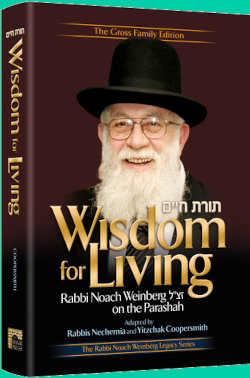
Wisdom for Living
Rabbi Noah Weinberg on the Parashah



10 min read


We have just finished celebrating Passover, the holiday of freedom. For a week we abstained from eating chametz, symbolizing banishing the yetzer hara, the evil inclination from our midst. How can we hold on to our newfound sense of freedom while transitioning back into eating bread and daily life?
The key is mastering mankind’s greatest gift – free will.
Our sages teach us, "Beloved is man, for he was created in God’s image; it is indicative of a greater love that it was made known to him that he was created in God’s image" (Pirkei Avos 3:18).
Unlike all other creations, Hashem gave mankind a unique gift, a Divine spark – free will. This gift gives us the ability to emulate God Himself by making independent choices. Used correctly, it gives us the power to create and change the world. If misused, this awesome power can lead to plundering and destroying the world.
But in order to harness this power, we must be aware that we have it in the first place!
Imagine an incredibly generous benefactor giving one million dollars to a homeless man on skid row. His life is completely transformed! He can live in a comfortable home, buy warm clothes, and purchase healthy food to eat.
But there is only one problem. The benefactor slipped the money into the bottom of the homeless man’s bag, and he does not know he has it. He is a rich man shlepping around a million dollars, but he lives in the same state of misery and abject poverty because he doesn't know what he has.
The gift of free will gives each of us enormous power and potential – but only if we realize that we have it. That is the meaning of the Mishnah’s statement: “It is indicative of a greater love that it was made known to him that he was created in God’s image."
Free will is badly under-utilized. Unfortunately, many of us live like that homeless beggar, unaware of the life-transforming power we carry around with us. Defining free will and recognizing its implications will enable us to begin to tap into the awesome potential within ourselves.
Most people define free will as the choice between good and evil. But the Torah frames free will differently. "See – I have placed before you today the life and the good, and the death and the evil… I have placed life and death before you, blessing and curse; and you shall choose life…" (Devarim 30:15, 19).
The Torah does not tell us to choose good or to choose blessing, because everyone naturally wants good and blessing. No one wakes up and says to himself, "Let's see what kind of evil I can do today." Even the most vile, immoral people rationalize their evil choices as good. The Torah instead defines the essence of free will as a battle between life and death, which is why the Torah exhorts us, "Choose life!"
But who chooses death?
Actually, all of us do, to some degree. Hashem made us a composite of a body and a soul, as the Torah says, “Hashem God formed the man of dust from the ground, and He blew into his nostrils the soul of life; and man became a living being” (Bereishis 2:7). Our lofty soul yearns to connect to its Infinite Source, and our lowly body yearns to go back to its source, back into the ground, dead, escaping all pain, effort, and responsibility.
Choosing death means choosing comfort, choosing to sleep. In the words of Shakespeare:
To be, or not to be, that is the question—
Whether 'tis nobler in the mind to suffer
The slings and arrows of outrageous fortune,
Or to take arms against a sea of troubles…
To die, to sleep…
(Hamlet, Act 3, Scene 1)
Our desire to escape from responsibility and challenge is constant. Suicide is the most extreme expression of this desire, but there are less dramatic forms of suicide as well – running away through drugs and alcohol, for instance. At every moment, we have to struggle to choose life – to accept the pain and embrace challenge and growth, to actualize our potential for greatness and change the world; or to choose death – to distract ourselves and avoid pain, to remain a mediocrity and satiate the yetzer hara’s endless desires.
Every one of us has a soul that yearns for greatness. Attaining that greatness is dependent upon how well we use our free will to live, to fight, to accomplish, and that begins by mastering the following five stages of free will.
The first step in using free will is to become aware of the choices you are making. Life is a constant stream of decisions. Once you become sensitive to the fact that you are constantly making choices, then you can monitor them and start actively flexing your free will muscles.
Don't let decisions just happen. Realize that you can take control of your decision-making and your actions. Ask yourself: Why am I reading this right now? Am I paying attention to what I am reading? Am I critically thinking about it or just mindlessly reading?
Your decisions shape your life and determine your destiny. Take charge. If you don't, you're just a pedestrian watching life pass you by.
Once you are consciously making decisions, evaluate the assumptions that your decisions are built on. Be sure you are independent and not just a puppet of society and a product of its values. Don't accept society's assumptions as your own until you think them through and agree with them. Live for yourself, not for society.
Furthermore, evaluate your past decisions; don’t be stuck by the decisions you made five or ten years ago. Start each day anew. A particular career you chose years ago in college may no longer be the best thing for you today. Make sure you are guiding your decisions, and your past decisions are not guiding you.
The Talmud (Sanhedrin 11b) tells us that within each of us, there is a fierce battle constantly raging between what our soul wants and what our body desires. The third stage of free will is becoming aware of this conflict.
The alarm clock rings first thing in the morning and the battle begins: do you jump out of bed, or reach for the pillow while hitting the snooze button?
Sometimes we can actually hear ourselves fighting it out. Do you remember the first time you went jogging? Your body screams, "Stop! This is going to kill you!" Your soul says, "Keep going. You can do it! This isn't going to kill you. It’s good for you!"
The soul wants you to exercise – it's healthy, there's a purpose. The body says, "Leave me alone. I'd rather sleep." The soul says, "Give up smoking; it's bad for you." The body says, "I can't quit. I'd rather smoke than face my frustrations. Besides, what's the big deal if I die a little earlier?"
This is the constant battle we face. The body wants to be comfortable, to sleep, and ultimately to die. The soul wants to strive for meaning, to do what's right, to grow, to live vibrantly with every fiber of its being.
To win the inner battle, you first have to distinguish between the cravings of the body and the aspirations of the soul. What does the body feel like doing, and what does the soul want to accomplish?
Make a list. What does the body want? Comfort. Sleep. Indulgence. Excuses.
What does the soul want? Greatness. Understanding. Meaning.
Once you clearly see the two sides, you are ready to make a decision and choose life over death. Work on becoming adept at sorting out the difference between what your soul wants and what your body feels like doing.
Who is the real you – your body or your soul?
The body says: "I'm hungry."
The soul says: "My body needs some food."The body says: "I'm tired."
The soul says: "My body needs some sleep."
The Midrash teaches: "The righteous talk to their heart, while evil people let their heart talk to them" (Esther Rabbah 10:3). The question is, who's in charge? Who will dictate what you're going to do?
Inner peace is attained only by identifying with your soul and disciplining the body to follow its lead. Use your free will to train the body and coax it to service the needs of the soul – the real you.
Once you realize that you are not your body, you attain some mental distance from the body's incessant drives, and you can begin to deal with them effectively. "My body claims that it's hungry and that if I don't feed it it's going to starve to death. Is that true? When was the last time I ate?"
In order for you to gain control of your body, you have to be clever. For example, what happens when you are dieting and someone offers you a mouth-watering piece of chocolate cake? Your first reaction is, "No, I shouldn't. I'm on a strict diet." But your body tries to persuade you: "A little piece won't hurt you." Or, "This is the last piece of cake you'll have. You'll start the diet tomorrow."
The body doesn't say, "Forget the diet, it's okay to be fat." It knows you will reject that argument out of hand. So it seduces you by getting you to give in a tiny bit, and then, once you have tasted the first bit of pleasure and your resolve has weakened, it hits you full force. The yetzer hara is relentless. If you give it a finger, it will eventually take the whole hand.
To win the war with your body, utilize the same strategies and beat the yetzer hara at its own game. Want to start an exercise routine? Don't tell your body, "From now on, every morning, fifty pushups." Tell it, "Just for the next five minutes, we'll exercise. And then we'll have a piece of cake." Want to learn something worthwhile instead of killing time in front of the computer? Tell your body, "Let's learn just for ten minutes. Then we'll check our messages." The body will follow, and it may even be convinced to learn for an hour!
As you gain control over your body, it will become easier and easier to win these battles, and the body will actually learn to appreciate what the soul wants. The first few times you jog your body will scream bloody murder. But if you keep it up, after two months the body will enjoy it as much as the soul does. The exhilaration of a runner's high is the inner peace of the soul and body working together in tandem.
The highest stage of free will is when you transcend the battle between your body and your soul and ask yourself only one question: What is God's will?
When you subjugate your will to Hashem's will, that is the highest form of living. You are using your power of choice to merge with the ultimate power in the universe: the Infinite, transcendental Source of existence. Making God's will your will is the truest fulfillment of the Torah's exhortation to "Choose life."
Pesach is over, but the challenge to be truly free is constant. Master the power of your free will. Don't be a zombie; make decisions actively. Don't be a puppet of society or your past decisions. Be aware of the conflict between your body and soul and then identify with your soul. Finally, make God's will your will.