 The Jewish Architects of Opera




4 min read
4 min read
4 min read



7 min read


Three practical tools for choosing happiness when life gets hard.
A week before my son’s bar mitzvah, a friend shared the following advice, “Something is going to go wrong or won’t match your expectations. If you want to enjoy the event, decide beforehand that nothing will stand in the way of your happiness that night.”
Her advice was spot on. Mishaps always occur. Our job is to decide whether we want to focus and ruminate on them, or move on, and enjoy the event wholeheartedly.
The decision to be happy during an event is, in microcosm, choosing happiness for the longest event of all time: life.
Life carries challenges and suffering; is it possible to maintain joy throughout it all?
Lucy Hone, a resilience guru, spent ten years researching this topic at the University of Pennsylvania. Her mentors were experts who trained the U.S. military in mental strength. She discovered tools and techniques to maintain happiness despite challenges but admits that when it came to applying them to her own life’s challenges, they fell short. When her daughter died suddenly in a car accident, she was forced to access strength she didn’t realize she had.
She shared her techniques in a TED Talk and began the presentation by asking the audience a poignant question.
“Have you ever lost someone you loved? Had your heart broken? Struggled through an acrimonious divorce, or been the victim of infidelity? Please stand up. Have you ever lived through a natural disaster? Been bullied? Or made redundant from a job? Ever had a miscarriage or an abortion, or struggled through infertility? Finally, have you or anyone you loved had to cope with mental illness, dementia, some form of physical impairment, or suicide?”
At this point the entire auditorium, filled with thousands of people, was standing.
She then explained that pain doesn’t discriminate; if you’re alive, you’ve experienced challenges.
We often ask, “Why me?” when faced with a challenge. Hone said when her daughter passed away, she realized the better question was, “Why not me?”
Resilient people understand that suffering is part of being human. This basic realization prevents feelings of discrimination when challenges hit.
The Mishnah asks, “Who is rich? One who is happy with his portion” (Ethics of the Fathers, 4:1).
This does not refer just to material goods, but also to the hand God has dealt us. Our life’s circumstances are our portion, and it’s our job to find joy within them.
Hone states, “We live in an age where many of us feel entitled to perfect lives. Shiny, happy photos on Instagram are the norm when, as all of us know, the very opposite reality is true.”
The following are three tips to bounce back into a happy state, no matter what real life brings.
If we have the capacity to choose joy during the few hours of a family celebration, we can also achieve happiness by tackling one day at a time.
One of the basic tenets of the Alcoholics Anonymous program is focusing on one day at a time. It is too daunting for the alcoholic to commit to a lifetime of never drinking again. It is useless to attempt to conquer such an unrealistic goal.
But everything changes when utilizing the day-by-day approach. It is unhelpful to think about tomorrow’s drinking, so it is pointless to spend mental energy on it. Just stay focused on remaining sober today.
I once heard the story of an alcoholic who would write at the end of each day how many days he had been sober. He died at the age of 84. The night before he passed, he wrote the following number: 17,892. He remained sober for 49 years by tackling each day independently.
The Talmud states, “Do not agonize about tomorrow’s problems, because you have no way of predicting tomorrow.”
One day at a time, we can crawl through life and overcome anything. We are all so much stronger than we believe.
Resilient people evaluate a circumstance and carefully direct their attention to what they have the power to change, while simultaneously accepting what they can’t. This valuable skill can be developed over time.
Practically, this means that happy people focus their attention on the good, no matter what is happening around them. Psychologists who work with the United States Army, refer to this as, “Hunting the good stuff.”
It is for this reason that every night at dinner, I pose the same two questions to my family:
“What was the best part of your day?”
“What made you feel grateful to God today?”
Both questions help us reflect on a positive moment or experience. A person cannot feel both grateful and resentful at the same time. But more importantly, these help to foster this inner trait of developing a good eye.
Sometimes finding the good really is more like hunting for good. When my newborn baby was in the NICU and I had hemorrhaged, I still maintained my gratitude log. One day, I felt so challenged that I had to search deep within for just an ounce of positivity. Even though I wanted to skip that day, instead I wrote, thank you God for a functioning brain, and for the fact that I can hold this pen and write this sentence.
When reviewing my journal recently, I realized how many moments of hope and Divine providence I experienced, though that time felt dark.
Hunt for good. It may be obscured, but it’s there.
Happy people ask themselves, is this harming or helping me?
When Lucy Hone lost her daughter in a car accident, her world began to fall apart. What helped her survive was continually thinking about that very question.
When faced with the choice to witness the trial of the driver who killed her child, she refrained. When looking at old pictures of her daughter and falling into a hole of sadness, she stopped herself and headed into bed, a true act of kindness to herself.
Self-care isn’t just about indulgences. It also includes refraining from actions and thoughts that harm us.
Hone writes, “This one strategy has prompted more positive feedback than any other. I’ve gotten scores of letters and emails from people saying what a huge impact it’s had on their lives. By asking yourself whether you really need to drink that extra glass of wine, spend another hour on social media, or rehash the same old argument with a family member, you’re putting yourself back in the driver’s seat. It gives you control over your decision making.”
We can achieve a state of joy by taking one day at a time, hunting the good, and helping ourselves to enjoy life to the max.
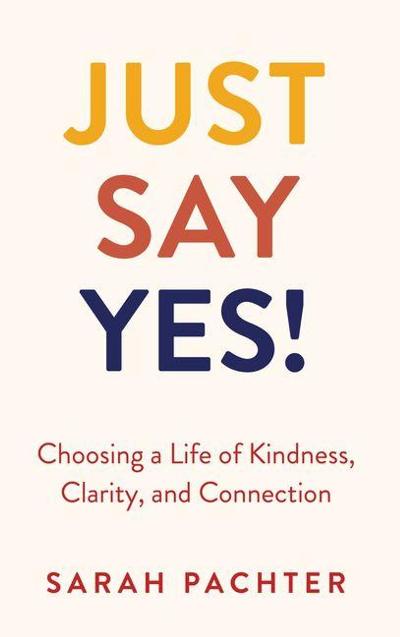 Excerpted from Sarah Pachter’s new book, Just Say Yes! In a world of constant overstimulation, where feeling bombarded has become the new normal, Just Say Yes! is the perfect tool to navigate the journey of finding inner balance. The three main relationships in every person’s life are to the self, to others, and to our Creator. Learning how to balance those relationships and when to say yes (and when to say no) is crucial to living your best life. Each section of this book focuses on a different aspect of that growth.