




 75 Date Night Ideas

5 min read
5 min read
7 min read



5 min read


I discovered that a key Jewish work on self-improvement was actually based on Franklin’s Autobiography.
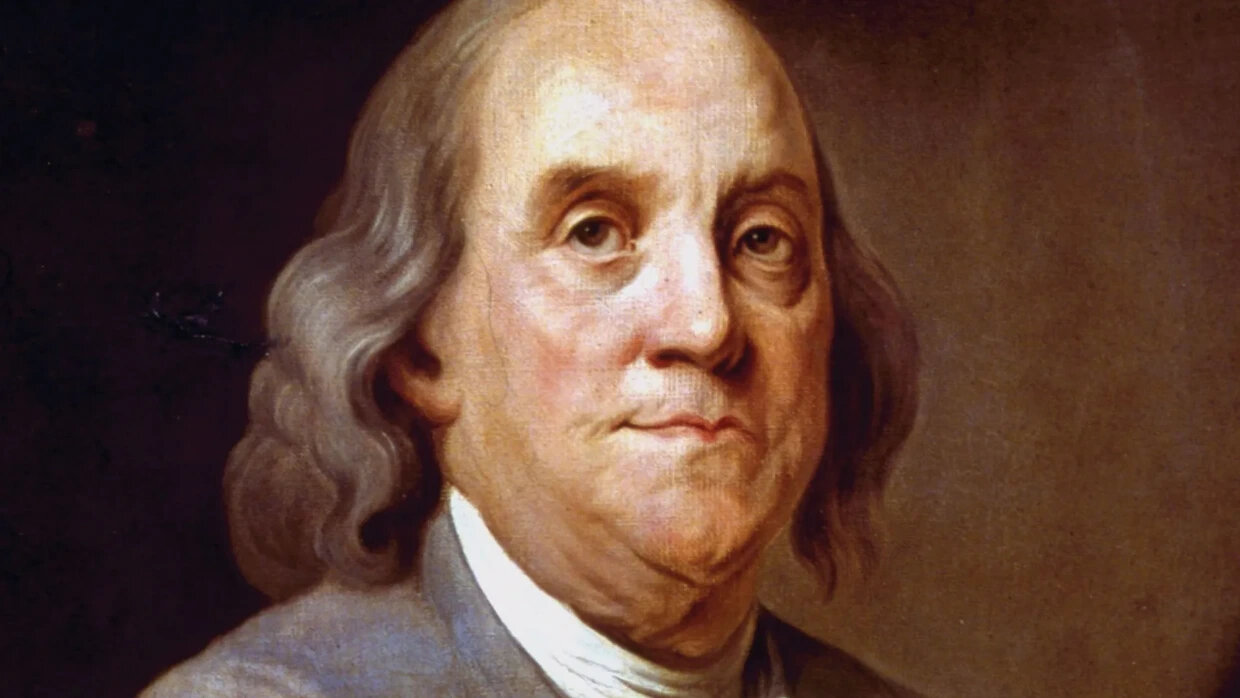
Benjamin Franklin is a larger-than-life character in American history, the legendary originator of everything from a printing press to public libraries, swim fins to a university.
Some years ago, I was lecturing about his Autobiography in the religious college where I teach. If George Washington was the Father of the Country and Thomas Jefferson its Architect, I told the class, Franklin—having signed every major document founding the U.S.—could be called its Inventor.
Described in the Autobiography, I told the class that Franklin also “invented” a method for spiritual growth to achieve “moral perfection.”
That’s when my lecture took an unexpected turn.
A student raised her hand. “Hey, I’ve heard of this system. We just learned about it in a Mussar (self-improvement) class yesterday—it’s exactly the same!”
The Mussar movement, a Jewish approach to ethical self-improvement, started in 19th-century Lithuania and still shapes Jewish thought today.
Curious, I dug deeper—and I found that a key Jewish Mussar text was, in fact, based on Franklin’s Autobiography.
Rabbi Menachem Mendel Levin, an early 19th-century scholar, published an influential book, Cheshbon haNefesh (Spiritual Accounting) in 1812 that is still in print today. He admits that the method he proposes for self-improvement isn’t original with him, though he doesn’t name Franklin’s work specifically as his model. But the details of his method of spiritual growth are clearly inspired by Franklin’s method for achieving “moral perfection”—in fact, the two systems seem identical.
Well—almost identical. A major difference reveals how a distinctly religious Jewish ethical approach could emerge from the ideas of Franklin, a Deist who believed in God but rejected organized religion—and how ultimately they can be very different.
Franklin’s and Levin’s methods for reaching moral perfection both use a 91-box grid made up of 13 virtues you will work on every day of the week to mark your progress. Slipped up on a virtue, say Temperance or Silence, on a Wednesday? Make a black mark in that box. Stayed strong? The box stays clear. Every week, one virtue gets special focus, though the other 12 are still monitored. Over a year, 52 weeks, you focus intensely on each virtue four times (4 times 13 equals 52, the number of weeks in a year; do the math!) Keep your notebook spotless, and you’ve mastered moral perfection!
Except that Ben Franklin never did, and Rabbi Levin says you never will...without the help of God.
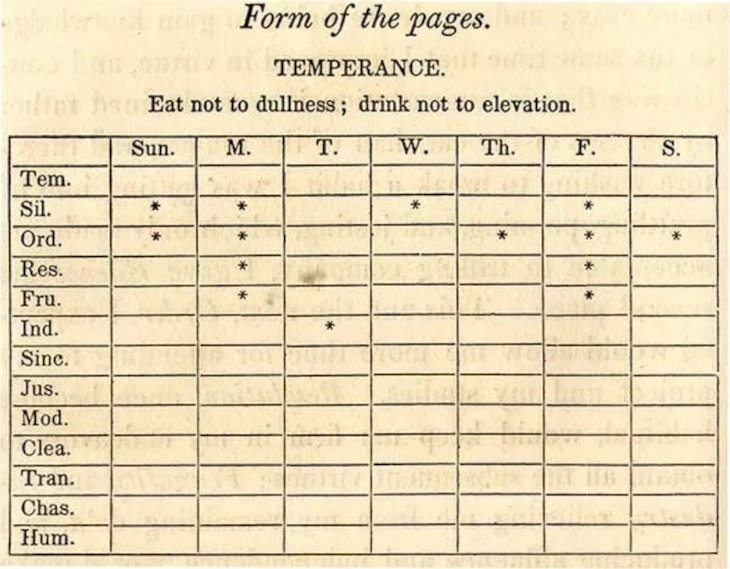 Benjamin Franklin’s 13 Virtues
Ben Franklin originally listed only 12 Virtues, but a “friend” told him people thought he was proud, so he added Humility as a Virtue to be attained—and one he confesses he never achieved. The best he could do, he writes, is to get the appearance of that Virtue. He describes Pride as the toughest passion to subdue. And he ends by blowing off Humility as a Virtue worth struggling for with a casual joke: “For even if I could conceive that I had completely overcome it [his Pride], I should probably be proud of my Humility.”
And that makes sense. Franklin was writing his Autobiography, describing many of his achievements—the original American rags-to-riches story. As a Deist, he acknowledges God as the Creator, but he’s really not interested in God’s role in his achievements. His story is his; what he did, where he failed, but mostly where he succeeded. Things to be proud of.
Not so Rabbi Levin. For him, Humility is the central Virtue of his system. The Biblical figure he cites most is Moses, described in the Torah as the humblest of all men. Humility is no joking matter: it is a necessary Virtue for one to attain fear and awe of God.
Ironically, as much as Cheshbon haNefesh emphasizes the need for an individual to be humble, it also exalts his position in the world: not as an individual, but as a human being.
In a philosophical introduction to his book, Rabbi Levin describes angels as perfect—but as pitiable, since they haven’t earned their place in Heaven. As humble as human beings must be in the face of God, they actually are above the angels, since they have the opportunity to work towards self-improvement.
Franklin states that the system he created doesn’t apply to any specific religion and is open to anyone striving to improve. Rabbi Levin saw the potential in the system, though he puts God, and not a human being, at the center. There is room for humility in the face of an Almighty God, but there’s also room for great pride, as with His help we can achieve more than angels.
Among his other accomplishments, Ben Franklin invented bi-focal glasses, great for improving physical vision. Rabbi Levin’s system has a deeper “dual vision.” He sees human beings as humble before an All-Knowing God, but proud of their potential for self-improvement.
Yom Kippur is a day of cheshbon hanefesh, of spiritual accounting, on steroids. While we might or might not use Rabbi Levin’s system for attaining moral perfection, his message of human humility on the one hand and human potential on the other can be an effective starting point for our journey towards self-improvement.













This subject has been very much debated and written about.
I believe one publication in Hebrew by a Yeshivah Mashgiach in Isael (Slabodka?) defended the author that he indeed was not part of the Haskalah and authored it himself.
I have done my own form of Franklin's 13 Virtues off and on for several years. I have my 9, not 13, which I arrived at after a lot of soul searching. My life is improved during the times that I am persistent with these "traits" as I call them. A few years ago, I gave a short talk at our synagogue for Rosh Hashana on this very topic, starting with "I would like to speak for a few minutes about someone who was not Jewish, but spent the majority of his life following a Jewish tradition, even though he probably was not aware of it. This tradition is Heshbon HaNefesh, which is an accounting of the soul, or a personal accounting." I followed that with an explanation of what Mr. Franklin did and how he did it.
You can find thorough descriptions of his 13 Virtues online and in his Autobiography.
I see your other comment that begins with "Utterly absurd..." Are you referring to a *different* comment?
Anyway, you are correct; the *idea* of cheshbon hanefesh goes way, way back. But still, R' Levin either knew English, or he had a student who knew English and who passed Franklin's pearls of wisdom to R' Levin. No doubt R' Levin could've come up with a similar list on his own. Perhaps he liked the way Franklin organized his ideas.
I like the emphasis on being humble before G-d. We are often told to take pride in ourselves and our work if we do it well. I am happily retired because I don’t have to engage in the endless self-promotion required nowadays to advance one’s career. I have always recognized that I put in the work, but success is from Hashem.
Fascinating! Thank you Dr. Zitter!
Utterly absurd to suggest that this Torah great who had no relationship to American politicians or the English language somehow borrowed his idea from Ben Franklin. The idea of cheshbon ha'nefesh goes back at least 2,000 years in Torah sources.
Interestingly enough this "Torah Great" was also part of the Haskalah movement but no to the point that he became a heretic. But is well known that he did base this work of off Benjamin Franklin. And to be honest, what's wrong with that? R' Yisrael Salanter ( who made the sefer popular with his grand apprbation and encouragement of it) saw the truth and in this approach which was honed by Benjamin Franklin and then written in "Sefer form" by Rabbi Levine. He saw it a useful tool for dealing with our baser animalistic instintcs which is a universal human condition. Non-Jews can work on themselves and give us useful insights as well.
Not sure where I suggested that we can derive no useful insights from non-Jews? But I am curious from where you gather that "it is well known" that he based his work off of Benjamin Franklin.
honestly just from being around, never actually researched it because I couldn't care less really, to me it's irrelevant where he got his inspiration from. But what does interest me is, from where are you coming from that you can so affirmatively state that "it is utterly absurd to even suggest!"
honestly just from being around?? So there is no evidence you're telling me. And being that cheshbon ha'nefesh is a concept dating back to well before the Talmud more than 2,000 years ago, why should I think that a European Rav somehow was versed in the autobiography of an American politician, something that we have never once heard about in the history of Jewish scholarship? A famous sefer being inspired by an American autobiography? Absurd. A wonderful and blessed year to all...
of course the concept is an ancient Jewish concept, the point of this article is that the methodology of how to practically implement it was derived from ben franklin's autobiography.
So Interesting ! Thank you Dr. Zitter