




 The Jewish People’s Undying Connection to the Land of Israel
4 min read
3 min read


8 min read


Four Jewish heroines who changed the world.
Once upon a time … in ancient cities and bustling shtetls, across laboratories, courtrooms, kitchens, and even outer space, Jewish girls grew into Jewish women who changed the world.
Bedtime Stories for Strong Jewish Girls brings to life the incredible tales of 50 Jewish heroines, scholars, spies, scientists, artists, athletes, leaders, and dreamers who dared to ask questions, stand tall, and light the way for generations to come.
Perfect for little readers with big dreams, this beautifully crafted book will inspire Jewish girls, and all children, to see themselves as part of a vibrant legacy of strength, creativity, and courage.
Enjoy these four inspiring stories excerpted from the book.

There once was a tiny woman who loved Yiddish. Her name was Molly. For as long as Molly could remember, she had always been a performer. She started by trying out her acts on her sisters in her family’s living room in Philadelphia but soon began to entertain others.
While her first public show was for the passengers of a trolley stuck in traffic, before long, she joined a formal troupe that performed all over the United States. It was in that troupe that she met her husband, a Yiddish theater director named Yankele. And Yankele had an idea.
“Molly, it is clear to me that you most enjoy performing comedies. And this is lucky, because all war-torn Europe needs is laughter,” Yankele explained. “The people just want to laugh again, and you can help them do that.”
Molly sighed. She wasn’t sure she could handle any more sadness – she and Yankele had been trying to have children for so long now, and they still had no baby. But Yankele was right. What was happening in Europe was awful. Its people, more than any of her other audiences, needed to laugh. And she was the one who could remind them how.
“Okay, Yankele. Where’s our first stop?” Over the course of World War II, Molly performed for refugees and soldiers stationed throughout Europe. At the close of the war, she brought her act to displaced persons camps as well. In one camp audience, a three-year-old heard sounds of laughter for the first time. All because of Molly. That three-year-old was not the only child in Molly’s life now.
After the war, she and Yankele chose to foster four children as their own. While mothering these children, Molly did not stop acting. Even at sixty-three, Molly did cartwheels across a Broadway stage. At seventy-three, she took on the role of Yente in the 1971 movie Fiddler on the Roof.
Yankele remarked that she was somehow “the girl who gets older every year and younger every day.” And Molly responded, without missing a beat, “It’s because of the laughter.”

Once upon a time, not too long ago, a German girl named Rahel wanted to become a doctor.
“Rahel, the Jewish community needs women doctors with both a talent for science and knowledge of Judaism,” her mother said to her one night.
She had overheard Rahel’s boyfriend, Elias, tell her that he did not want her to continue her medical education. And while Rahel’s mother liked Elias, she did not like to see him discouraging her daughter.
Rahel smiled. “Mother, I will become a doctor. I have already submitted the permission request to sit for exams.” Rahel shook off her annoyance that only women had to submit such requests, just as she had shaken off Elias’s words. “But I also will marry Elias. He may not want me to be a doctor, but he won’t stop me. I’m glad he is comfortable enough to tell me that he disagrees with me.”
And just as she promised, Rahel did both. For the next twenty-five years, while raising their five children, Rahel practiced as a doctor, educating women on proper healthcare for themselves and their families. By 1933, Rahel and Elias were no longer young. In fact, Elias had been sick for some time, and even though Rahel was a doctor, he was too sick for her to help him.
“Rahel,” Elias said, turning to his wife sitting at his bedside. “When I die, I want you to move to Palestine. It is too dangerous to stay in Munich. You and the children need to stay safe and free.”
It was hard for Rahel to meet Elias’s eyes. Could she really move with their teenage children across the world to a land she did not know?
“Remember Abraham,” Elias said. He was talking about the biblical story in which God told Abraham to leave his birthplace and go to a new land. “Promise me.”
Rahel knew Elias was right. The Nazis were gaining power, and there was trouble ahead. She promised. When Rahel arrived in Palestine less than a year later, she got to work. She was determined to help make the Jewish state strong, medically or otherwise.
And, as the institutes that still bear her name to this day prove, that’s just what she did.

“Esty!” her mother called as she was leaving. “Don’t forget your parasol! It’s so sunny today!”
Sixteen-year-old Esty rolled her eyes. She was so embarrassed by that parasol!
“I’m only going to help Uncle John, Mother. I won’t be in the sun,” she said, but she took the parasol anyway.
She didn’t want to waste any more time away from her Uncle John’s lab, where she helped create creams, lotions, and perfumes. If she was lucky, he even let her name these creations!
“Hi, Esty,” Uncle John greeted her. He seemed more excited to see her than usual. “I have an idea. Do you know what you want to do after high school graduation?”
When Esty thought about her future, she only knew she didn’t want to end up like her mother, who had worked so hard as a homemaker with nine children, or her father, who struggled to earn a living at a job he did not enjoy. But she wasn’t sure exactly what she would do.
Her uncle continued, “I’ve seen you sell the products we create here to friends. You are talented, and I’d love for you to join my business as a saleswoman. Of course, you will still be able to help me in the lab if you’d like.”
Esty thought for a moment. She certainly enjoyed selling beauty products, but she most loved creating them. Perhaps this would let her do both? And maybe she could create a cream to replace the parasol she hated so much! “Okay,” she agreed. “When can I start?”
Shortly after graduation, Esty began selling her uncle’s products, but before long, she was making her own. When she sold fifty thousand bottles of her perfume in its first year, she decided to launch her own company, named after herself but making her name sound as her father called her in his European accent: Estée Lauder.
Her husband joined her, and together while raising their two children, they built Estée Lauder into a billion-dollar company, selling its products around the world, including a cream that protected skin from the sun and saved countless women from having to carry Esty’s much-hated parasol.

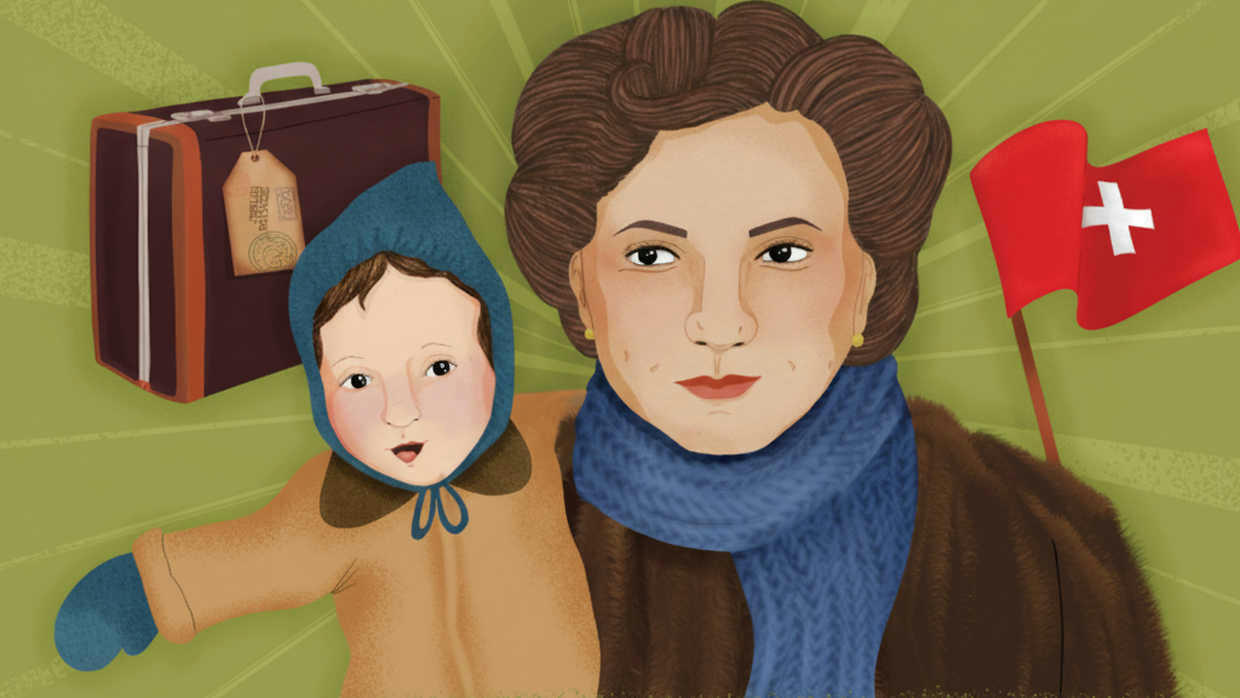
Once upon a time, a woman named Recha was lucky enough to move with her husband to neutral Switzerland before war engulfed Europe.
“For the last time, I assure you, we are not operating a hotel,” she told a neighbor who had knocked on her door, confused by the many people Recha had inside.
The neighbor was skeptical but left, and Recha sighed in relief. She had been helping refugees for so long now: housing them, feeding them, and providing hope for a better future. But it wasn’t easy. Just last year, she’d been sent to jail. Luckily, the judge had dismissed the charges against her and even contributed a hundred francs to her rescue efforts.
She smiled, remembering. Many of her non-Jewish neighbors had taken up her cause as well, and she would forever be grateful. Recha turned back inside and saw the daily minyan assembling.
“Recha,” her husband called to her, “do you still want to send that telegram?” Although they had already saved many Jews, Recha felt it was time to make more use of their connections. The idea was simple. The Sternbuchs were connected to the president of Switzerland, and he had connections to a top Nazi official, Heinrich Himmler.
It was already 1944, and the Nazis had begun losing hope that they would win the war. So, Recha thought, Himmler might be willing to undermine the Nazi agenda in exchange for safe passage. Recha could capitalize on that opportunity, having the president communicate a lie she had concocted: Himmler could save himself by saving some Jews. The president agreed to help. A few days later, he told Recha that Himmler was convinced. Recha had done it again!
By the end of the war, Recha had saved more than 300,000 Jewish lives. And she wasn’t done – for the rest of her life she would search for Jewish children hidden all over Europe to reconnect them to their families or others who would care for them. Recha was a woman with a mission.
When the world around her fell to pieces, she discovered within herself a fierceness that remade her into a rescuer of uncompromising courage.
Click here to order your copy of Bedtime Stories for Strong Jewish Girls












These women were pioneers for Jewish women and women in general, also the Jews have 4 mothers too, and it is important that girls should know their worth in this day and age, also women learn STEM in school and please don't forget a fifth woman that was a actress and Jewish Hedy Lamar were she was before her time making technology to be able to use the Wi Fi and other devices we use today, and I think she was a genius too, they can be other Jewish women pioneers too