







 Those Shameful Thoughts and What They Really Say about You

4 min read
3 min read
6 min read





Nearly 40% of divorces now happen after 50. Here’s what's driving it, and how to know if your marriage is worth saving.
Another call, another divorce. Last night I heard about another one of our peers getting divorced. This has become almost a monthly occurrence.
“Gray divorce” – couples who, after decades of marriage, decide to split up later in life – accounts for nearly 40% of divorces in the United States.
After raising children, facing challenges, weathering storms, celebrating milestones, and navigating life together for decades – now you get divorced?
What’s going on?
There are many factors, and we’re going to address some of the most common ones, along with practical tools for prevention. But first, let’s talk about the elephant in the room:
Yes, there are times when divorce is the right choice.
Many marriages that seem beyond repair can, with the right help and genuine commitment, be saved.
After more than 40 years of marriage and close involvement with thousands of couples over the years, my husband and I have come to another conclusion: Many marriages that seem beyond repair can, with the right help and genuine commitment, be saved.
We have seen marriages that appeared to be falling off a cliff, and then, with the right intervention, watched couples pull them back.
When two people genuinely want to make their marriage work and seek excellent help before they reach a crisis point, they can not only survive a difficult period, but sometimes emerge with a marriage that is stronger and more fulfilling than it was before.
The key word is before.
If you wait until the marriage is in full-blown crisis, it will be much harder to turn things around. Pay attention when things are merely beginning to feel off course. Don’t wait for the ship to hit the iceberg.
And not every therapist is the right therapist for every couple. The right professional can be enormously helpful; the wrong one can make things worse. If the person you are working with isn’t helping, find someone else. Keep looking until you find the help that works for you.
You need to know that you did everything you could to save your marriage.
A wise rabbi once compared divorce to an amputation.
Your hand hurts. Do you cut it off?
No.
It really hurts. Do you cut it off?
No.
It hurts so much you can’t sleep at night. Do you cut it off?
Still no.
But if your hand became gangrenous and the infection is spreading up your arm?
Yes.
Marriage can be like that.
Do you get divorced because marriage is hard?
No. Marriage is really hard.
Do you get divorced because you are struggling so much that you can’t sleep at night?
Not necessarily.
But when the marriage has become destructive and is causing profound and ongoing harm?
Then it’s time to consider amputation because it’s killing you.
When the marriage has become destructive and is causing profound and ongoing harm, then it’s time to consider amputation because it’s killing you.
But we need to be careful about mistaking pain for pathology. A difficult marriage is not necessarily a broken marriage.
So let’s look at some of the reasons couples divorce later in life and what we can do about them.
One of the most dangerous mistakes couples make is allowing their entire lives to revolve around their children.
Of course, our children are a tremendous part of our lives – practically, emotionally, spiritually, and in countless other ways. Raising children can consume enormous amounts of energy. But in the process, some couples slowly neglect the core relationship of their family: their marriage.
The challenge is to navigate each stage of parenting together while continuing to nurture the relationship between husband and wife.
And that requires a sense of humor.
When your children are little, what is your number-one goal every day?
Get them to sleep!
When they become teenagers?
Wake them up!
You have to laugh together through some of the craziness. What’s the alternative? Fight and cry?
Not only does that make marriage miserable, it certainly doesn’t create the kind of home environment our children need.
That’s why date night is not a cliché. It is not a lofty goal reserved for couples who have extra time and money.
Making time for one another is crucial.
And I recommend a rule: For the first 15 minutes of your date, you are allowed to talk about the kids. After that, the kids are off-limits.
People sometimes ask, “But then what will we talk about?”
That question should make you pause. What did you talk about before you had children?
You need to keep blowing on the embers of your marriage so that the fire stays alive.
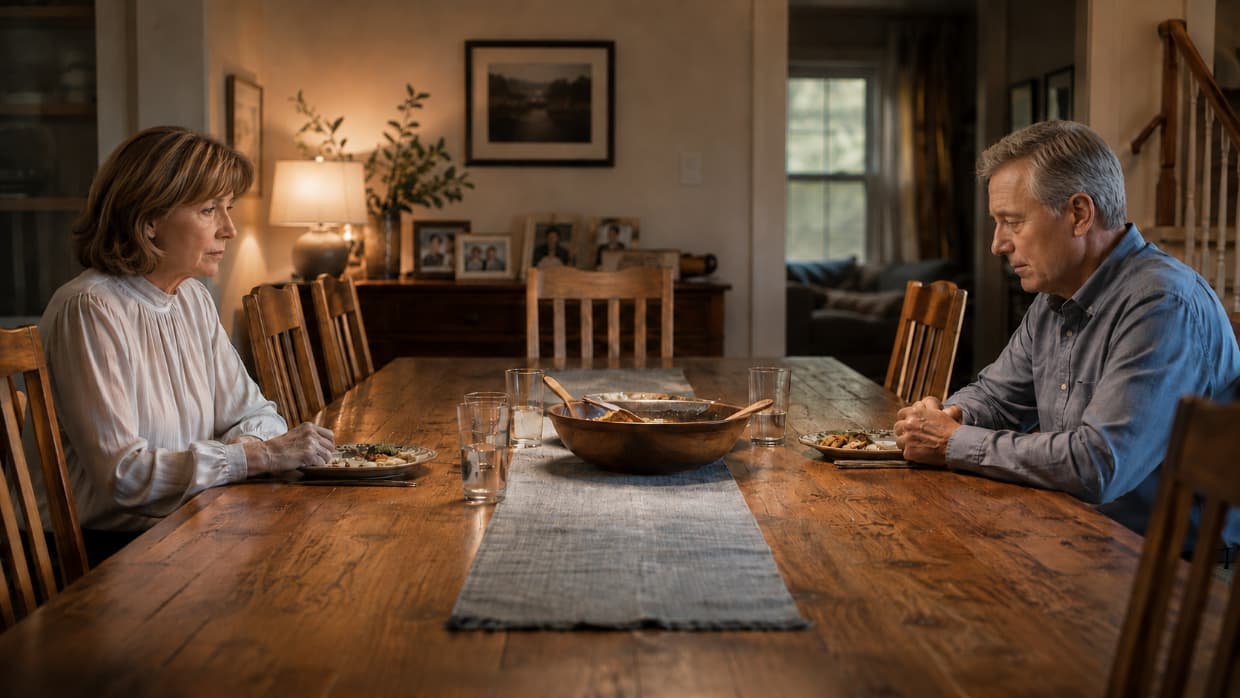
Because if everything in your relationship has always been about the children, when they eventually leave home, you may look across the table at your spouse and suddenly think: Who are you?
There was a time when financial dependence could be a powerful factor keeping a woman in a marriage. If leaving meant having no way to support herself or her children, she might stay, buying time to work on the relationship.
Financial independence for women is unquestionably a positive development. Women should be able to support themselves and have options.
But it has also removed one of the practical barriers that once made couples think twice before ending a marriage.
That means something else has to take its place: The conscious decision to work on the marriage.
When I was growing up, there was one divorced couple among my parents’ social circle. In my grade-school class of 30 children, only one came from a divorced home.
Today, divorce is much more common. In some social circles, it has even become the norm.
Think about what happens when a Hollywood star goes on a talk show and announces that he or she has been married for 10, 15, or 20 years.
The audience applauds.
That tells us something.
In the traditional Jewish world, there is still greater social pressure to get married, work on the marriage, and stay married.
And while social pressure can certainly be misused, some kinds of social pressure are good.
In my parents’ generation, the social stigma and financial realities were so overwhelming that some couples remained trapped in toxic marriages.
We need encouragement – from family, friends, community, and society – to make difficult but worthwhile choices and to persevere when things become challenging.
There was, however, a downside to the old system.
In my parents’ generation, there were couples who probably should have gotten divorced. But the social stigma and financial realities were so overwhelming that they remained trapped in marriages that were unhealthy or even toxic.
Those couples may have needed the “amputation.”
The answer, therefore, is not simply stay married no matter what. Nor is it if you’re unhappy, leave.
The answer is having the wisdom to know the difference between a marriage that needs healing and a marriage that has become destructive.
Perhaps the most common rationalization for gray divorce is: “At least now it won’t hurt the kids. They’re out of the house.”
But that isn’t necessarily true.
Your children may be adults, but they are still your children.
When their parents divorce after decades of marriage, their world can be shaken in profound ways.
They may wonder: Was everything I remember real? Were all those family memories a lie? If my parents’ marriage could fall apart after all those years, what does that mean for my own marriage?
Their understanding of their childhood may suddenly be reframed.
And now they have to navigate holidays separately, family celebrations separately, and relationships with each parent separately. If they have children of their own, they must figure out how to help their children navigate a family structure they never expected to have.
Grandparents divorcing can be deeply painful for grandchildren, too.
No, divorce doesn’t erase the happy years. Those memories were real. But it does change the family reality.
A bomb has been thrown into the family system, and many people can be hurt by the explosion.
Think of your life as a wheel.
Your children are one spoke. Your career is another. Your friendships, finances, community, health, spirituality, and countless other areas are additional spokes.
But what holds all those spokes together?
Your marriage is that hub.
Don’t assume you can build a strong, successful life around a weak center.
Choose wisely.
And then, once you choose, work on your marriage like crazy – before the first gray hair ever appears.
Don’t wait for the empty nest to discover that you have lost your relationship.
Don’t wait for a crisis to seek help.
Don’t allow the children, work, finances, and endless demands of life to push your marriage to the bottom of the list.
Yes, marriage requires a lot of work.
But the right marriage, nurtured with intention, humor, patience, commitment, and help when needed, is one of the greatest gifts we can give ourselves, and our children.
It is worth working for.











I dunno, telling married men how bad you feel for them due to their wives is not helping matters.
Who is doing that?
Redpill
Also, as the end-of-life approaches, the time to do things that are important to you dwindles. If you really have the need to do something your partner will not (like travel) you might need to take different paths to reach personal fulfillment.
If you divorce in order to reach personal fulfillment, you may be able to travel, but you just threw a hand grenade into your family that could impact generations.
A woman’s financial dependence? Goes both ways now pal,
and that’s a healthy thing.
Not sure what you mean.
Meaning financial dependence of the man on the woman’s income
A Kesiva V'Chasima Tova.
Some good points
Thank you.
In over 60 years as a therapist, I did not meet even one person who was considering divorce unless their partner had a mental illness or personality disorder which made it impossible to build a truly empathic, trusting relationship. Most people stay with a disturbed spouse in their private gehinom to protect the children from PDA - post divorce abuse (which occurs in 95% of divorces), to protect them from the ostracism and scorn which they inevitably endure and to preserve the illusion of a "normal, happy family" to outsiders in order to get "good" shidduchim. I, myself, did not want to be divorced. Rav Shlomo Zalman Auerbach, z.tz.l., gave me a psak on 3 separate visits, telling me that I had to take this unwanted step.
Wow-- thank you for sharing your courage.
Sometimes I think divorce and abortion are similar in certain ways.
People think they're solving one problem but they're actually creating a million new problems instead.
And, like abortion, there are times when it's the right thing to do, like when the Mom's life is in danger, in the case of abortion.
And, like abortion, people are not honest about it afterwards.
"If I could go back in time, would I do it again...?"
I feel like if people honestly admitted to their regrets, others would hear.
Instead, society glorifies both these things.
A woman getting an abortion imagines it'll be like it never happened.
People getting divorced imagine they're going back to their pre-kids single life.
Obviously, sometimes both these things are necessary.
Not a small percentage of those who divorced regret it later. It’s not pretty out there.
I had an abortion (in fact, more than one), and I do not regret it at all. I had had to switch to a new kind of contraception, which was not as reliable; hence the unwanted pregnancies. I was not ready to be a mother: I was not married, was in the middle of my education, and was not financially stable. These were done as early as possible. I have zero regrets, and I now have a child I adore and can take care of properly.
Thank you for sharing your personal experience.
I just love Lori! Her articles are perfection! (In my opinion.) The only thing I would mention is the "don't talk about the kids" thing. I think talking is the main thing and whatever's on your mind is the chosen conversation!
Rabbi Lazer Brody has an awesome rule. 1 hour of communication every day and the husband should focus on listening!
Nice! (and thank you for your kind words)
Why is there not one word in this article about real problems, like coercive control, mental illness, addictions, betrayal, infidelity, physical abuse or verbal abuse? These problems don't exist in the frum world? There are no narcissists, sociopaths or psychopaths? The superficial attitude is: everything can be fixed, there is a cure for all illnesses, everyone needs to be forgiven for everything, only see the good in everyone, no one ever has a malicious intention to hurt another person and a saintly person tolerates and excuses abuse. Actually, marriage is NOT such hard work where unconditional love exists on both sides! You live on a different planet where everyone is kind-hearted, honest and self-aware. Time to get real!
What article did you read? Perhaps you missed: "Do you get divorced because you are struggling so much that you can’t sleep at night?
Not necessarily.
But when the marriage has become destructive and is causing profound and ongoing harm?
Then it’s time to consider amputation because it’s killing you."
That's the planet I live on.
Sorry but date night is a cliche. Once you're married dating is over and done with. Why? Because you're married. Dating one's spouse isn't going to fix any problems that may be lurking in the background, the so-called elephant in the room, that many will sweep under the rug to avoid rocking the boat. If something is wrong, you just need to come right out and say it then work on a solution that is agreeable to both.
No one said or implied that it will fix problems-- we are trying to prevent problems-- prevent drifting apart, getting away from the magic of the relationship. Life happens, don't let it sweep away your marriage.
Andrea - don't discount date night - as just a CLICHE'. I get feedback from a lot of clients & sources about their relationships - AFTER Marriage. ONE of the feed backs - IS - having events - such as a DATE NIGHT - or some other kind(s) of special time - SET ASIDE - to keep the marriage spark ALIVE - BEFORE - any MAJOR problems start to arise.
Especially - after the children start coming into the marriage. Even setting up a group - that will help others - have time for a SPECIAL DATE!
I think the real issue is when you have so many elephants in the room that there is nothing left to talk about.
As cliched as this may sound, maybe writing out a list of concerns can help. Don't censor yourself. Nothing is too trivial or wrong. I find that writing things down can help me organize my thoughts in order to tackle big issues one at a time. No, it isn't poppies and rainbows but imo the act of writing can give one greater focus.
#1: Ask G-d to give you clarity to make the right choice WHOM to marry-- and the right people to help you gain that clarity.
Recognize that your spouse is a gift from HaShem, and treat him/her accordingly. Thank HaShem for your spouse, ESPECIALLY on the days when you don't want to.
Nice!
Wayne - a great time for that - is - on Friday night - instead of just repeating words from the Siddur - the Eshet Chayil - take your spouse - in your arms - & THANK THEM - for the things you know they did for you - especially - in the last week.
A good marriage is worth fighting for!
YES!
A nice article. Thank G-d it isn't relevant to us. We're married 49 years and going strong. It's easy to stay married when your spouse is your best friend.
You are blessed.
Wonderful!
I Missed My Husband
By Bracha Goetz
Months after we were married –
My husband disappears!
And now – suddenly – here he is –
After twenty-eight years!
I mean, I saw him sometimes,
As we were racing past,
But the children’s needs were pressing,
So his would come up last.
Now there’s just the two of us,
At the kitchen table.
My husband waited patiently.
Others may not be able.
Thank G-d, it isn’t too late.
Thank G-d, I’ve got today.
Our home can last forever.
If I do things the right way.
Magnificent.
1 husband and wife have little to say to each other
2 he concentrates on work or golf or his club and she with her charity work and women friends
3 both losing their religion after discovering that Moses could not have written the Torah as so many places and tribes/nations did not exist at that time
4 grandchildren speak a. Different language- computers au etc
5 families move away
Heartbreaking.... (note: Moses did not write the Torah, G-d did)
Deafness? We may all be deaf to some of what others say, but if we realize the
damage deafness does, we may try to overcome it, one way or another day
I know a doctor, who has the license plate "Deaf Doc" She is deaf and treats the deaf.
(Just now, I tried to post two comments on the "Easy button" and I hope that Aish will
not be "deaf" to my desire to share a lesson for readers. Thanks. This is amazing.)
In Eruvin 54b, of the Talmud, a Rabbi Preida, gave his student 400 repetitions
of each lesson, and more. And so, in a marriage, misunderstandings might be
overcome, with repetition, and commentary.
Perhaps, the "Easy" button can sometimes help. But sometimes, patient
repetition may help. Writing things down, on paper, may help. I like to use
catchwords, and slogans, to make points, but this may offend some people.
(Again, I hope, Lori can comment on the "Easy" button idea. Tnx Good Year)
Depth psychotherapy for each spouse can do what other methods cannot.
Whatever works!
Shavua tov! It is very refreshing to see Lori Palatnik here as I haven't seen her work here in awhile. Divorce IS complicated, painful and expensive. I appreciate the medical analogy.
Thank you for your kind words and thoughts.
Another very common reason for divorce at this stage is when a husband decides that he's had enough of the marriage and leaves his wife. Unfortunately this is common, especially in the secular world.
A growing trend is women doing the same, not just in the secular world.
There is a reason for this trend that no one is speaking about… many well meaning therapists break apart couples and families. Relationship therapy is different than individual therapy.
https://time.com/article/2026/08/29/therapy-has-a-relationship-problem/
Yes, sometimes therapy can do more harm than good in relationships and you need to make sure that a therapist shares your own values. I'm a retired therapist myself, and know the dangers. Thanks for the link.
Yes-- unfortunately there are very few excellent therapists-- the right one can save your marriage, most will make it worse.
Therapists need to seek out their OWN therapy from time to time. Also, an honest and ethical therapist will tell you if they do not think they can help you. I have a master of social work degree and have witnessed individuals who enter the mental health field for the wrong reasons.
Thank you - very insightful. Practical and helpful. Helps me anyway.
Thank you!
I humbly would like to mention that main problem I have with this article is thatOlam Haba-the world to come is not mentioned once. We are in this world for the sole purpose of building an eternity for ourselves. That is called Olam Haba. See first chapter of the book Mesillas Yesharim for more on this. Divorce is only for VERY LIMITED circumstances. Being alone for ones adult years is MUCH worse than living with someone who is not perfect or someone you don't particularly get along with. Marriage is hard work. It is like polishing a diamond. You scrub and scrub and sometimes it really hurts and hopefully you stay to together to walk all your children and great grandchildren down the aisle. That is a great achievement and it can only happen if we focus on the BIG PICTURE of life.
No sorry... our purpose here is not building an eternity for ourselves in some other place. Our purpose is to take part in G-d's creation. Judaism is not a Gnostic Religion like: Christianity, Hinduism, Buddhism, and New Age.
If G-d is not present in our marriage, of course the relationship will be incomplete. This is why a religious ceremony is so important, because we believe that He planned our spouse for us, and we need His help every day in our marriage. Marriages can become toxic, it's true, but as you say, it's very rare, and loneliness is the great scourge of our age.
In then Next World we spend eternity with...our spouse!
Being alone for one's adult years is absolutely NOT much worse than being with someone you don't get along with. Plus, with children, grandchildren, co-workers, friends and extended family, and of course a cat LOL you're not exactly alone.
I think women are realizing that they really don't need a man in their lives. Especially if they are financially independent and have shouldered career, child-rearing, and home repairs, etc without meaningful help. They are not excited to be a caregiver for an aging spouse now.
Lori IS focusing on the big picture. However,there are occasions when the individuals would be better off getting divorced. Nothing is casual about this decision. Also, far too many women have stayed in abusive marriages because they believed that was what they must do, I recently saw a video made by an 89 year old woman who said that for 50 years of her marriage she was verbally abused by her husband. She only had peace when he passed away and was too ashamed to share this issue with anyone. Nobody deserves such paom om their lives.
When love dies beneath the breast, there still should be respect. This can only be achieved, if going into marriage, a couple recognizes marriage is more than just about love.
Divorce is just a sign of a greater condition: Living life is a lot of very hard work, and from time to time, it will really push you down, and demoralize you.
So, marriage, cannot, by life's very nature, be about an ideal, and fantasy, that never really existed to begin with.
Perhaps, after 50, or when children are raised; it should automatically be about partnership, and pursuing promoting HaShem's ideals, in word, and deed; studying, and helping all humanity, together.
Wise words.
Date night was mentioned. My husband a”h and I couldn’t do date night because I had an elderly mother living with us and no night time aide. So we did date lunch. Once a week we went to our chiropractor and then went to lunch somewhere. Nothing fancy. A bagel place or a pizza shop. Just to spend a little time out of the house. We were in our 70s.
We are now in our 80s and we do the same! Once a week, a lunch out or even just a morning coffee and cake somewhere we haven't been before - time to be together, focus on one another and not about the kids or the house. Very, very important. And we are both retired therapists, so we realize how necessary it is to work on our relationship and our relationship with G-d.
My husband often brings me coffee in the morning and we sit and catch-up...his joke is:
"How do you know it's a mitzvah for a man to make his wife coffee?"
"He-brew" 🙂
I love it!!
LOVE!
Aww....! Thank you!