 Those Shameful Thoughts and What They Really Say about You

6 min read
5 min read





Seven well-meant phrases that make a spouse feel worse, and what to say instead.
Maybe he comes home from work and drops onto the couch without saying hello. Or she’s on the phone with the bank for the third time this week and her voice keeps rising.
You can feel the stress rising and because you love them, you want to help. So you say something that only makes matter worse.
King Solomon wrote, “If there is worry in a man’s heart, let him quash it” (Proverbs 12:25). The Hebrew word yashchena (“let him quash it”) can be read two ways. The Talmud (Yoma 75a) records one reading as pushing the worry out of your mind. Another reads it as yasichena, “let him talk it out” with someone else.
That second reading is where you come in. Your spouse needs to feel they can tell you what’s worrying them without being judged or told what to do. That sense of emotional safety, knowing you can bring your worries to your spouse and be heard, is one of the foundations of a close marriage. Here a 7 common phrases that get in the way and what to say instead.
Being told to calm down rarely helps when you’re already overwhelmed. It suggests your feelings are the problem.
Try: “That sounds like a lot. Do you want to tell me about it?”
Even if you did warn them, saying so now won’t help.
When someone is overwhelmed, being right is the least helpful thing you can be. You can talk about what to do differently once the stress has passed.
What helps more? “Okay. What do we do now?” Notice the “we.”
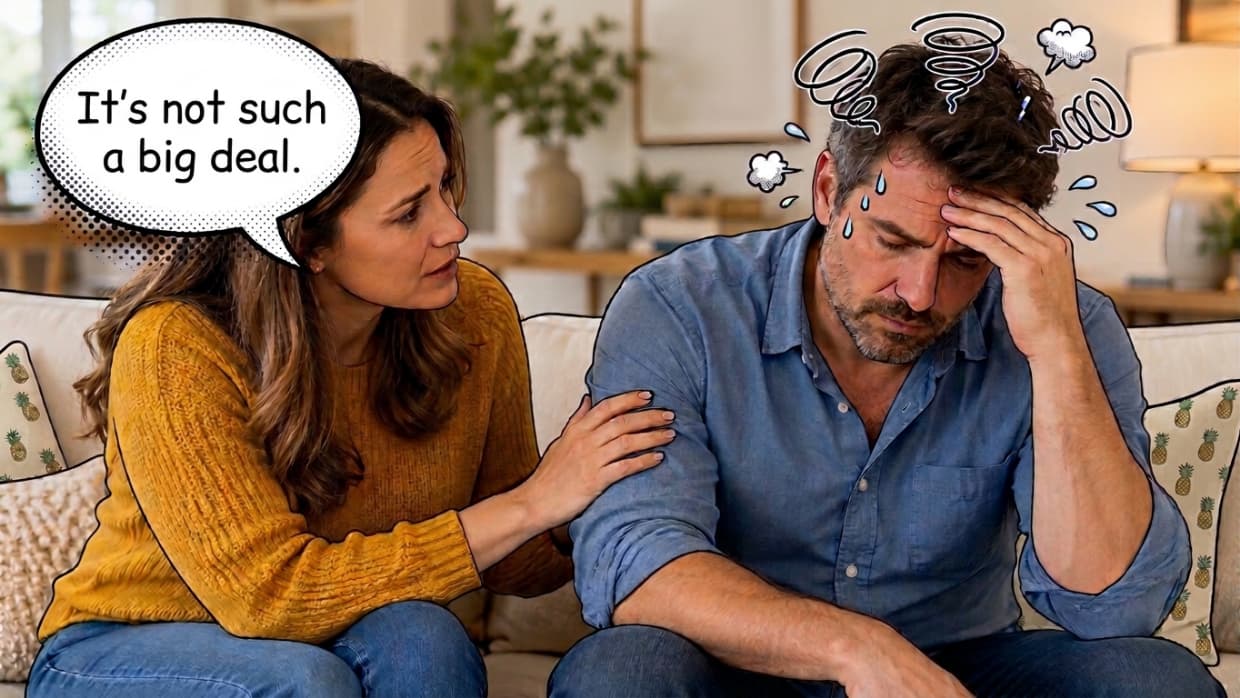
To you, maybe it isn’t. To them, it is. And that’s what matters when you’re trying to support them.
Minimizing usually comes from a good place. We want them to feel better, so we shrink the problem. But what they hear is, “You’re overreacting.” Instead of making the problem seem smaller, acknowledge what they’re going through.
Try: “I can see this is really getting to you.”
“Should” points to the past, to something that can’t be changed in the moment.
Instead, ask what would help right now. Then actually wait for the answer, even if it’s “Nothing, just sit here.”
It probably was. You both work hard, and you both deserve support.
But when you answer their stress with your own, the conversation can turn into a contest over who had it worse, and neither of you feels heard.
Take turns. Let them go first, and ask for your turn later.
Try: “I want to hear everything. Afterward, can I tell you about my day too?”
Some of us are fixers. Someone shares a problem, and before they’ve finished the sentence, we’re on step three of the solution.
Sometimes advice is welcome. Often it isn’t, at least not yet. A stressed person usually needs to feel understood before they can think clearly enough to weigh a solution.
One useful question: “Do you want me to help you fix this, or do you just need me to listen?”
It’s simple, but the answer can make all the difference. You may be surprised how often your spouse wants something different from what you were about to offer.
Silence can be kind. It can also feel like being left alone with it.
Dr. John Gottman, a relationship researcher, uses the term “bids for connection” for the small ways people reach out to each other. Sometimes a sigh or a quiet “What a day” is an invitation to connect. When we keep missing these moments, our partner may start to feel we’re unavailable when they need us.
You don’t need the perfect response. Put down the phone. Sit next to them. Bring the tea without asking. You don’t have to press for details about the call with the bank. Let them tell you when they’re ready.
There’s a world of difference between solving your spouse’s problem and sitting with them in it for a few minutes.
Most of the time, they don’t expect you to make the stress disappear. They need to know they’re not alone with it. That they can come home, drop onto the couch, and find the person beside them is on their side.
So the next time you feel the tension in the house, pause before you speak and ask yourself one question: Will what I’m about to say make this heavier or lighter for them?