




 The Hidden Pattern of Jewish History

6 min read
7 min read
6 min read



10 min read


Among Neighbors, a new film, tells their harrowing story.
This isn’t “another Holocaust film,” explains award-winning screenwriter and director Yoav Potash in a recent Aish.com interview. His newest movie, Among Neighbors, tells the harrowing story of what happened after Holocaust survivors returned to their homes in one small Polish town. Many were murdered by their neighbors, the crimes covered up and long forgotten.
A decade ago, Potash’s friend and colleague Dr. Anita Friedman invited him to visit Poland with her family and film a ceremony she was organizing there.
Dr. Friedman is President of the Koret Foundation, a group dedicated to strengthening Jewish life in and around San Francisco. Her grandparents were born in the small Polish town of Gniewoszow, which was two-thirds Jewish before the Holocaust. She grew up hearing stories about the vibrant Jewish life her family enjoyed there.
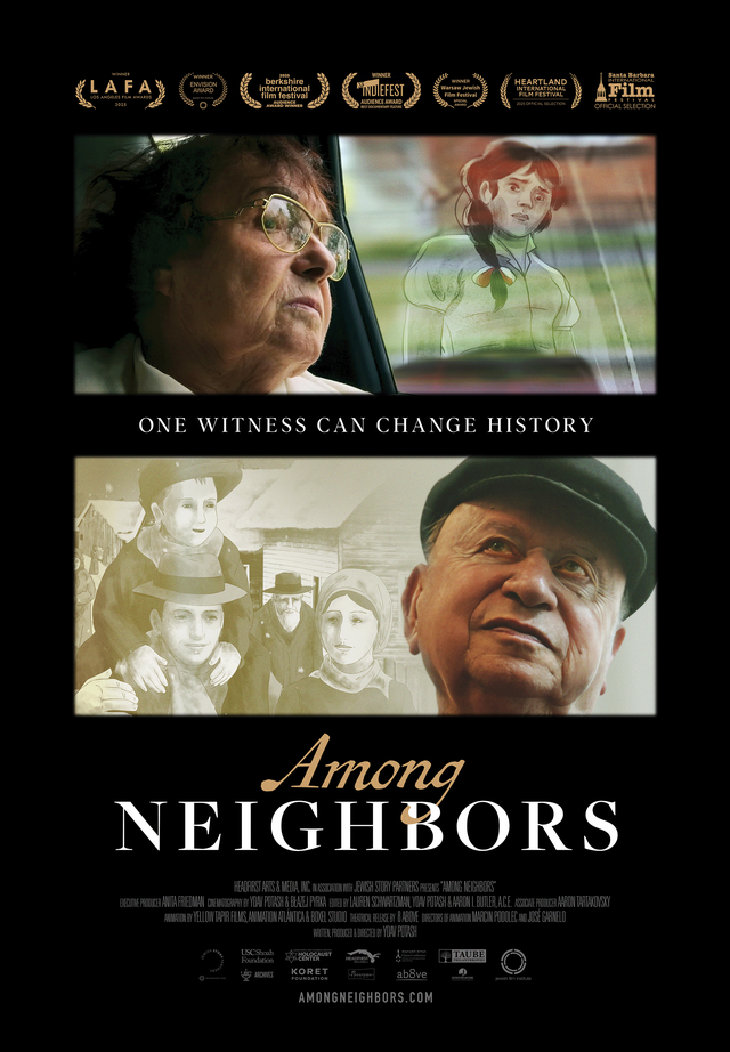
Gniewoszow was now a small, rundown village; its Jewish cemetery was unkempt and had been vandalized. Dr. Friedman had organized the renovation of the cemetery and asked Potash if he was interested in coming along and filming its rededication.
“I responded: ‘If you’re going to schlep me all the way to Poland, why don’t I spend a few extra days in the town and talk to old people and ask if they remember the Jewish people who once lived there?’” Potash explains.
He began by knocking on doors in Gniewoszow, asking residents if they knew anyone who remembered the Jews who used to live there. It wasn’t easy. One elderly resident, captured on film in Among Neighbors, describes how the house she lives in was once owned by Jews. After the town’s Jews were deported, first to a hastily built Jewish Ghetto in the town, then to Nazi death camps, residents described that “people moved into the Jewish houses.”
“This was a Jewish house,” one resident tells Potash. Admitting as much has got her into trouble with her neighbors: after she told two Jewish visitors a few years ago that Jews once lived in her house, her neighbors turned on her. “What did they say?” Potash asks her: “That the Jews should have died out.” Even today, this elderly woman described, her neighbors felt hostile to Jews.
Potash knew from his research that some survivors had been murdered long after the Holocaust ended when they tried to return to their homes in Poland. The largest attack took place in the town of Kielce in July 1946, a year after World War II concluded. When rumors spread that Jews had kidnapped a Christian boy (the rumors had no basis in reality), local police and over a thousand locals converged outside a building that housed 180 Jews, then began attacking the Jews inside. By the end of the day, 42 Kielce Jews were killed and 50 more injured. At least one non-Jewish Pole was murdered by his fellow Poles for offering aid to Jews.
Yet residents in little Gniewoszow also described locals murdering Holocaust survivors who dared return after the end of the war. Potash could scarcely believe what he was hearing. “That’s where I first heard from Polish lips that Jews were murdered in this town at Polish hands after the war. I’d heard this (in history books) but it was entirely different from hearing it from someone who was alive at the time and on the Polish side.”
Potash realized he wasn’t only going to film the Jewish cemetery’s dedication. “I decided this would be a documentary.” Little did he realize that it would take him ten years to make and would uncover harrowing details about the fate of Gniewoszow’s Jews.
Learning about Jewish life in Gniewoszow was like filing in a puzzle, Potash describes. The town is small and obscure, and there are few official records. Much of the texture of his film comes from a handful of elderly residents reaching back into their earliest memories to remember a Yiddish phrase or Jewish custom.
One non-Jewish resident recalls listening to the sound of Jewish weddings when she was a small child. “They used to sing Mazal tov, Mazal tov, Mazal tov,” she remembers with a smile spreading over her face. “I have no idea what that means.” Others described playing with Jewish neighbors or how kind Jewish shopkeepers were to them.
 Fragment from a Jewish tombstone
“On the whole it was bittersweet talking to these people,” Potash explains. “It was heartening to see and hear them get excited about certain memories, especially things that were really tangible to them like remembering how the Jewish shopkeepers would give kids candy or how Jewish shopkeepers would sell ice cream. Spontaneously, about three of the elders I talked to started talking about matzah or remembered a Hebrew word.”
Yet he encountered a “mixed attitude” where on one hand residents would describe warm childhood memories about Jews, but on the other hand would display antisemitic attitudes in Potash’s presence. One woman described playing with Jewish friends as a child, while on her wall hung a grotesque picture of a bit-nosed Jew holding a coin. (Some residents call these types of antisemitic images “lucky Jew” pictures and believe they bring wealth.)
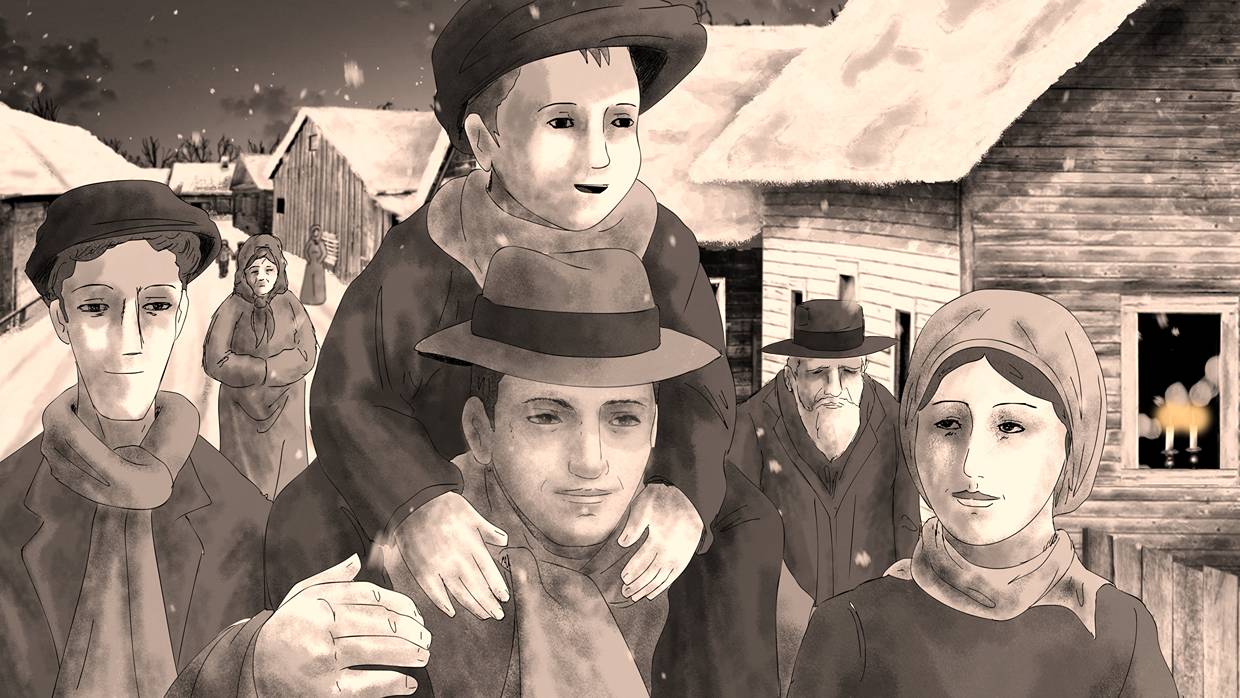
Using eyewitness and expert testimony, as well as illustrations, Potash describes Gniewoszow’s Jews being herded into a Ghetto in 1941. One local clerk, Boleslaw Paciorek, forged identity documents for nine Jews, allowing them to leave the country. Other residents did little to help the Jews in their midst. “Very very few” Poles sheltered Jews a former resident explains.
While researching the town, Potash discovered Harry Lieberman, an elderly Jewish painter who was born in Gniewoszow. In his 80s, Lieberman took up painting, crafting vibrant, beautiful scenes of life in his hometown. These beautiful works help us see Gniewoszow’s Jewish life in color, not only in the black and white of official photos and newsreels. Jews in pre-War Poland and elsewhere didn’t inhabit a black-and-white world of still photographs: life was rich and happy. Viewing Lieberman’s bright paintings helps us visualize that.
While Potash was researching this film, amazing coincidences started to happen.
Potash contacted virtually every museum and Jewish organization in Poland in the course of his decades-long research. So when the staff at the Jewish Historical Institute in Warsaw received a handwritten letter from an elderly Polish woman asking for help finding her childhood friend in Gniewoszow, they put her in touch with Potash.
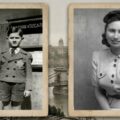
The letter writer was Pelagia Radecka, 85 years old when she and Potash met. For over 70 years, Radecka had been searching for Janek Weinberg, a little Jewish boy who lived across the street from her. She remembered his entire family fondly: Mr. and Mrs. Weinberg owned a fabric store and Mrs. Weinberg was always kind to her and even gave her a beloved piece of fabric that Radecka treasured for years. The Weinbergs begged her family to shelter them from the Nazis, but her father refused.
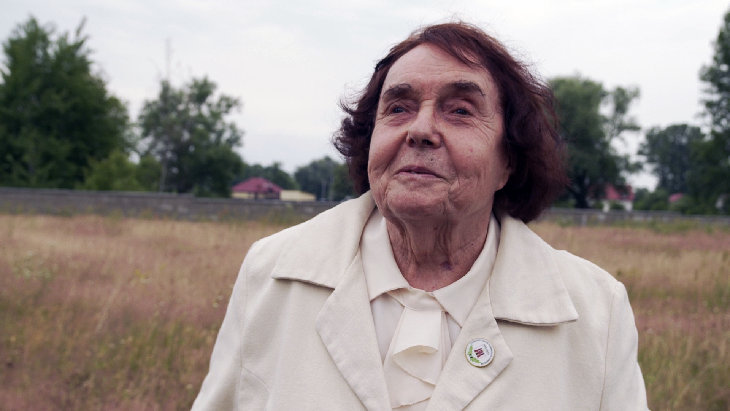 Pelagia Radecka
Radecka harbored a traumatic secret. At the beginning of the war, the Weinberg family fled town. After the war concluded, Mr. and Mrs. Weinberg - along with three other relatives - returned to Gniewoszow. Their presence was bitterly resented by the Poles in town. One night, Radecka heard gunshots in the Weinberg's house. Entering the next day, she saw to her horror that Mr. and Mrs. Weinberg, along with Mrs. Weinberg’s brother Elie, had been murdered. Her friend Janek was not present. Now, at 85, she wondered if she could find any information about what had happened to him.
Harry Lieberman’s granddaughters told Potash about one of Lieberman’s cousins from Gniewoszow who’d survived the Holocaust, and now lived in Israel: Yaakov Goldstein. As he learned more about Goldstein, Potash realized with shock “He wasn’t just related to Lieberman: He was the story!” Yaakov Goldstein seemed to be Janek Weinberg, the very childhood friend Pelagia Radecka was searching for.
Pelagia Radecka was a young girl when her neighbors left Gniewoszow and were murdered. Few people in the town ever wanted to discuss it. She was mistaken about some of the details she remembered: the family’s last name was Goldstein, not Weinberg. (Radecka read an inaccurate newspaper article about the family’s murder which misidentified them.) She remembered her friend Janek having a young sister: that girl was the daughter of a rabbi and his family who lived in the apartment above the Goldsteins. Janek now went by his Hebrew name Yaakov. In the emotional heart of the movie, Potash was able to bring these childhood friends together.
Yaakov Goldstein survived the Holocaust with great suffering. His parents paid a Polish family to take his baby brother Ezra; he has no idea what happened to him. Goldstein’s parents begged another Polish family living in Warsaw to shelter him. They did so, but forced him to live in a tiny, dark, cockroach-infested crawlspace where he had no room to even lie down. For two long years, Goldstein hid in that space, curled in a ball until his legs became weak and useless, never allowed to leave, and was sustained only by library books that one of the family’s daughters used to lend him.
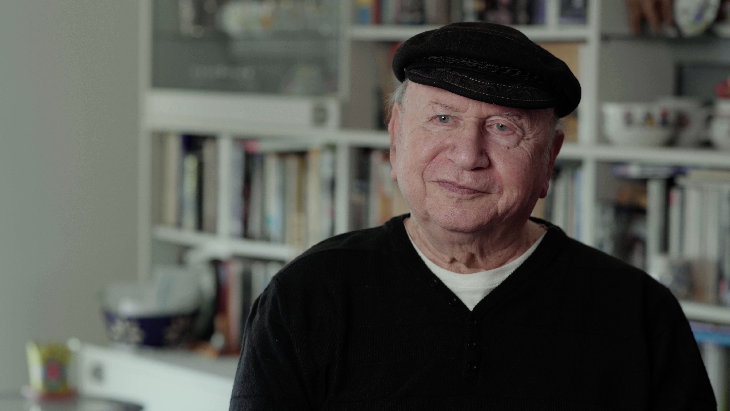 Yaakov Goldstein
After the conclusion of World War II, at age 14, he moved to Israel alone. He eventually became an eminent historian and built a beautiful life for himself and his children. Yet he never knew what became of his parents. Pelagia Radecka was finally able to tell him how they died, along with his Uncle Elie, murdered by their former neighbors six months after World War II had ended.
“It should have been a time of peace,” Goldstein sighs, “but it wasn’t.” He thanks Radecka for helping him to finally know what happened to his parents. “You look like your mother,” Radecka tells him fondly.
As they part, Radecka and Goldstein smilingly promise to meet each other again when they are 100 years old. Instead, they each passed away during filming, both at the age of 91. That was the fate of many of the witnesses who appear in Among Neighbors, Potash notes. “This is their last testament.”
Asked if he believes that Jewish Holocaust survivors might have been murdered in other towns besides Gniewoszow after the war ended, Potash is certain that the answer is yes. Yet without anyone to undertake the intense research and interviews he performed, the stories of other survivors who were murdered by their neighbors after the war are lost to history.
Among Neighbors concludes with a local man and his elderly father restoring a Jewish tombstone they’d kept in the junkyard behind their house in Gniewoszow for over 70 years. At the beginning of the film, they tell Potash that they bought the Jewish tombstone for pennies and thought that one day it might be good to repurpose it for a whetstone or other item one day.
At the film’s conclusion, after learning more about their town’s history, they agree to clean off the tombstone and return it to Gniewoszow’s newly restored Jewish cemetery. “It’s not right to steal a people’s history,” the son says with tears in his eyes.
 Filmmaker Yoav Potash and Yaakov Goldstein
Indeed. This film restores the history of the Jews of Gniewoszow, and by extension all Jewish victims of the Holocaust and of pogroms and other violence afterwards.
For more information and viewing possibilities, visit https://www.amongneighbors.com/






Unlike the Danish who saved almost all their jews and kept their houses with fresh flowers on the table when they returned. The poles suffered for 50 years under Soviet rule. Besides the war.They at least got some payback.
Unfortunately this is not just a Polish story. In most places survivors who returned to their hometown were murdered by former neighbors who took over their possessions. after a while they only went back escorted by armed friends and only to see if they could find surviving relatives there.
I just read your article and it brought back a memory of a USA/neighbor of Polish heritage telling me about her Jewish uncle and how he survived the Holocaust and returned to his small Polish town after WWII only to be murdered by his neighbors. To me it was so unreal, how something like that could have been done, so I half believed her intil NOW. WOW. So bad.
Where could I see this film?
Sharon if you find it let me know!
https://www.amongneighbors.com/
Saw this movie @ the lemmele Encino. It was excellent. Q & A for 30 min with producer. Only showing through Thursday. See it!
I am a child of survivors. I remember when my father said that his brother in law came back to his hometown.He went to his house and saw people were living there. When he knocked on the door , and said this is my house they killed him ! He survived camps but came home to get killed by Romania people in his hometown
Poland's government is JewHating,thin skinned about collaboration with the Nazis,and protest any mention of the Poles and the Holocaust,as famously against Netanyahu.
As they directly told Israeli singer Noa Kirel at Eurovision,when Noa praised Poland for giving Israel maximum points,surprised,since her entire family was exterminated there,"it's offensive,and you are invited to Poland to learn how the Polish suffered".
At check-in,business,Warsaw to US,I had a large book about Jews in Poland from the Jewish Museum.The attendant asked what it was about.I said it's from the Jewish Museum and it's a book of Polish History.This provoked her histerical,contemptuous laughter,saying there was no such thing as Jews and " Polish History".I complained to the airline,who sided with her.
Recently, my father-in-law, Naftali, stopped over in Warsaw, travelling El Al from NY to Tell Aviv. (In the Holocaust, a Polish family hid his family in their basement for 22 months, even after the Nazis butchered their Polish neighbors for also hiding Jews.) Guarding the El Al terminal was a young Polish soldier. The soldier approached him and asked, "Tell me, did the Polish people kill Jews or save Jews during World War Ii ?"
Naftali looked him in the eyes and said, "You want the truth, or do you want me to make you feel good?"
The soldier took a breath and said, "I want the truth."
Eyes still locked, he replied, "The truth is, a lot of Polish people killed a lot of Jewish people. But you are looking at one Jewish person that Polish people saved."
I never got to meet my in-laws who came to America from Poland. My late husband never talked about it. I don't know what their name was before they arrived here or how to find it. How sad and shameful. Now Americans are openly antisemitic. May G-d bless Israel and the Jewish people.
And if you report this in Poland you will go to jail.
Fantastic! This history needs to be told! Reading about the Holocaust over a 40 year period I read many stories about Jewish people returning to Poland to look for their family members, only to be attacked in the streets or murdered when they knocked on the doors of their houses! Completely unnecessary! The Jewish people were looking for family members not there to claim their houses OR businesses back! I can't IMAGINE surviving the horrors they went through only to be murdered in Poland! Many of the murders were carried out by youth gangs who patrolled the streets looking for Jewish people!
I'm so absolutely thrilled this film was made! Poland denies their past, and people have no idea what went on! It needs to be told!
Thank you for sharing this story. Interesting, though, that Potash isn't aware of the murderers in other cities and seems to imply that the research has not been done. The research HAS been done and there are unfortunately plenty of cases of Poles murdering Jews postwar. I've have an MA in Holocaust Studies and work in the field. I've come across this many times in academic books and testimonies. My own grandparents were from Radom, and when they returned to their city, they eventually chose to flee due to several instances of murder - including in the building they lived in. There is also a well-known case of the Gutman couple in Radom in August 1945; they were murdered on their wedding night and then their bodies were mutilated. It's a shame that Potash is unaware of the prevalence.
After the Holocaust, my father returned to Siercpc, Poland, to try to find any survivors from his family. Before the war, about half the town of about 6,000 were Jewish. He found no one and said he felt threatened. He heard that others had returned too, and that some were murdered, as they tried to reclaim their homes and or businesses. He only stayed a short time (a few days), and left forever.
The only country that didn't give money or anything , back to Jews after the war is Poland, my mom( obm) who was from Poland and a Holocaust Survivor( obm) from Auschwitz-Birneau told me how anti Semitic the Poles, were that is why she( obm) never went back to Poland, also I wouldn't go to the concentration camps in Poland either, the Poles make money off the tragedy of murder of 6 million Jews, I wonder if the so called Jews in Poland are real Jews or not, now in Poland I think they show things having to do with Jewish people, that is kind of strange to me
The Nazis couldn’t murder 3m Polish Jews without the help of the local Polish population. There were hundreds if not thousands of small Jewish communities spread throughout Poland. the Nazis would have no way of knowing who were Jews. Local populations saw their chance to take over Jewish houses and businesses. Opportunism, greed and hatred mixed with antisemitism. When those Jews who had survived returned home the locals feared losing their houses and businesses they had stolen.
The nazis knew who were Jewish from the census recorded pre war times! They also relied on the Polish people to tell them where hidden Jewish people are! The nazis had every single name of Jewish people from birth to the elderly!
Now the Poles are whitewashing their involvement in helping murdering Jews, if you say otherwise you get thrown in jail, Poles want to whitewashing the past,and their hand in helping the Nazis( may their name be erased)
This is personal to me. My father's family was originally from Gniewoszow though they moved to Lublin around 1920. One of the 7 Jews murdered in Gniewoszow after the war was his (female) cousin. I don't know anything about her except that her last name was (probably) Frajberg. Would appreciate any information about my murdered relative.
Now I understand why, when I was growing up in the 1940s, my (Jewish) grandmother and my mother and aunts used to say "The Poles were the worst." My grandmother had escaped to America from the pogroms of the Old Country in the 1910s, but her whole family that remained behind was wiped out years later in the Holocaust.
My mother Leah Klainberg was from the city of Kielce.
She was on her way back to see if possibly any of her large family survived.
When a Pole on her bus? train? heard where she was going he very emphatically said.
Get off and turn around - they are killing the Jews who are going back there.
Remembering the Berger family after the shoah in plonsk they were murdered by poles. The next day a truck appeared and took survivors to czestochova. My mom was there- she was terrified. and was told by a polish woman she was with not to go out- it’s too dangerous
Pogromen i Kielce - Wikipedia, den frie encyklopædi https://share.google/wNcyHcGJK9xkRHLrR
This film sounds heartbreaking, but should be viewed by all nevertheless. I'm now wondering where we can see it, as it surely won't be shown in mainstream cinemas. Maybe streamed somewhere?
I heard and read about it, how sad that Jews went back after the Holocaust and got murdered in Poland, the Jews that went to other countries like America or then Palestine were luckier, if you had relatives living in other countries you would go there, my mom's( obm) feeling was don't go back to Poland, and she( obm) absolutely right 100%, the Poles deny they collaborated with Nazis( Y"S) and you can get thrown in jail if you say it in Poland, and maybe if you say this truth too Jews getting murdered after the Holocaust by going back to Poland, will you also end up in jail in Poland once again, but ironicly Jews go on trips to former concentration camp sites, and Poland gets money for it, so why are Jews going to Poland and giving money to anti semites, it is a paradox
I think I understand the urge to see those places that shaped your relatives' lives, even though it doubtless profits some antisemites too. Going there helps reclaim a part of your past and to assert your right to remember.
You’d be surprised how intergenerational anti semitism is
Totally agree with you