







 The Quiet Erasure of Jewish Artists in America

13 min read
7 min read
11 min read
9 min read





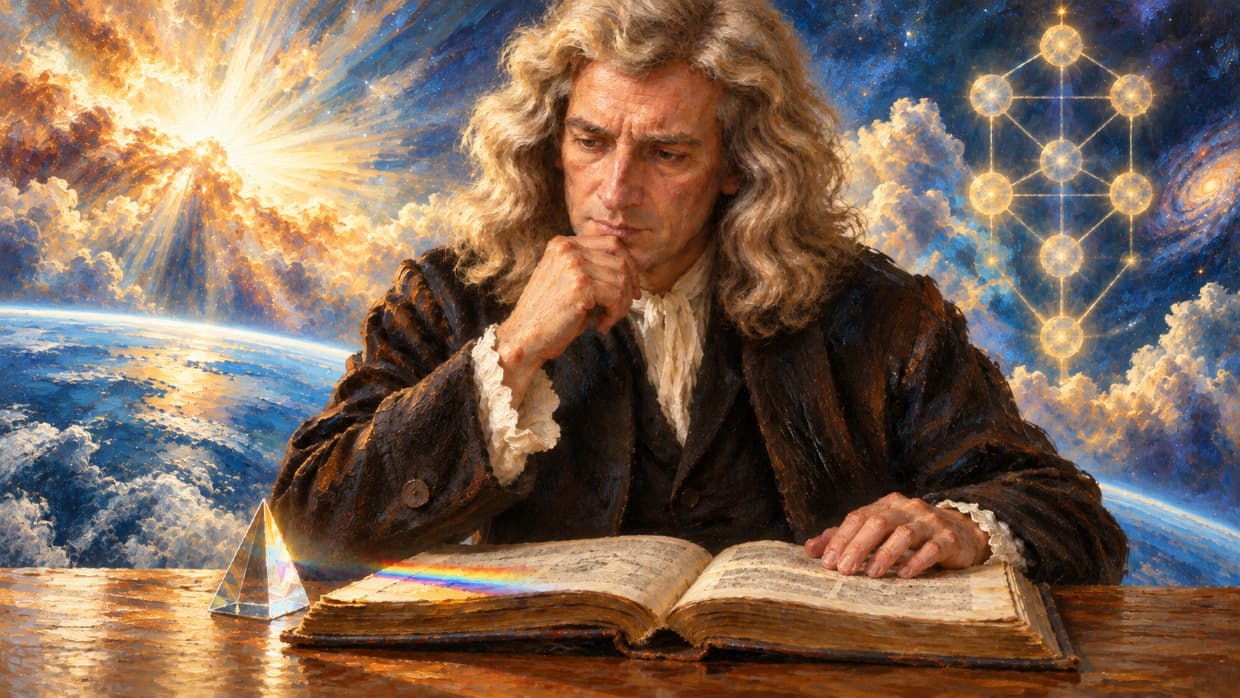
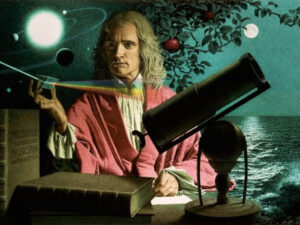
Isaac Newton owned more books on theology than science, including a Latin translation of Jewish mysticism. What he found there changed how he saw the universe.
The story of the Tree of Knowledge occupies just 25 verses in the Torah. Beginning in the third chapter of Parashat Bereshit, the story of Adam and Eve eating from the tree quite literally changes the course of humanity.
Here is the basic synopsis: Following the story of Creation, the Torah presents the story of Adam’s sin, which begins in the final verse of the second chapter: “The man and his wife were both naked, but they were not ashamed” (Gen. 2:25). Enter the snake. Despite God’s earlier warning that eating from the Tree of Good and Evil will surely cause death, the snake reasons to Eve that God is just trying to prevent Eve from becoming like God. Eve eats from the tree and proceeds to feed Adam as well. Immediately afterward, in chapter 3, Adam and Eve’s “eyes are opened” (v. 7) and they realize they are naked. After fashioning clothes for themselves, Adam and Eve hear the sound of God “walking in the garden” (v. 8). God calls out to Adam and Eve, “Where are you?” (v. 9) They hide. Eventually, Adam and Eve acknowledge their sin, and God curses them, respectively with the pains of labor and the difficulty of childbirth. The story concludes with their banishment from Eden.
There are many questions that the commentaries ask about this story. What was the sin of Adam and Eve – was eating from the tree such a big deal? How could Adam and Eve have sinned? They were just created! Why did Adam and Eve sin? Didn’t they realize how dire the consequence would be?
These are all very important questions, but there is one crucial question that is too often overlooked: When did Adam and Eve sin?
As we will explore, this may be the most foundational question to the very roots of human history and the different worldviews that continue to animate society. In order to better understand the significance of this question, let’s talk about the role of Jewish thought, particularly Kabbala, in the Scientific Revolution.
When Isaac Newton died, there was a curious dilemma. The famed scientist, associated with ushering in the Age of Enlightenment, left behind boxes of books and manuscripts. Yet judging from his library, he seemed anything but enlightened. Newton had more books on theology than any other subject. As explained by Professor Matt Goldish in his eye-opening book, Judaism in the Theology of Sir Isaac Newton, his library was filled with books on religion, particularly Judaism, including translations of Maimonides’s Mishneh Torah and a recently published translation of Kabbala into Latin called Kabbala Denudata.
People quite literally thought Newton had gone crazy. Newton’s religious writing had trouble finding a home.
When his theological writing was offered to major universities – Harvard, Yale, Cambridge – they all declined. They were concerned that Newton’s fascination with religious thought would upend the more classical view that scientific thought meant the abandonment of religious ideas. Newton’s library and writing told a different story.
People quite literally thought Newton had gone crazy. Newton’s religious writing had trouble finding a home. As described in painstaking detail in Sarah Dry’s The Newton Papers: The Strange True Odyssey of Isaac Newton’s Manuscripts, Newton’s theological writings were at best overlooked or at worst deliberately hidden in order to preserve his rationalist reputation. Newton left no will and no children. Eventually, most of his manuscripts were put up for auction. The bidding was lackluster.
Two people made it their mission to buy and disseminate Newton’s theological writings – famed economist Lord Maynard Keynes and Israeli polymath Abraham Yehuda. After purchasing Newton’s writing at auction and examining their contents, Keynes was stunned. He later wrote in his essay, “Newton, the Man”:
In the eighteenth century and since, Newton came to be thought of as the first and greatest of the modern age of scientists, a rationalist, one who taught us to think on the lines of cold and untinctured reason.
I do not see him in that light. I do not think that anyone who has pored over the contents of that box which he packed up when he finally left Cambridge in 1696…can see him like that. Newton was not the first of the age of reason. He was the last of the magicians, the last of the Babylonians and Sumerians, the last great mind which looked out on the visible and intellectual world with the same eyes as those who began to build our intellectual inheritance…
Why do I call him a magician? Because he looked on the whole universe and all that is in it as a riddle, as a secret which could be read by applying pure thought to certain evidence, certain mystic clues which God had laid about the world to allow a sort of philosopher’s treasure hunt to the esoteric brotherhood.1
The greatest teacher of Jewish history I ever had was Professor Elisheva Carlebach, Salo Wittmayer Baron professor of Jewish history, culture, and society at Columbia University. She also taught classes at Yeshiva University’s Bernard Revel Graduate School of Jewish Studies. I studied the Enlightenment period in Jewish history with her. She once asked the class, “What was the signature contribution of the Scientific Revolution?” Students gave all sorts of answers – more rationalism, more access to information, better scientific theories – all of which are correct, but she instead shared a basic feature that surprised us all. It was about horses’ teeth.
Imagine, Professor Carlebach explained to us, you were trying to figure out how many teeth a horse had. Previous generations would make suggestions based on their conceptual priors. A horse should have ten teeth because ten is a perfect number. No, others would argue, a horse should have fifteen teeth because the number fifteen has horse-like qualities. It was not until the Scientific Revolution that scholars insisted on actually counting horses’ teeth. Of course, this debate never happened, but her story highlights the shift toward empirical experimentation that characterized the Scientific Revolution.
And this may help us better understand why so many scientists were so fascinated by Jewish thought.
Christians have long been fascinated with Jewish scholarship. For most of the medieval period this interest was primarily in order to convert or disprove Jewish beliefs. In the Early Modern Period a new motivation arose for Jewish studies among Christians, namely to help them formulate their own ideas. A movement known as Christian Hebraism developed that took more interest in rabbinic texts in the hopes it would point a way toward a more pure and pristine version of Christianity and religion. Figures such as John Lightfoot and Johannes Buxtorf immersed themselves in rabbinic literature – in the original Hebrew and Aramaic – in order to better understand their world. Lightfoot even looked to the concept of Sanhedrin to better consider how Parliament should function.
One book was particularly popular among scientifically minded Christian Hebraists: Kabbala Denudata, the Latin translation of Lurianic mysticism known as Kabbala. Translated by Christian Knorr von Rosenroth, the work was eventually disseminated throughout Europe by the itinerant scholar Francis Mercury van Helmont. One of the most fascinating books I have ever read, The Impact of the kabbalah in the Seventeenth Century: The Life and Thought of Francis Mercury van Helmont (1614-1698) by Professor Allison Coudert, details how Van Helmont’s travels impacted the Scientific Revolution. A copy of Kabala Denudata was one of many Jewish books that found its home in Newton’s library. Newton likely never even had a serious interaction with a Jew, but he was fascinated by Judaism. While he may have been a skeptic of Kabbala – he debated its merits with his co-founder of Calculus, Leibniz – he saw something within Jewish thought that motivated rather than hindered his curiosity.
What attracted these scientists to Lurianic mysticism?
Coudert explains:
The Lurianic Kabbalist could not retreat into his own private world. He had to participate in a cosmic millennial drama in which his every action counted. The Lurianic Kabbalah was the first Jewish theology which envisioned perfection in terms of a future state, not in terms of a forfeited ideal past, and as such it contributed to the idea of progress emerging in the West.2
Like the new spirit of experimentation ushered in with the Scientific Revolution, Jewish thought also saw perfection as a future state rather than a forfeited past. No longer would scientists sit back and contemplate the universe; instead, they would proactively search and explore to find meaning within the grand riddle of the universe.
This brings us back to the question of “When?”
The Torah is deliberately ambiguous about when the story of Adam and Eve eating from the tree took place. A plain reading of the Torah seems to indicate that it happened after the story of Creation. Meaning, God created a perfect world and only afterward was the world corrupted by mankind.
The Talmud, however, is very explicit: The story of the Tree of Knowledge is a part of the Creation story. It took place, according to the Talmud, on the Friday of Creation (Sanhedrin 38b).
This presents a radically different worldview. If the story of the Tree of Knowledge is a part of the Creation story, that means that the world was not created with perfection – that task remains the responsibility of mankind.
If the story of the Tree of Knowledge is a part of the Creation story, that means that the world was not created with perfection – that task remains the responsibility of mankind.
I was once invited to a conference on sin that was supposed to take place in Eichstätt, Germany. I hoped I was invited because of my book, Sin*a*gogue: Sin and Failure in Jewish Thought, which expounds on many of these ideas, rather than my reputation as a sinner. Either way, the conference ended up taking place virtually due to Covid, but I presented the talmudic dating of the story of the Tree of Knowledge to my fellow panelists, each of whom was representing a different faith tradition. One of the Christian scholars gasped, “That is impossible!” So much of the traditional Christian worldview, most notably their approach to Original Sin, assumes the world was created perfectly and it was only mankind that corrupted it.
This Christian scholar then asked me a fantastic question: How could this story have taken place as a part of Creation if, at the end of the sixth day, when this story supposedly occurred, God looked at the world and said it was “very good”? (Gen. 1:31) Surely a world that just experienced such a catastrophic sin should not be described as good, no less, very good!
It is a fantastic question because it gave me new insight into the interpretation of the Midrash (Genesis Rabba, Petihta 9). On the only day of Creation that is described as “very good,” the Midrash actually interprets the word “very” to refer to the creation of the evil inclination. “Very,” according to the Midrash, highlights the subjective rather than objective perception that clouds mankind’s judgment. It is a very good question with a literal very good midrashic interpretation.
Perfection, according to the Jewish tradition, always lies in front of us. It is not a forfeited state but one that needs to be created and recreated within each generation.
A common refrain within the liturgy of the High Holy Days is a prayer from the book of Lamentations: “Bring us back to You, Lord, and we will come. Renew our days to be as they once were (kedem)” (5:21).
To “renew our days to be as they once were” is a somewhat contradictory request. Days, presumably, can either be old or renewed – how can we ask for both? Based on this seeming contradiction, the Midrash reinterprets the term kedem; it is not referring to an antiquated time, but rather it refers to a place. The term kedem, explains the Midrash (Lamentations Rabba, Petihta 5), refers to the Garden of Eden, which in the Torah is referred to, on two occasions, as kedem. Curiously, when demonstrating the association between the word kedem and the Garden of Eden, the Midrash ignores the first reference in the Torah, which reads, “The Lord God planted a garden in Eden, in the east” (Gen. 2:8), and instead chooses the second reference to the Garden of Eden as kedem. The latter reference, “He drove out the man, and he dwelled east of the Garden of Eden” (Gen. 3:24), does not refer to Adam’s idyllic residence in the Garden, but rather his exile. Why does the Midrash, when interpreting our plea to “renew our days to be as they once were,” skip the first reference to the Garden and instead read our prayer as a reference to Adam’s exile?
A dear friend, R. Dr. Simcha Willig, showed me a remarkable interpretation of our prayer to “renew our days of old,” from R. Rob Scheinberg. His words:
The word “kedem” in Genesis 3:24 is not a word associated with the Garden of Eden itself, but a word associated with the exile from the Garden. The decision to quote the word “kedem” from this verse, rather than from 2:8, indicates that, from the perspective of this quotation from Eikhah Rabbah, “hadesh yameinv ke-kedem” does not mean “renew our lives as they were in the Garden of Eden.”
Rather, it means, “Renew our lives, as you renewed our lives aher we were exiled from the Garden of Eden.” “Kadesh yameinv ke-kedem” is then not a plea for restoration of a formerly perfect condition, but rather it is a plea for resilience, a plea for the ability to renew ourselves after future crises and dislocations, just as our lives have been renewed before.
As Elie Wiesel said, “God gave Adam a secret – and that secret was not how to begin, but how to begin again.”3
Similar to the Lurianic shift in perspective, the focus of the story of the Tree of Knowledge is not about reclaiming a utopian past, but having the resilience and grit to create a more perfect future. We did not forfeit perfection with Adam’s sin, but assumed the responsibility to create it ourselves.
Excerpted from I Read This Over Shabbos: Reading Jewish History in the Parsha, Maggid Press







EXCELLENT! Spot on! The process is not about untaintedness it is about reconnecting and reconnecting and reconnecting.