




 When Ms. Rachel "Likes" Antisemitism


10 min read
14 min read


7 min read


San Diego Comic Con celebrates Will Eisner’s groundbreaking graphic novel that is more relevant than ever.
One of the most interesting panels at San Diego Comic Con was a discussion on the iconic Jewish author Will Eisner, one of the earliest cartoonists to work in the American comic book industry, who often wrote and drew graphic novels about Jewish characters.
Having dealt with antisemitism growing up and during his career, Eisner constantly worried about the rise of Jewish hatred.
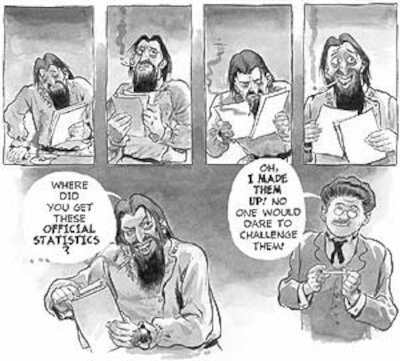
His last graphic novel, “The Plot: The Secret Story of the Protocols of the Elders of Zion,” was finished prior to his death in 2005. The comprehensive book was a provocative account of the making, and refutation, of the infamous antisemitic hoax, “The Protocols of the Elders of Zion,” a fabricated text falsely purporting to detail a Jewish plot for global domination.
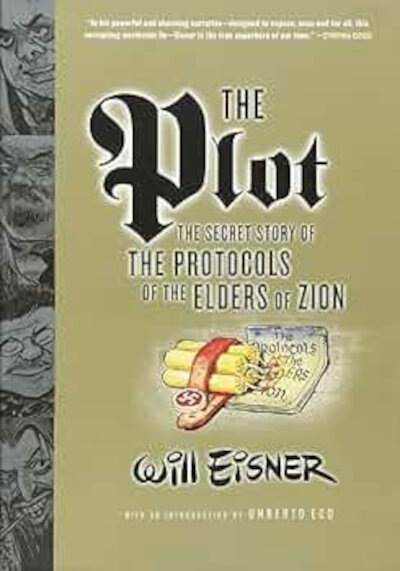
Originally published in 1905, “The Protocols” is still a worldwide bestseller fomenting hatred of Jews.
The panel was the inspiration of Danny Fingeroth, longtime comics historian and author of “Disguised as Clark Kent: Jews, Comics and the Creation of the Superhero.” He is also the Chair of Will Eisner Week, an annual, worldwide celebration of the cartoonist’s work and legacy.
Though sidelined by Covid during Comic Con, Fingeroth appeared in a pre-recorded video interview at the panel with Nicolas Meyer, the writer/director of “Star Trek II: The Wrath of Khan.”
Meyer, who wrote the Sherlock Holmes novel, “The Adventure of the Peculiar Protocols,” cited “The Plot” as being important to his research for the book.
 The Spirit
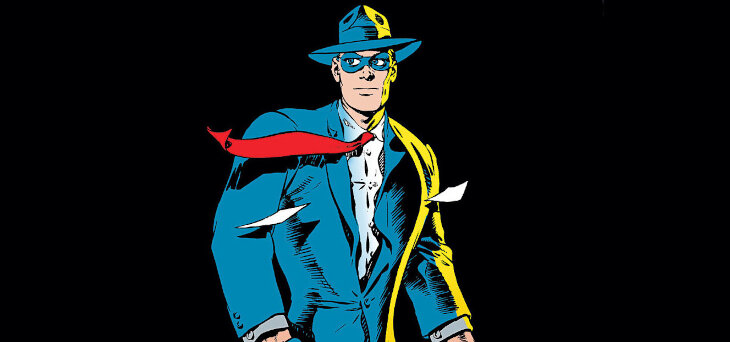
Eisner helped pioneer the modern graphic novel with his iconic character the Spirit, a comic book about a masked crimefighter that appeared in comic book inserts, in newspapers all around the U.S., from 1940-1952, noted Fingeroth.
“The Spirit was known for its innovative, film noir-inspired art and for his dramatic but tongue-in-cheek stories and dialogue,” he told Aish.com. “Legendary cartoonist and screenwriter Jules Feiffer began his career working for Eisner.”
Eisner’s Spirit stories often contained Yiddishisms as well as characters and settings that were straight out of the Jewish Bronx, Fingeroth pointed out. “For example, one Spirit story featured a character named ‘Slim Mazel,’ a play on the Yiddish ‘shlimazel,’ the recipient of bad luck.”
“With his groundbreaking 1978 graphic novel, ‘A Contract with God and Other Tenement Stories,’ and with many of his graphic novels completed over the next 25 years, Eisner often dealt with 20th century Jewish life in America, including the conflicts between immigrant parents and their U.S.-born children.”
Fingeroth said that “A Contract” was among the first longform, comics format to deal with Jewish subject matter.
“Many readers, and Eisner himself, saw him as the graphic novel equivalent of Jewish authors Saul Bellow, Bernard Malamud, and Philip Roth.”
During the panel, Karen Green (Columbia University), moderator Dr. Miriam Mora (Academic Director at The Center for Jewish History), N. C. Christopher Couch (University of Massachusetts Amherst who helped Eisner with “The Plot”), and Roy Schwartz (co-curator and programming consultant for the JewCE: Jewish Comics Experience) discussed Eisner’s history in comics, his use of Jewish narratives, and his influence on the art form.
Mora told Aish.com that she jumped at the opportunity to bring Eisner, and this work of his in particular, back into discussion. “Not only does ‘The Plot’ continue to be important, but it is as valuable a resource for education as it ever was.”
Mora, who is curator of the Museum and Laboratory of the Jewish Comics Experience, said that when reading the book, she remembered being surprised by the ways in which Eisner chose to present his narrative.
“This is not the narrative presented in the false ‘Protocols,’ but the narrative of the story behind the ‘Protocols.’ I knew from the moment I read it that it was a labor of lifelong determination to defend truth and disprove misinformation of the most dangerous kind.”
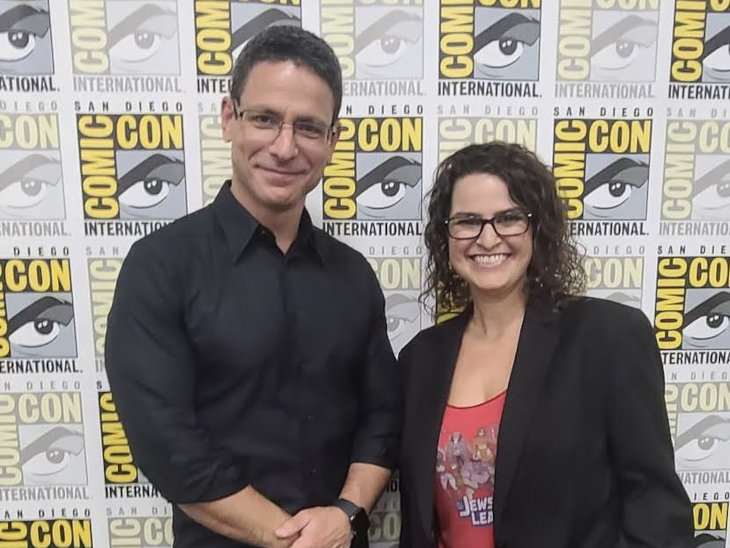 Roy Schwartz and Miriam Mora
Mora stressed the book’s relevance in 2024, not only because of “rising and increasingly visible” antisemitism.
“Not only because it continues to be translated, printed, and disseminated in so many languages around the world. It's relevant because what ‘The Protocols’ promote is a specific form of antisemitism, one which accuses Jews of maintaining a dark, global, malevolent power. It's a particularly dangerous narrative because it is self-fulfilling: if someone believes in a malevolent Jewish global conspiracy, any defense tends to reinforce their beliefs by using Jewish denial as evidence of their deviousness.”
She continued: “By pointing out the actual origin of the original text, Eisner attempts to cut the lie off before it is able to fester, pointing out how it was originally published about an entirely different (non-Jewish) malevolence in France.”
Mora hopes that convention attendees left “eager to reread or read the book” for the first time, and “with a new appreciation for the tremendous labor it was for Eisner.”
“I think many of them may not have considered the personal journey that not only brought him to the project, but that he included in the graphic novel, drawing himself in, fighting disinformation and trying to speak rationally to the irrational.”
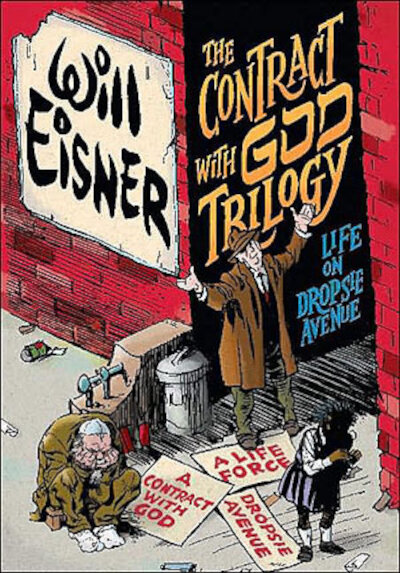
Schwartz, a CNN pop culture historian and critic, described “The Plot” as a landmark graphic novel and a must-read for any serious comic fan, Jewish or otherwise.
“Unfortunately, with antisemitism in the West today being almost as high as on the eve of the Holocaust, raising awareness to this hatred and combating blood libels and misinformation about Jews are more important than they've been in decades,” he asserted.
"’The Protocols’ especially, which is the subject of ‘The Plot,’ are experiencing a revival, thanks to the internet and intentional dissemination by governments of some countries, like Egypt, Syria, Lebanon and Iran,” Schwartz said.
“‘‘The Protocols’ have also mutated into different strains, as various conspiracy theories involving Israel, AIPAC, George Soros, Mark Zuckerberg, etc., which come from across the social and political spectrum, all share the idea that Jews are secretly manipulating the entire world to their own nefarious ends.”
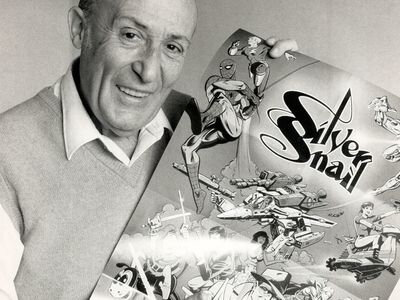
Schwartz hopes that conference attendees also gained a deeper appreciation for Eisner and his “everlasting legacy” in comics.
“Eisner wasn’t just a pioneer of the comic book industry, he was a forefather of the artform. He even gave it its name; sequential art,” Schwartz explained at the panel. “He originated or helped develop much of its visual language. A lot of what we see in comics today, and in pop culture in general, we owe to him.”
Addressing a question in the Comic Con audience, Schwartz said that Eisner’s work was never not Jewish. “Even when he did ‘The Spirit,’ it was suffused with Jewishness. The Spirit ran around what was obviously the Lower East Side, with its narrow alleyways strewn with clothes lines and bubbes yelling across at each other in Yiddish-y accents. His name was Denny Colt, but it was probably really Coltowitch or something.”
As Eisner grew older, his work gradually became more personal and explicitly Jewish.
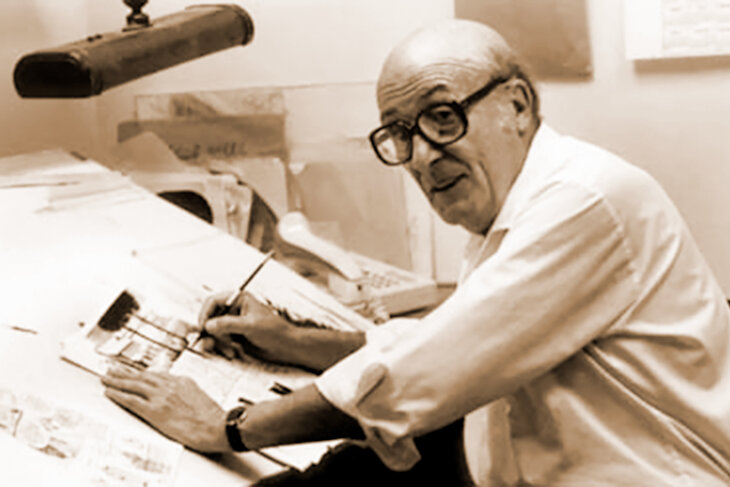
“From ‘A Contract with God’ onward–which by the way, is generally considered the first graphic novel, which is why Eisner is often called the ‘father of the graphic novel’--almost all his work was autobiographical, to different extents, or at least about Jewish subject matter.”
When asked what he hopes readers got from reading ‘The Plot,’ Schwartz said, “I hope they were inspired to stand up to antisemitism and misconceptions about Jews whenever they encounter them, using whatever tools at their disposal, just like Eisner used his art.”











Critics often attribute superhuman (and dark) power to us, while Jewish defenders dismiss this as nonsense, insisting we're just like everyone else. But neither perspective is fully accurate.
We aren’t just like everyone else. The Torah, Bible, and Koran all single out Jews with a unique, God-given role in history, and we’ve been equipped with special tools to fulfill this purpose. A Jew is an 'exclamation point—!' Whatever we do has a unique intensity and innovation. (Take Eisner, who wasn’t just another cartoonist, but the 'father of the graphic novel' and 'forefather of the comic book industry.') Our choice is how to use these tools. Use them for the light of true Jewish spirituality, we gain the world's respect and praise; otherwise, we gain their suspicion. There's no middle ground.
You are absolutely right
I met Will Eisner in the mid-eighties and we kept up a correspondence that lasted nearly twenty years until his passing. Among the things he gifted me over the years was a Yiddish edition of A Contract With God; among the things I sent him was some research material for an adaptation of stories from the Talmud, a project he (sadly) did not end up pursuing. Thank you for this tribute to his legacy.