Click here to buy
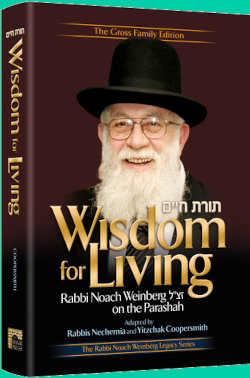
Wisdom for Living
Rabbi Noah Weinberg on the Parashah



10 min read


“I am the Lord, your God, Who has taken you out of the land of Egypt, from the house of slavery” (Exodus 20:2).
The first of the Ten Commandments is to know there is a God. It is also the first mitzvah in the Rambam's listing of the 613 mitzvot. He explains:
The foundation of all foundations and the pillar of wisdom is to know (leida) that there is a Primary Being who brought into being all existence. All the beings of the heavens, the earth, and what is between them came into existence only from the truth of His being.
(Sefer Mada, Hilchos Yesodei HaTorah 1:1)
The Rambam specifically uses the verb “leida” – to know – in explaining our obligation in this mitzvah. But whom is this mitzvah addressing? Someone who does not believe in God does not believe in a Commander, and without a Commander, there can be no commandment. And someone who does believe in God is already fulfilling the mitzvah. Therefore, this mitzvah seems to be either irrelevant or redundant.
Our answer is predicated on the fact that one’s belief in Hashem lies on a continuum of understanding. This mitzvah is speaking to the believer and it is telling him to deepen his belief in Hashem. A belief in God based only on the teachings of one’s parents and teachers must be upgraded. Hashem wants a person to shake off his complacency regarding his belief in God and strengthen this fundamental conviction by independently verifying it.
This is accomplished by establishing a rational foundation to corroborate what you have been taught to believe and accept. Furthermore, by identifying your questions and doubts, and working on gathering the information you need to resolve them, you move your belief in Hashem further up the ladder of your convictions, bringing it to a higher level of knowledge. This is the ideal way to fulfill this mitzvah, as the Sefer HaChinuch explains (Mitzvah 25):
And if one merits to climb the heights of wisdom, and his heart understands and his eyes see the clear-cut evidence that the belief he has believed is true and evident, there being no other possibility, then you he is carrying out this mitzvah in the best way possible.
The first step in upgrading your belief in God is to assess the current strength of your belief, by categorizing it into one of the following four levels of convictions:
Knowledge is absolute clarity based on an overwhelming amount of evidence. For example, we all know we have 10 fingers, and no matter how hard someone tries to persuade us that we have 11 fingers, our conviction will remain unshakeable. This is the level of clarity we should ideally strive to achieve in our belief in Hashem, as outlined above by the Sefer HaChinuch.
The second level of conviction is what we call emunah, belief. It, too, is based on evidence, but it lacks the full clarity of knowledge. For example, you are willing to accept the check of a close friend without concern that it is going to bounce, even though you do not know the exact balance in your friend's account.
The gap between knowledge and belief can be caused either by a lack of evidence or by an unresolved question that undermines one’s certainty.
The next two categories of convictions lack any valid basis for belief.
Every person is raised with a certain set of beliefs, which varies from society to society. People brought up in India believe that cows are holy. Americans growing up in a liberal western society are likely to believe that there are no absolute truths. An Arab born and raised in Gaza is likely to believe that Jews are evil oppressors. Unless they examine the validity of their convictions, these people will remain nothing more than a product of their society, as their beliefs are merely an accident of birth.
It requires a concerted effort to independently think through your beliefs, and it is therefore much more comfortable to just go with the flow of your society and adopt their beliefs as your own.
Blind faith is a conviction based on an emotional or physical desire for something to be true. This form of faith lacks any shred of evidence to substantiate its position. In fact, people who trust blindly are often willing to take a leap of faith that goes against the evidence contradicting their conviction. For example, a smoker might confidently state, “This cigarette won’t harm me,” despite knowing the overwhelming evidence that smoking is life-threatening.
Use these four definitions to help you assess the current quality of your belief in Hashem. Once you have pinpointed where you are at, you can then begin to work on strengthening your belief by either filling in the gaps in your understanding or by seeking answers to the questions that weaken your confidence in Hashem’s existence. Although this may be a bit uncomfortable, confronting your questions will ultimately strengthen your clarity and dispel your doubts, while disregarding your questions guarantees that your belief will never become rock solid.
A student at Aish HaTorah once challenged Rabbi Noah Weinberg with the following question. His sister was traveling with her friend through the American South. They had a terrible car accident, and her friend sustained painful burns all over her body. A born-again Christian came to speak to her in the hospital, and he told her that if she accepted JC as her savior, her terrible pain would end. The friend dismissed him and told him to leave.
The next day the Christian returned and again promised that her pain would end if she accepted JC. In a moment of weakness, she said that she accepted him as her savior, and sure enough, her pain immediately disappeared.
The student then asked Rabbi Weinberg, "If miracles are proof of the existence of God, doesn't this story serve as a proof for Christianity?"
Rabbi Weinberg replied with the following parable:
Imagine that the United Nations convenes an international conference on the existence of God. Leading philosophers and religious leaders from all over the world are in attendance.
In the middle of the discussions, a powerful-looking man walks up to the front podium and demands, "Silence!" The entire building suddenly lifts off the ground.
Everyone is in shock. The man then says, "Watch!" To the amazement of the entire group, the building begins flying all over Manhattan.
"Let's dive under the water now!" he says, and the UN building goes straight down into the ocean. People can see fish swimming by their window.
"Now let's fly into outer space!" The building heads straight up and lands on the moon.
After collecting moon rocks as souvenirs, the man steers the UN building back to earth, where it settles back down on its original foundation.
Everyone is speechless, and the man says to all of the philosophers and religious leaders, "I am God, bow down to me!"
Everyone in the room hits the floor and bows, pleading to him to be merciful towards them. The only person left standing is an old Jewish janitor of European descent who works for the UN. Despite numerous pleas from all the others, he remains standing and tells this powerful man, "Sir, I have no idea how you did what you did, but God you're not."
How can we understand this janitor’s confident refusal to bow down? To answer, let us change the end of the story.
They zoom down from outer space, and the powerful man says, "I am a frog, bow down to me!" Do you think anyone in the room would bow down? Chances are, they would say something similar to what the Jewish janitor said: "Sir, I have no idea how you did what you did, but a frog you're not."
Everyone knows that a human being cannot possibly be a frog, because we all understand what a frog is and what a human being is. The old Jewish janitor has enough understanding of Who God is to know that a human being can never be God, no matter what kind of miracles he performs. But if you do not have a clear definition of God, you are liable to jump to false conclusions, especially when miracles are involved. You might even believe that JC was responsible for her recovery, when in fact there is no logical correlation between the two.
So what is the Jewish definition of God?
There are three primary axioms that define Hashem, and we are obligated to understand and believe each one as part of the mitzvah to know that God exists:
Each of these axioms carries significant implications for our daily lives.
Love is expressed through giving. And the more altruistic the giving, the more it expresses one’s love. When a gift is given with an ulterior motive, it is manipulation, not love.
Since God is infinite and perfect, there is nothing He can receive from His creations. Therefore, His gift of creating life is the purest possible expression of love, and can only be for the benefit of the recipient. We are given the opportunity to develop a personal relationship with the infinite Creator of the Universe, which is the greatest gift possible, and there is absolutely nothing we have done to deserve it. Indeed, as King David stated, “The world is built on kindness” (Tehillim 89:3).
The fact that God is the Sustainer means that nothing in the universe exists independently; everything exists only because Hashem wills it into existence. This implies that it is fruitless to rely on any power or person other than Hashem, because ultimately all these other powers are themselves completely dependent on Hashem. They can only help us if Hashem decides to work through them as His messengers. Therefore, it only makes sense to go to the source; deal with the puppeteer, not his puppets.
God, in His role as Supervisor, orchestrates everything that happens to us. Even trivial events happen for a reason, as the Talmud teaches that even the frustration of having to stick your hand into your pocket a second time to retrieve the correct coin is a lesson from the Almighty (See Berachos 5a).
There are no accidents; everything that happens to us is a personal message from Hashem. He is constantly talking to us through the events that occur in our daily lives. Pay attention and listen.
The Jewish people survived as a tiny minority in a very hostile world for over 2000 years in exile. We clung to our beliefs despite unremitting persecution because we were supremely confident that our beliefs were true. We understood the intellectual foundation for our core beliefs, and that enabled us to reject all attempts to convert us regardless of the terrible consequences we faced. And it is this clarity of conviction that will enable us to survive the unremitting temptations of secular society, and to give over to our children a rock-solid understanding in the reality of God and His Torah.