







 The Shofar: Beyond Words
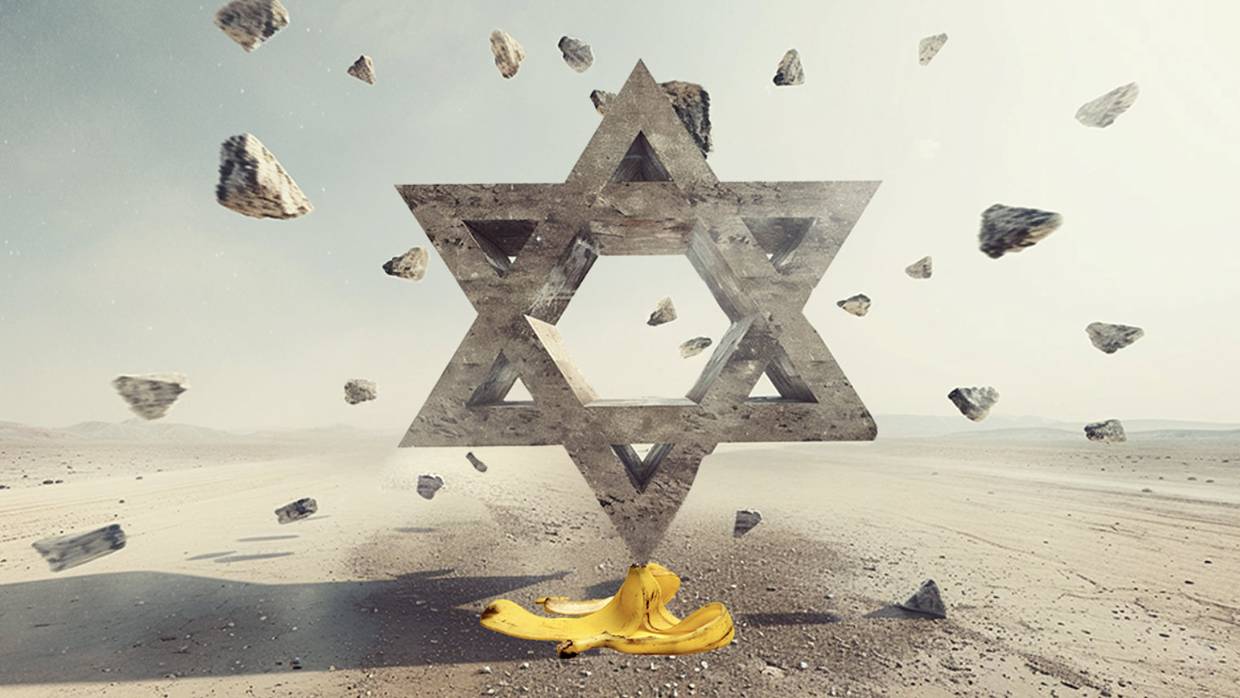






Like Schopenhauer, Judaism believes laughter arises from incongruity and absurdity.
According to ancient Kabbalistic sources, every month of the Jewish calendar is associated with a different aspect of the human experience. The month of Adar, in which the festival of Purim falls, is associated with laughter. What is the deeper significance of laughter and how does it reveal the essence of Purim?
Aristotle and the later philosopher Thomas Hobbes maintained that humor is usually an expression of one’s superiority over another. It arises when one has avoided the pitfall into which the object of the joke has fallen. Sigmund Freud believed that jokes are masked aggression, a way to express violence or hostility toward another in a verbal format cloaked in humor. The philosopher Stephen Fry maintained that every joke is really a communication paradox—like when Yogi Berra famously remarked about a stadium, “No wonder no one comes here anymore; it’s always so crowded.” The German philosopher Schopenhauer believed that humor arose from incongruity and absurdity.
To understand Judaism’s approach to laughter, we need to look at the first mention of laughter in the Torah, which appears in the Book of Genesis (Chs. 17 & 21) when God informs Abraham and Sarah that they will have a child. Abraham was 100 years old; Sarah was 90. Neither was seemingly capable of having children. They were living in the Middle East as an elderly couple, and God came to them with the astonishing news that not only would they have a child, but that this child would carry their heritage of monotheism throughout the world and history.
Their reaction? Laughter. Indeed, God instructed them to name their son Yitzchak (Isaac in English), which means “he will laugh.”
Yitzchak, the first person born as a Jew, is someone whose very name means laughter that is associated with absurdity.
Thus, the first person born as a Jew is someone whose very name means laughter that is associated with absurdity.
When a person encounters something absurd—when a situation seems to be progressing in one direction and then abruptly pivots in the opposite direction—the natural response is laughter. The more incongruous and unexpected the plot twists, the greater the laughter. As Groucho Marx commented: “What is funny? When a gentleman in an expensive suit, walking in a dignified manner, slips on a banana peel—that is funny. When the same dignified gentleman carefully steps over the banana peel only to fall into an open sewer—that is hilarious!”
Historically, the Jewish people have had an excellent grasp of the absurd—hence their renowned sense of humor and legacy of great jokes. Jerry Seinfeld once noted that the predominance of Jewish comedians stems from the fact that Jews have often been outsiders, allowing them to observe life’s absurdities from a detached perspective.
Even the Bible contains examples of Jewish humor. In Exodus (Ch. 14), after God has taken the Jews out of Egypt, they find themselves trapped: the Red Sea in front, the desert behind, cliffs to the north, and the Egyptian army in pursuit. Instead of simply crying out in fear or despair, they say to Moses with a touch of sarcasm and Jewish cynicism: “Is it because there were no graves in Egypt that you have taken us to die here?”
Most people in such a dire situation would likely scream, “Help us! This is terrible! Oh my God!” But in classic Jewish fashion, the Israelites add a biting layer of irony: Oh, is there a shortage of graves in Egypt? Do you have a real estate issue? Is that why you brought us here?
This is clearly absurd. The Israelites had just witnessed ten plagues—miracle after miracle—yet they are now suggesting that this entire exodus happened because of a lack of burial plots in Egypt.
Jewish existence throughout history is, in many ways, absurd.
Maybe the Jews in Egypt were onto something. Jewish existence throughout history is, in many ways, absurd. It began with a child who, by all logic, should not have been born—to elderly parents who should not have been able to conceive. That same child, Isaac, was nearly sacrificed on an altar but was saved at the last moment by the word of God. The knife was literally at his throat, yet he survived.
In a sense, the Jewish people are just like their ancestor Isaac—our very existence is improbable, even absurd. The Purim story reflects this theme perfectly. There are no open miracles, yet there are improbabilities upon improbabilities, absurdities upon absurdities, and plot twist after plot twist.
Iran (Persia) launches an invasion of Iraq (Babylon), toppling the regime and seizing control of the country, along with much of the Middle East. The new Iranian ruler (Achashverosh) initially governs with tolerance, allowing freedom of religion and permitting exiled nations to return to their ancestral lands. However, a second regime change overturns this brief era of benevolence, replacing the ruler with a corrupt and ruthless despot.
Assassination plots against the new tyrant multiply, but one attempt is foiled by a Jewish government official, Mordechai. Meanwhile, the despot’s personal life unravels—his marriage collapses, and he executes his wife in a fit of rage.
Seeking a replacement, he decrees a nationwide beauty contest, compelling women from across the empire to participate. His choice falls on a Jewish woman, Esther, who conceals her heritage while maintaining contact with husband, Mordechai —the very official who once saved the ruler’s life.
Soon, an extremist antisemite rises to power as prime minister, Haman, and persuades the ruler to authorize the annihilation of the Jewish people across the empire. As the decree spreads, mobs of fanatics take to the streets, preparing for state-sanctioned pogroms without fear of retribution.
In a masterful display of persuasion, the Jewish queen wins over her husband the king, convincing him to revoke the order and instead grant the Jews the right to defend themselves. Seizing the opportunity, Jewish communities organize, arm themselves, and crush the would-be executioners, leaving few survivors.
In the capital, additional mobs attempt a second wave of attacks the next day, but the Jewish defenders rise again, defeating their assailants and quelling the massacre. In addition, the prime minister and his sons, complicit in his treachery, are hanged, and the Jewish official is installed as the new prime minister. And, bingo, we have a new Jewish festival of Purim.
We celebrate Purim by publicly reading this story, giving gifts of food to one another, and offering generous donations to the poor, as well as by reciting special prayers. All of these practices are understandable: we wish to publicize the incredible divine providence behind our survival. By sustaining each other, we are doing the exact opposite of what our enemies intended—eliminating us.
But we also celebrate by holding a festive meal, during which we are unusually obligated to drink wine excessively. I believe this obligation to inebriation exists so that we may become attuned to every absurdity we perceive—and laugh at them all.
Although Schopenhauer was both German—a nation not typically associated with hilarity, and a philosopher—a profession rarely steeped in laughter, he may have been right about laughter.
Why do we laugh when we sense absurdity? Because the soul, whose origin is in a world of truth and clarity, recognizes the contradictions of this world as illusions. When it detects absurdity, it experiences a glimpse of its true home—the world of truth—and laughs at the distortions of this transient reality.
The Talmud (Taanit 22b) relates that Elijah the Prophet once informed Rav Beroka that two individuals in the marketplace were so meritorious that they were guaranteed an exalted place in the World to Come. Rav Beroka asked Elijah to identify them, and Elijah pointed to two brothers. Curious, the rabbi approached them and asked what they did. The brothers replied that whenever they encountered people who were sad or in conflict, they would tell them jokes, make them laugh, and bring them joy.
By making others laugh, these brothers were not merely lifting their spirits; they were connecting them to a higher reality, to a world beyond suffering and illusion. In bringing joy to others, they were, in a sense, offering a glimpse of heaven itself. And so, it is fitting that they too were destined to be eternally connected to that higher world.
This may also shed light on why the great Talmudic sage Rava would always begin his lessons with a joke (Talmud, Shabbat 30b). On a simple level, we might say that his purpose was to capture his students’ attention, keep them engaged, or simply put them in a good mood. However, there may be a deeper reason. Perhaps before guiding his students toward intellectual and spiritual enlightenment, he sought to first elevate them emotionally—connecting them, through laughter, to a higher spiritual realm.
In one of his most beautiful psalms, King David writes:
“When God returns the captivity of Zion,
Then our mouths will be filled with laughter,
And we will be like dreamers” (Psalm 126:1–2).
This passage teaches that in the future, at the time of redemption, the Jewish people will be filled with laughter as they look back on their period of exile and suffering. They will realize that all of it was, in essence, a dream—a painful dream, no doubt—but a dream, nonetheless. Redemption, by contrast, will be reality.
Spontaneous laughter is the soul’s reaction to seeing this world, with all its suffering, injustice, and falsehood, for what it truly is: absurd, and therefore laughable.
In this sense, Judaism aligns with Schopenhauer’s understanding that laughter arises from absurdity. However, we would add that the joy associated with laughter—its spontaneous and uncontrollable outburst—is the soul’s reaction to a fleeting taste of truth and clarity. It is the moment when we see this world, with all its suffering, injustice, and falsehood, for what it truly is: absurd, and therefore laughable.
On Purim, as we celebrate the survival of the Jewish people through extraordinary plot twists and uncanny “coincidences,” we begin to grasp the miracle of our own improbable, absurd, and eternal existence.












I believe that Sarah's laugh at hearing she would have a child was the incongruity that her body was becoming younger to enable her to have a child while Avraham's was remaining old. That was why she was afraid to admit that she laughed as it wouldn't be a nice thing to say to Avraham.
Laughter urges the brain to produce Oxytocin, the social bonding chemical that fosters trust and safety. Laughter also changes 'fight or flight mode' to 'rest and digest.' It boosts immune system responses, redirects our brain to focus, and reduces stress hormones. I would think laughter is among humanity's greatest gifts.
The author identifies Mordechai as Esther's husband. For 75 years I thought he was her uncle. Which is it?
Uncle
Even Moses did not know the ways of Hashem, and us human beings don't know how things will unfold in the end like the Purim story did, also a Rabbi said " this to is for the best" even if anything bad happened to him, like when someone missed the Titanic ship and then it hit the iceberg and a lot of people lost their lives, so only Hashem knows what is really going on and us human being don't real see the full picture maybe in some time in the future we will
Mark Twain comment I am paraphrasing I think " Every nation rise up and the fall and they are gone in a puff of smoke every nation are mortal except the Jews they are immortal " my view is Jews are like the mythical bird called a phoenix which get reborn from the ashes, like after the Holocaust Jews that survived the Holocaust went to then Palestine which became the state of Israel that looks like a kind of a rebirth to me
An accurate observation.
There's a thin veil between laughter and crying, as demonstrated in the Chuckles the Clown episode (when he dies) of the Mary Tyler Moore Show. Both are emotional releases. Being Jewish has almost always necessitated such release.
Very true, beautiful thought
GREAT!
Thank you