




 Free Will, God, and the Logic of Choice

5 min read
12 min read
12 min view
4 min read



5 min read


Darwin’s Theory of Evolution remains just that, a theory, despite nearly two centuries of searching for proof of transitioning species. The gaps between all species have only widened.
I wrote What Darwin Didn’t Know, when I, as a physician, realized many people have no clue how complicated the human body actually is, and how we could not have come about by undirected forces and random accidents. Humans are way too complex. There is obvious forethought, foresight, and fore-planning in our design. In a sense, we are a Do It Yourself kit (DIY) with the instructions mostly in our genes.
I believe Charles Darwin was honest but mistaken. He had promised a second book to scientifically prove his point, but he never wrote it. His Theory of Evolution remains just that, a theory, despite nearly two centuries of searching for proof of transitioning species. The gaps between all species have widened. Also, no one has ever seen (or caused) one species to evolve into new species. Groups might get faster, bigger, more camouflaged, or more slippery, but amoebae remain amoebae, rabbits remain rabbits, and monkeys remain monkeys. The determining genes are numerous and extremely complicated. They sometimes jump around and groups can be read backwards Nearly all changes require hundreds of thousands of microscopic and submicroscopic modifications, many of which must occur simultaneously or in tandem.
Darwin didn’t know why a child resembles his parents. He didn’t know that arteries carry oxygen which is exchanged for carbon dioxide at the cellular level; and, then carbon dioxide is exchanged for oxygen in the lungs. Special cells handle these processes.
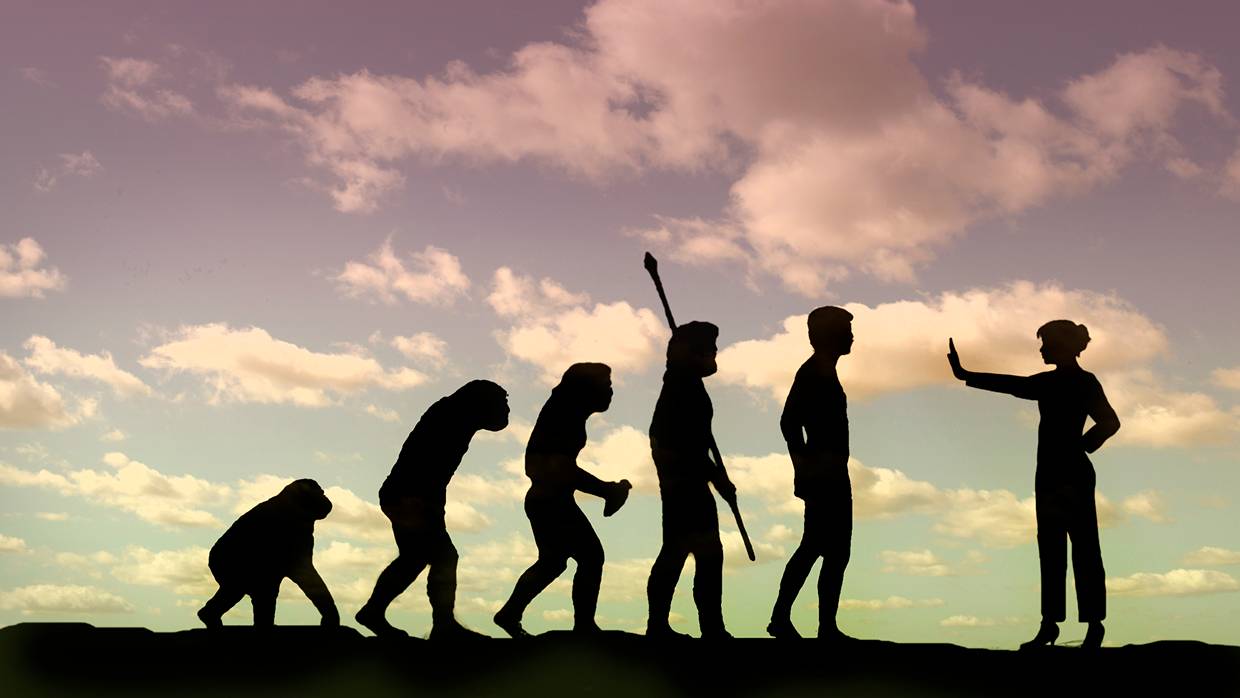
During the nineteenth century, there was a strong craving for an alternative explanation for our presence that did not include a Creator. Darwin’s writings fit the bill and they came at the right time, in the right way. Looking back, they were only speculation. The drawings of a fish crawling out of the sea and progressing through a reptile, an amphibian, a mammal, an ape and finally a human being looked good, but didn’t prove a thing. No one knew how species transitioned from cold-blooded to warm-blooded. Or change from water-breathing animals to air-breathing animals, or from walking types to flying types, or from apes that ponder bananas and insects in scalps to humans who write songs, feel compassion, invent machines and ponder philosophy. None of these are simple steps.
Darwin might have known what a cell looked like (this is debatable, however), but he definitely didn’t know that every cell was a tiny collection of sophisticated factories, twisted chemicals and nano-machines. He couldn’t have known that the nucleus, or the command center, inside each cell was loaded with organized, genetic instructions that could replicate themselves trillions of times. He had no idea how select chemicals carry commands (directions) along nearly invisible highways to different submicroscopic factories throughout the cell protoplasm. Or there are nanomachines that make repairs and untangle any twisted DNA or RNA.
Darwin didn’t know every cell type has a specific function(s). White cells fight infection, pituitary cells in the brain put out growth hormone, especially in the growing years, thyroid cells make thyroid hormone which waxes and wanes as metabolic needs change, and the adrenal gland cells put out cortisol as need for stress and host of other needs. Trillions of nerve cells control everything muscular and memory. Specialized cells monitor blood pressure and signal other cells when the readings are too low or too high to make corrections. Other cells watch the heart rate, oxygen concentration, salt concentrations, kidney function and hemoglobin. None of this came about with random changes. And these are the simple examples.
For argument sake, take a moment to imagine a sudden, fully-melted Antarctica that goes from two settlers to over thirty-five trillion settlers (like cells in a newly conceived fetus) in nine months. Suddenly, multiple cities (organ systems) appear with populations that exceed one billion. There are a seemingly-infinite number of factories. The Capitol (the brain) has thirty-five to a hundred and thirty billion residents and is the governing body. All occupations are present. All institutions and all types of businesses, too. All of these new residents (cells) come from a variety of races, shapes, sizes and ethnic backgrounds. Yet, they all speak a universal language. Each individual is connected to as many as 10,000 other individuals chemically, mechanically and/or electrically.
Next, imagine how much designing/planning has to go into setting up electrical power, arranging grocery and other necessity procurements, starting farms (with support), setting up water systems, arranging telecommunications and other means of communication, digging sewer systems and disposal mechanisms, laying down streets/highways, establishing ways to control traffic, procuring cars and trucks, building homes, high-rises, hotels and shopping malls, etc, establishing rail lines and airports plus servicing, setting up and running multi-level government positions, making and enforcing rules, setting up a postal mechanisms, removing criminals and maintaining jails, arranging for repairs of all sorts, arrange painting of all sorts, cleaning the streets, setting up businesses, and so on and so on…. And all that is child’s play when compared to the creating a human being from day one in utero.
Darwin had no idea the beginning of human life was so complicated. I suspect he didn’t realize having a heart without a way to make red blood cells is useless. Having blood without 66,000 miles of piping for distributing nutrients won’t sustain a life. Having nutrients without a way to hunt them down, bite, chew and swallow them, chemically break them down, and absorb them from the G.I. tract won’t work. One can’t have a clotting system without a way to remove the clot later and heal the wound. And one can’t have spontaneous clotting. One can’t have a muscle system that only pulls and doesn’t push, or no means to fight off infections.
The examples are endless. If he would have known all the things science has revealed to date, one needs to wonder if he would have written The Origin of Species.











According, to Jewish texts I think in the midrash , it says Hashem created many worlds and then destroyed them, until we ended up with this world, and secondly King David in Psalms says people don't know how Hashem measures time a day can actually be a thousand or million of years, this seems to solve the debate of evolution and creation in my view, we don't how many years( it could be millions of years) between different world until, creating this world which is 5786 this Rosh Hashana, I think the rabbis would agree with my theory which I read or heard about, did any other religious people hear this fact which seems to shed light with the debate who is right and who is wrong about science and religion
Dr Simmons, please familiarise yourself with modern Biology textbooks and scientific articles discussing the evolutionary processes within populations. Merely listing the complexities of the human body will not dismiss the wealth of evidence supporting the scientific theory of evolution. Charles Darwin was correct in his conclusions, and he established the unifying theory of modern Biology that kick-started the development of important sub-discplines. Moreover, thousands of evolutionary biologists have deepened our understanding of evolution over decades to answer questions even beyond Darwin's understanding. Oh, and I'm sure you know that Albert Russell Wallace discovered the theory of evolution by natural selection independently!
With respect to the doctor’s amazement and stating the obvious in the complexity of the human body, he offers nothing in return but being critical of a, whether in part or in full, theory and very possible explanation of how we got here and how we and animals have survived. Darwin seems the closest we have come to an explanation. I think the author is coming from too much a religious and biblical argument than a scientific one. I believe they can survive together. Not one or the other. Anyone can be critical but then one must offer a real and better argument. To me Darwin makes a tremendous amount of sense at least until proven otherwise.
If Darwin's observations would have enlightened him. He would have also observed that - as I've stated before - in a home vegetable garden - also in the forest. in the same surrounding ground - if you plant the seed - of any vegetable - or in the forest - the seed of any tree. You will see that - a watermelon - NEVER BECOMES A RADISH - A TREE - A CARROT - NEVER BECOMES CELERY - A PINE TREE - DOESN'T BECOME A GIANT REDWOOD. In the animal world - breed a cat - & it doesn't become a mouse - or a horse. Humans - don't become elephants or birds - etc.. I wonder how that occurs - without the control of an intelligent being - LIKE - G-D - who the Written Torah Tells us - G-D CREATED - & ONLY IN 6 DAYS. When the earth was just the continent of PANGEA - MAN - invented ALIEN DEITIES.
Nice article.
I would refer readers to the fantastic book "Darwin's Black Box" along the same lines of this article.
Sam, you have much to learn in modern biology...
Thanks
I be neither scientist nor philosopher but none has answered the simple and obvious question of the chicken and the egg???
It's not which came first. They both came at the same time, just as the male and female human being. Nothing else makes sense. I have a whole article on this precise question. Goggle: Evolution News Geoffrey Simmons and scroll for this topic. I have related articles here at Aish Go to the bottom of the article where it shows an old pic of me and click on more articles by me
"if... would have" is not English.
Any other thoughts on the article?
An article "If the Bible Writers Would Have Known" would have been more beneficial to Jews trying to find their way in the modern world. Frankly, I think that your denialism is embarrassing for Jews like me who accept the fossil evidence of millions of years of hominid evolution that you seemingly don't.
As some other comments suggest, I believe that your confusion arises from a basic misunderstanding of evolutionary history. To be sure, there is a theoretical aspect to our understanding of this history as we try to connect the datapoints. There is disagreement among experts about specific details and some theories have been discarded based on fresh evidence, but that is not a rejection of the fact that there IS an evolutionary history leading to the modern species of humans.
Aside from your blasphemous comment about "Bible writers" (which contains a grammatical error, BTW), you ignore the fact that prestigious, non-religious scientists have discredited the theory of evolution, which was never more than a theory.
The diehard proponents of this pathetic attempt to justify a godless universe are those who, like you, refuse to consider the possibility of a Creator (most likely because they can't abide the mere thought of the responsibility this imposes on them).
What is ironic, Barb, is that you are blind to your own blasphemy. Religious people who think that they can speak on behalf of God or who make claims about knowing the unknowable, they are the blasphemous. Prophets who make claims about God's words or intentions are either delusional or fraudsters. Religions like Islam are built on such blasphemies.
I am not an atheist. It is false prophets that I don't believe in. People who parrot false prophets are the blasphemers... and I know you agree with me because, you, too, reject false prophets, just not enough of them!
Thank you--this is a (tragically) common error in grammar. I don't understand why English-speaking people use "would have" for "had "
If there is something you don't understand, then you should study it!
"Would have" is appropriate because the premise of the article is conjectural. First, there was no way that Darwin could have known the facts cited, and, second, the author is projecting what Darwin would have written had he known.
What is important to note about the article is that the author is attempting to speak on Darwin's behalf but draws a conclusion that isn't supported by the argument.
I think the author doesn't understand a few concepts. First: a theory remains a theory until disproved. The author isn't looking at organisms as a whole but at the appearance of the human. So let's go there. The human is larger, stronger, less teeth imbedded, larger brains, and greater genetic diversity than just 1000 years ago. Humans live longer today than 500 years ago, but live less years than 3000 years ago.
What the author is not aware of is that God designed each organism to modify itself according to its surroundings and evolution merely describes the path the organism had taken and trend the path the organism may take into its future.
Think of it this way: How accurate would a comparison be when comparing an apple to a pineapple.
There’s so much to unpack here. Evolution is a theory only not a fact as some would you. Animals can change to adapt but they cannot change into a new species. It’s way too complicated. Maybe read my articles already published by Aish after my biography and/or my two books also mentioned therein for further informan. Maybe read The Cambrian Explosion. Authors that might help are Behe, Jonathan Wells and Stephen Meyer. And there are many others. We all believe there’s an Intelligent Designer. The Science actually supports that
I think it is important to differentiate between was is fact and what is theory. Facts are what we observe. For example, we observe that the weather changes seasonally... that's a fact. We also observe that the sun rises to a varying zenith over a 365+ day cycle ... also a fact. That these two facts are related is a well-accepted scientific theory. We don't "prove" theories; we "test" theories to see how useful they are in explaining what we observe. Some theories have proven to be more accurate than others.
Because we have observed that organisms change from generation to generation, evolution is a fact. How genetic mutations (another thing we have observed), or perhaps other factors, relate to these changes is a matter of scientific investigation and theory.
To contrary we have NEVER seen one species or organism change into another. We can't make it happen, either.Only modifications that are likely in their toolbox, like painting a cr a new color or adding a new addition to a house.
If you begin by assuming that evolutionary change is impossible, you will conclude that species can't evolve. That's an example of a circular argument.
In another comments, you admit that it takes many changes (why do you ASSUME "thousands"?) before species can be differentiated, but you ASSUME that they would have to be SIMULTANEOUS changes; again, beginning with an assumption that can only lead to your conclusion.
In another comment you mention the Cambrian explosion and the "sudden" onset of new species, but this was a period of millions of years; a period during which millions of changes were possible.
You are parroting arguments from decades ago which were thoroughly debunked then and have been further debunked with new discoveries, particularly in genetics.
How ironic that you accuse another of circular reasoning, particularly since your own words can be used against your pro-Darwinian evolution argument!
While most phenomena can be said to evolve (including language), your use of the term reveals a sort of fanatical fervor, thereby disqualifying any objectivity on your part concerning the theory of evolution.
No, Dr Simmons. We have countless recorded examples of speciation, both in the wild and in the laboratory.
It's preposterous to define facts as phenomena that we observe since we cannot necessarily rely on our observations -- especially not when they're tainted by our prejudices!
Ergo, one can always "test" theories to ensure that the outcome is in line with a desired presumption.
The primary purpose of the theory of evolution is to deny God's existence. I love when people use ridiculous terms like :settled science", which means nothing other than what science currently believes. For example, "science" believed the world was flat for most of the world's existence. The also used to believe in things like continental drift and the supposed safety of nuclear power which we now know is untrue.
Going back to evolution, they used to believe in gradual mutation until they realized this couldn't possibly be true. Thus, they came up with the current idea of sudden mutation. The fact that there is not only zero proof of this or that is no "missing link" is something that is just dismissed in the road to atheism.
It’s not just one or two mutations but thousands simultaneously or more. To change a species in some good way. I agree with most of which you say. Not so sure about continental drift. Thanks
We actually *have* seen evolution in progress. Here are two examples.
Researchers in Russia have taken wild wolves then interbred the ones that are most tolerant of humans. After about 4? generations, the resulting ones are practicably indistinguishable from domestic dogs, including the fact that they developed floppy ears!
In another example, researchers exposed lab mice to an Almond odor before sending a small electric current to part of the floor. They found that the mice developed more odor detectors in the nose for this smell, *and* this trait was passed down to their children and grandchildren, even though it had nothing to do with DNA. Maybe RNA.
Interesting it that is not a change in species. Look up the Cambrian explosion. Sudden onset of dozen of new and different species. Defeats r the Darwin tree of life.
Surprised you didn't pull out the good old "antibiotic resistance" card -- it's happening almost in real time and it's having real effects.
The title of this otherwise excellent article grates on the ear (of an editor, anyway!).
It should say: If Darwin Had Known.
Likewise, the closing sentence should read: If he had known all the things science has revealed to date, ...
I'm confused. You wrote: "The gaps between all species have widened." Therefore, you admit that species are evolving away from each other, which implies that, in the past, species were more similar. Going further then: in the distant past, there is no reason to doubt that the ancestors of species which are seen as different species today were so much more similar that they were, in fact, the same species.
What is it that you are trying to refute?
I agree. Anyone who thinks evolution involves a monkey becoming a human being clearly doesn't understand anything about evolution.
Agree
Exactly. Species change into different species - there isn't an "end point", so therefore there isn't a "transitional species", as that implies the species has a defined start and a defined completion. If there was one type of finch that flew to an island and now there are ten, which is the "final boss finch"? None of them, as they all fill a different niche. One can describe the genetic distance between them, and between each and the ancestral finch, which then implies that they've evolved...
Every species have ranges of changes. A finch can change beak shape and or size. That isn’t evolution. Natural forces impact a species toolbox and some can change appropriately
Just the opposite. There are more and more things that need to change especially on the microscopic level. Read my book and/or read Billions of Missing Links, my sequel
With all due respect, I think that you have undermined your own argument. You have acknowledged that species evolve but, at the same time, you assume that each species must have had a distinct starting point. However, a species that leaves a point had to arrive there in the first place.
There are no "transitioning species " as in missing link talk. We all vary given the probabilities in shuffling the gene pool. That is the point as contexts change whether by climate or asteroids. When the Melankovich and other cycles rotate the ice ages and the volcanism and mantle currents move the continents around those varieties of species best adapted survive and those not so, not.
You should be more humble before the fact that Moses and our other ancestors did not have the instruments and maths that we do.
With respect, what is said here of the human body is true for every mammalian species and indeed most animal species on this planet. I suspect that opposition to the evolutionary theory (which has plenty of supporting evidence within the parameters originally established) comes from the term “random” used to describe evolutionary changes. But this word should be understood in context to human predictions, not in the sense of meaninglessness. Humans cannot predict when or where mutations occur but the Creator can certainly direct and cause changes in accordance to divine purposes.
It is indeed a challenge for the human mind to comprehend the scope and scale of randomness in the world. The number of random events that have occurred while I was writing this short comment is virtually inconceivable. Regardless of this challenge, I believe that it is well worth the time and effort to try to comprehend in whatever way we can the immense impact that randomness has on our lives and such effort would be far more valuable than the pointless contemplation of the possibility of an unknowable divine purpose.
Sure, if you insist on a (hefker) world without a Creator, then randomness will get you nowhere fast!
It takes humility to admit that not everything in this universe is "knowable" to mere mortals.
And it takes clear, unbiased vision for a truth-seeking mortal to realize that this world was given to us as an opportunity to strive to improve both ourselves and our environs.
What a pity to waste one's time on earth living "randomly"!
There is incredibly strong evidence there is a Designer afoot
Randomness plays some role but there is clear cut design ( incredible design) found in the information placed in the DNA and RNA
I would argue that randomness, along with time, are the most important elements in "the incredible design". Would it even be possible for life to exist in a world without randomness? If we can marvel at the incredibility of DNA, what stops us from marveling at something even more incredible: the mechanism, randomness together with billions of years, that created DNA? It is so marvelous and incredible that we have difficulty contemplating its implications. Yet, everything about our lives is driven by it!
To the contrary, with all due respect, there are no facts to support evolution
What Darwin observed is that a given species, if without competition, will fill all available ecological niches. The finches on Galapagos Island became many specialized subspecies - variants - but they did all remain finches. Rather like the many different breeds of dog.
The idea that one species evolves into a different species is an extension of the theory not fitting into the original parameters.