







 Those Shameful Thoughts and What They Really Say about You





Empires that conquer space collapse, while a people who sanctify time endure.
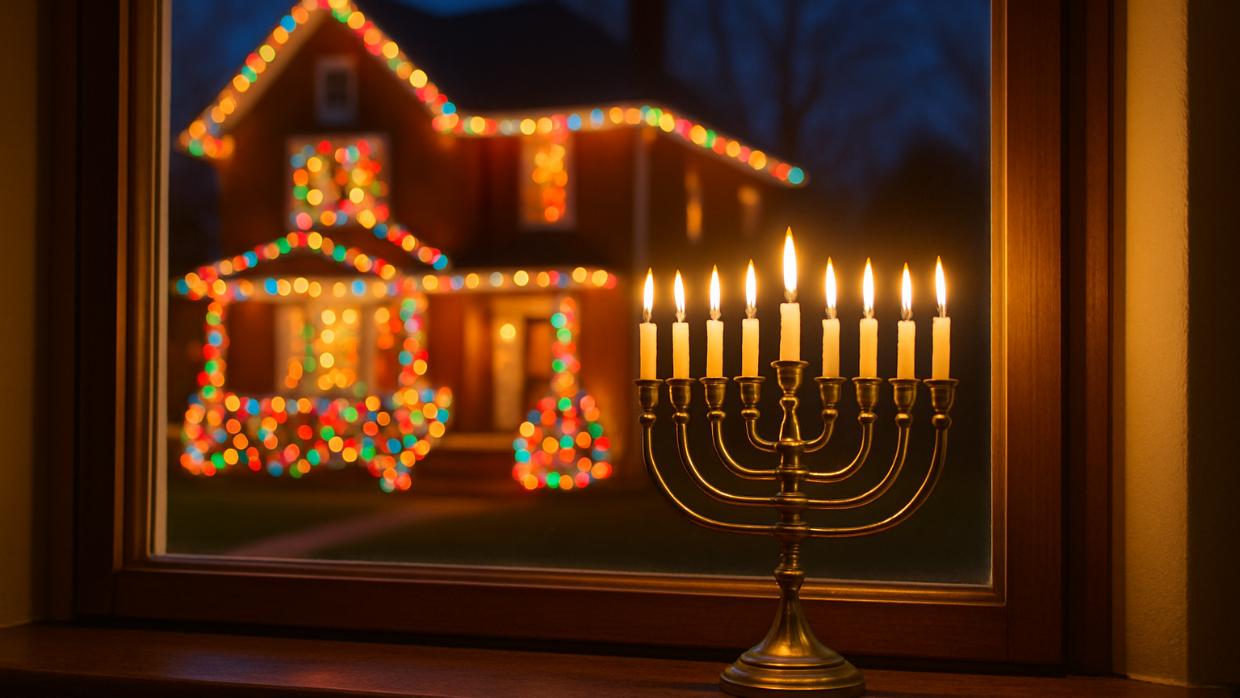
Walk outside on a late December night and the contrast is hard to miss. Neighborhoods are lit up with displays, colorful and bold, each one louder than the next. And then, in a single window, a menorah flickers. The flame is small and steady, but somehow it draws you in differently. There is a weight to it that seems disproportionate to its size. How is it that something so modest carries what all that spectacle cannot?
The answer begins with a phrase at the heart of the Hanukkah story: rabim b'yad me'atim, the many delivered into the hands of the few. On the surface, this was a military miracle, a small band of Jewish fighters defeating the mighty Greek army against impossible odds. But a deeper look holds a different clue about an idea that shaped history and still speaks today.
Greece was the superpower of its age. Big armies, visions of conquest, territory expanding across the ancient world. To be large is to expand, to be seen. Greece built stadiums you could see from miles away, theaters carved into hillsides. Everything was visible, projected outward.
Armed with this expansive vision, Greece marched onwards to conquer the ancient world, filling space while destroying what others have built. So when Greece met Israel, the outcome seemed obvious. Greece saw the Temple, a grand building, a revered space, and knew exactly what to do. Defile its precious space and the Jews will fall. They had done it before. Topple a nation’s monuments, and its people crumble with them.
To sanctify time is to meet God where no army can follow.
But here was the Hanukkah surprise and even the Jews may not have seen it coming. The sacred didn't vanish; it moved, from the grandeur of the sanctuary to the smallness of every Jewish home. And within the home, something smaller still: a moment in time. The Temple could be desecrated. A moment cannot.
This was Israel's hidden strength: homes built not with stone, but with moments in time. Shabbat isn't a where; it's a when. To sanctify time is to meet God where no army can follow. That's why a Jew in Babylon could keep the same Shabbat as a Jew in Jerusalem. No Temple required. You can lose your home, your country, your Temple. You cannot lose Shabbat.
This is why Greece targeted the specific mitzvot of Shabbat, brit milah (circumcision), and Rosh Chodesh (sanctifying the New Moon). What do these share? Each sanctifies time. The seventh day of the week, the eighth day of a boy's life, the first day of the month. Hanukkah itself touches all three: eight days, always containing a Shabbat and the first day of a new month, Tevet. These are moments no army can occupy.
This is the deeper meaning of rabim b'yad me'atim, the many delivered into the hands of the few. For while the many fill space, the few sanctify time. Victory lies not in a single battle, but living with faith through time and over time. Returning each week to Shabbat, each month to the new moon, and passing it forward across generations.
In the end, time belongs to those who sanctify it. And when you sanctify time, time gives back. One night's worth of oil burned for eight. The cruse stayed small. Time opened up. This is where miracles live.
So while the Christmas lights dominate lawns and storefronts, filling space with color and noise, the menorah works differently. A window is enough, a table, a home.
Israel also needs space, but not space that dominates. Space that holds. The flame sanctifies the smallness of time, and in doing so, makes the small space holy. A window becomes sacred, a home becomes a temple.
Night after night, it grows and glows. Not with loudness and brightness, but with the truer power of patience and humility. This is the shine that spectacle can never hold.
Empires filled the ancient world, built large to outlast time, and failed. But Shabbat keeps arriving and the new moon keeps appearing. And the flame that was lit in Jerusalem over 2,000 years ago is still being lit during Hanukkah, in your city, in your home. An enduring light that refuses to be drowned out by size, by power, or by noise.









Thank you: this is wonderfully inspiring, because it's true!
Beautiful way of looking at things I like it