




 Dostoevsky Was an Antisemite. I Still Think You Should Read Him


6 min read


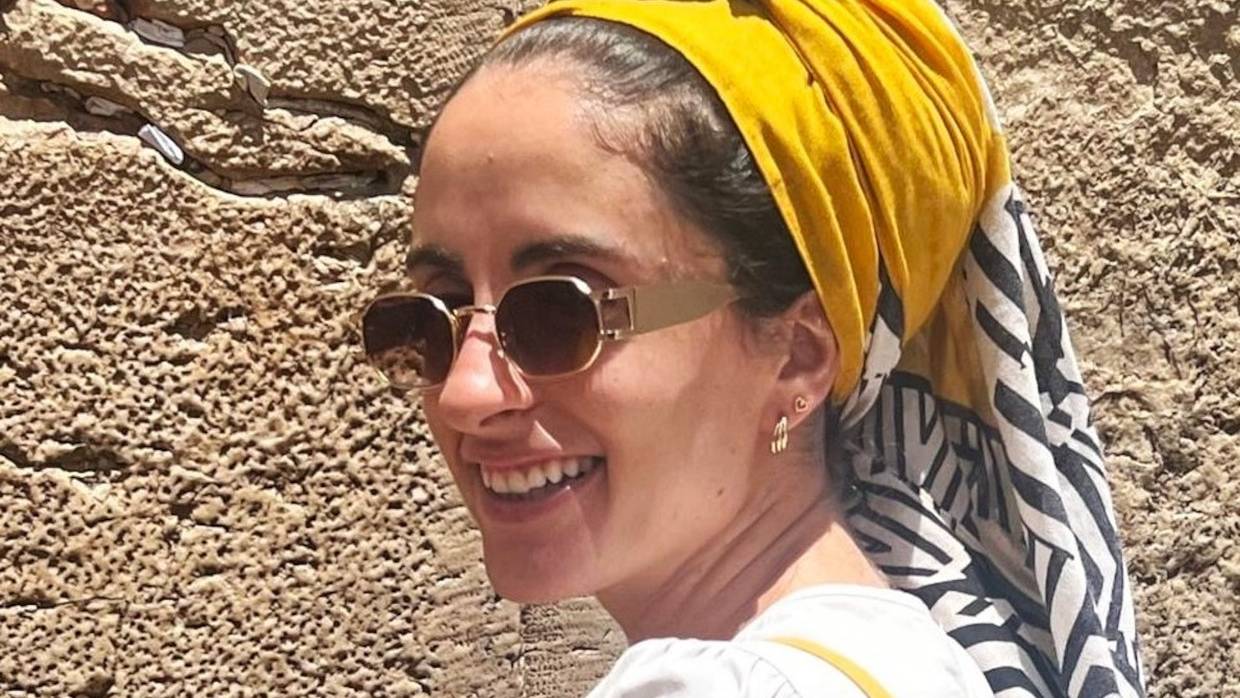
How Hannah Abitbul left behind her non-Jewish life in Mexico and became an online Jewish educator reaching hundreds of thousands of unaffiliated Jews.
The teenage Mexican actress stumbled upon a YouTube clip one day by a Spanish-speaking rabbi talking about how to find happiness through the Bible.
The video would change Hannah Abitbul’s life forever.
The 18-year-old who was used to doing TV commercials and soap operas on Telemundo—an American Spanish-language channel owned by a division of NBCUniversal—quickly ordered a Bible on Amazon and started reading it, trying to grasp the lofty biblical concepts after having been raised as a Catholic in a secular household.
 Hannah Abitbul acting in Mexico. Credit: Courtesy of Telemundo.
Although she was born into the world of television acting and commercials as her mother worked as a booking agent for a modeling agency, she was always interested in Judaism, even as a little girl.
What do you do on the Sabbath?” she would ask the secular Jews working as producers or photographers at her work. “We light the candles,” they replied to her, she recounts in an interview with JNS in Tel Aviv.
Still curious, she sought out more information online about Judaism, including learning about keeping kosher, as she pondered theological questions about the source of her own religion.
After buying her Bible, Abitbul decided to seek spiritual guidance and searched on Google for “synagogue near me.”
 Abitbul (right) with her mother and sister
She visited the synagogue in Mexico City that came up on the web, and at the entrance she gave the Mexican name she was born with. The local security guard told her she could not come in for security reasons. However, the employee, who was new on the job (and didn’t know much about Judaism himself) agreed to take her number and give it to the rabbi since he heard that the synagogue had been looking for a minyan, a public quorum of 10 men required for public worship.
Some days later, the rabbi called her back and said he didn’t understand what she had wanted but agreed to meet her. Abitbul told him that she was interested in converting, but he replied that at 19, she was still very young, could decide later that it wasn’t for her.
Today, you will want Judaism, and tomorrow, Buddhism or vegan,” he told her.
Insisting that she was studying Judaism, the rabbi asked her what Jews eat on Yom Kippur, the Day of Atonement (a fast day). “I don’t know, but I like to cook,” she replied.
Not surprisingly, the rabbi was unimpressed.
Undeterred, she kept phoning him until he agreed that she come to a Friday-night service. The congregants were already in the middle and she said she was “mesmerized” by the songs welcoming in the Sabbath.
I felt like I knew the song, even though I had never heard it in my life,” she said.
 At Aish in Jerusalem
She persisted in keeping in touch with the rabbi and began going to courses in Judaism at the synagogue after work to prove that she was serious.
The rabbi asked the teenager if her parents were aware of her Jewish studies, and when she told him no—that they were sure she was at parties on Friday nights—he insisted that she tell them.
Abitbul told her mother that she had something important to tell her, and the two met for sushi lunch. Her mom had no clue what was to follow. Upon hearing that her daughter wanted to convert to Judaism, she was shocked, and after first assuming that it was because of a Jewish boyfriend, insisted on meeting the rabbi and his wife to be sure her daughter was not involving herself in a cult.
After a cordial meeting with them, her mother relented.
The next major surprise for her parents came when she told them that she wanted to study in Israel, where the rabbi told her she could learn and eventually undergo a conversion.
Her family, who thought that Israel was only about war and terrorism, refused to help her financially. Abitbul paid her own way from her earnings in acting.
After three months studying at a Jerusalem girl’s seminary in 2017, she returned to Mexico because her mother had fallen ill with cancer, passing away the following year.
After her mother’s death, Abitbul reconsidered whether it was right for her to return to Israel as she had planned. Her older sister told her to do what made her happy and not to stay in Mexico because of the family.
Abitbul returned to Israel. A year and a half later, she completed her conversion process, which happened on the very weekend of the Jewish holiday of Shavuot, which marks the giving of the Torah at Mount Sinai.
Ironically, around the very time she finished her conversion, her cousins who were applying for a Spanish passport had discovered that her father’s family from Spain—completely unbeknown to him—were Anusim, Jews who were forced to convert against their will.
Shortly after converting, Abitbul, 27, met her future husband, Avishai, on a popular Israeli dating app that caters to the traditional and religiously observant (her husband became religious himself on a post-army trip to India). Today they are proud parents of a two-year-old son.
 With her husband and their young son in Jerusalem.
He is 100 percent non-Spanish-speaking,” she said of her husband, noting that his family in the Israeli coastal city of Ashkelon, not far from the Gaza Strip, wondered aloud during the war how she had left the beaches of Mexico for a tumultuous life in Israel.
Abitbul's passion and unique story caught the attention of the folks at Aishlatino.com, Aish’s Spanish site. They invited her to create video clips about Jewish holidays and Judaism for Spanish-speaking audiences.
It was always natural for me to be in front of the camera,” she says. “We need to be proud of our Judaism and who we are.”
Her videos took off, garnering quite a large following. Today, Abitbul plays a key role in running Aishlatino’s social media. With over 300,000 followers on Tiktok and 100,000 followers on Instagram, she is responsible for bringing Jewish wisdom to hundreds of thousands of people around the world and getting a whopping 275 million video views of the past two years. Hannah Abitbul has certainly found her home.
A version of this article originally appeared on JNS.













"... that in blessing I will bless thee, and in multiplying I will multiply thy seed as the stars of the heaven, and as the sand which is upon the seashore; and thy seed shall possess the gate of his enemies; and in thy seed shall all the nations of the earth be blessed; because thou hast hearkened to My voice."
Interesting story. How about also a story of shabbat tzvi converted to Islam. Thats interesting how pikuach nefesh was a permissibility in the gadol tsadiks knowledge of being allowed to convert to another monotheistic belief...
Boy, are you mixed up! Shabtai Tzvi was a false "messiah" (same as any others who have claimed that title); he simply acted on his own accord in trying to save his (very thin) skin.
Mazal Tov querida Hannah!!! I would not be surprised to learn that your mother is also from Converso (Anusim) descent! Bendiciones!
You have a 25% chance of being correct. Genetic studies of South Americans and Latino’s of European descent indicate 25% have Sephardic ancestry. They fled the inquisition but the inquisition followed them. Hence the high rate of conversion to Catholicism. Kiddush Hashem to all those who find their way back!
A beautiful re-connected path on her life's journey. It surprised me greatly that her surname didn't ring any bells early on---and I don'r mean Catholic church bells---as for me the Hebrew---especially the Spanish Hebrew popped out after I saw it in print and tried pronouncing it. The name Abitbul, which came down through her patrilineal line, together with her name Hannah, seems like a conversion that was destined. I am sure that there are a lot of 500-year old anusim genes that hopefullyy will re-connect with their stolen past.
A lovely, heartwarming article. It illustrates the power of DNA. Traits may skip a generation or two but will eventually reappear. Kudos to Hannah for following her dream!