
 6 Tips for Healthier Social Media Use



7 min read


Tragedy struck the illegal Jewish Moroccan emigration to Israel on a dark sea voyage that cost 44 lives.
They left their homes in silence, under cover of darkness, driven by a single dream, only to meet tragedy at sea.
In 1956, Morocco gained independence from France, and aliyah to Israel was officially forbidden. Between 1956 and 1961, Moroccan Jews immigrated clandestinely, aided mainly by the Jewish underground and the Israeli Mossad agency. Families slipped away at night, boarded ships bound for Europe, and from there continued to Israel. Through this secret network, approximately 30,000 Moroccan Jews made aliyah.
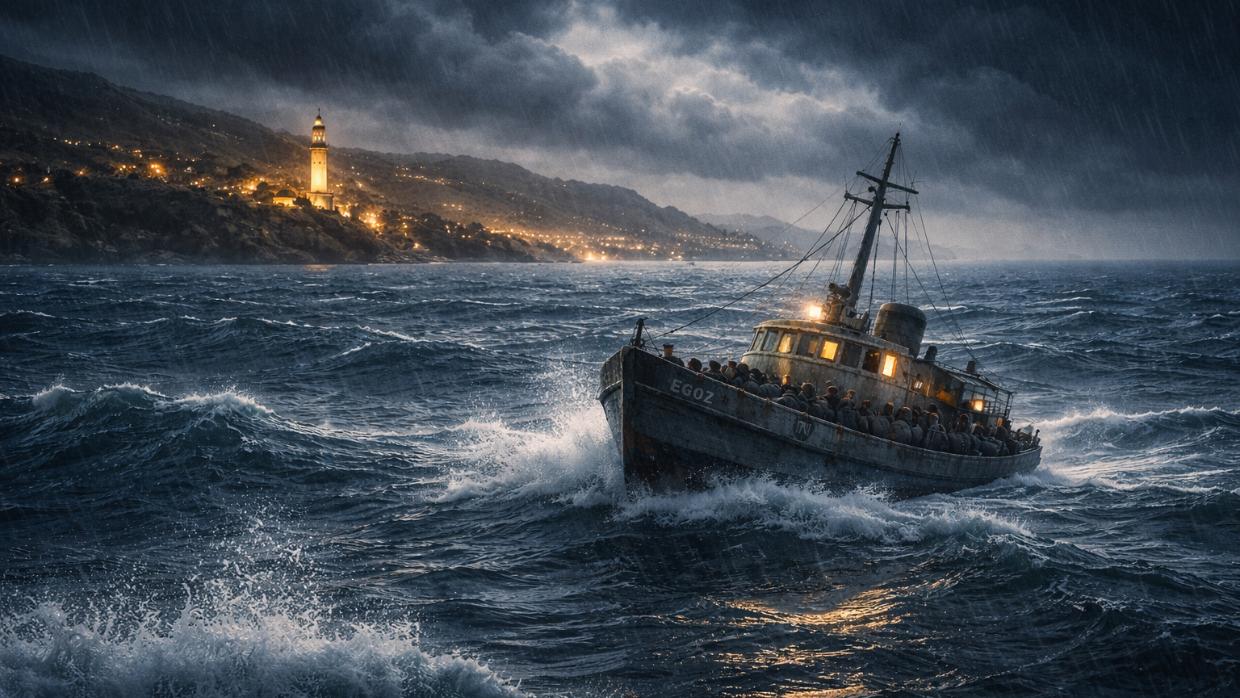
One vessel, originally called Pisces, was an old, small British naval boat converted into a smuggling ship. Renamed Egoz (Hebrew for “walnut”), it transported Jews from the El-Chuseima beach in northern Morocco to the port of Gibraltar. From there, they boarded other ships to Europe and eventually reached Israel. Over three months, the Egoz completed 12 successful journeys, ferrying about 50 people each time. More than 300 Jews were smuggled out during its operation.
On January 10, 1961, to divert suspicion, a group of Moroccan Jews from Casablanca pretended they were embarking on a pilgrimage to Ouezzane, to the grave of Rabbi Amran ben Diwan, and later to a wedding in the Al Hoceima region. There, armed and hooded men transferred them by tugboats to the Egoz.
Only ten miles from the Moroccan coast, the hull split and the Egoz sank. Three crew members, including the captain, escaped in the only lifeboat, leaving the passengers behind.
On board were ten families and a Mossad envoy, Chaim Tzfarti, a 28-year-old Israeli born in Fez, sent as a radio operator. This was his final mission before returning to Israel to marry. Jacques and Denise Benarroch had married just the day before. David Dadon, who had previously been arrested at Casablanca airport for carrying a fake passport, was traveling with two of his children, eager to reunite with his wife and two other sons already in Israel.
Despite a favorable weather forecast, the sea was rough and violent. Only ten miles from the Moroccan coast, after just 30 minutes at sea, the hull split, possibly after striking a rock, and the Egoz sank. Three crew members, including the captain, escaped in the only lifeboat, leaving the passengers behind.
The machinist, Paco Perez, refused to abandon the passengers who were comprised of mostly women and children. Twenty-two bodies wearing life preservers were recovered. The wreckage of the ship and the bodies of the remaining passengers, including 16 children, were never found.
The tragedy sent shockwaves around the world. Poster and leaflet campaigns in Morocco and Israel condemning the disaster angered Moroccan authorities. Negotiations ensued between the future King Hassan II and a committee of prominent Jewish leaders seeking a religious burial for the victims. The prince agreed, and the deceased were buried in a remote corner of the Al Hoceima cemetery, in a discreet ceremony without relatives present.
Gila Gutman-Azulai of Haifa had been smuggled out of Morocco at the age of ten with her 12-year-old sister, Fanny, aided by the Jewish underground in which their eldest brother, David, was active. She lost six family members in the tragedy.
“Before the catastrophe, we were eight children and my mother,” she recalled tearfully. “After that fateful night, only three of us remained alive. It took many years before I could speak about it.
“We had no idea our family members were on that voyage,” she said. “My sister and I were told about their deaths two months later. We were at boarding school in Israel when our uncle arrived, took us to his home, and told us the terrible news—that our mother and five of our siblings had drowned.
For 20 years I hid my loss. Only after I married and had children of my own who kept asking why they had no grandparents did I begin to search for answers.
“I burst out crying. After the shiva, when we returned to school, what I call the ‘thunderous silence’ began. Everyone knew what had happened, yet no one spoke to us—not the counselors, not the principal. We had suffered the worst loss imaginable, and no one showed concern. I began to think it was shameful to talk about it, as though I had done something wrong.
“For 20 years I hid my loss. Only after I married and had children of my own who kept asking why they had no grandparents did I begin to search for answers.
“One day I heard a man on the radio say he had commanded a ship that brought Jews from Morocco to Israel. I called immediately. That was the beginning of my long journey to uncover the truth. I met many people involved in the secret voyages, including the 12 successful trips the Egoz had made before the fatal thirteenth.”
Her brother David was 19 at the time of the sinking. Having been active in the underground and involved in persuading Jews to leave, he felt personally responsible for the deaths of their family members. He carried this burden of guilt for the rest of his life and never spoke about it.
Before his death in 2017, he told Gila that despite having a beautiful family and many grandchildren, he still missed their mother deeply. “She and our siblings were supposed to be here with us now,” he said through tears.
The accession of King Hassan II in February 1961 enabled negotiations for a secret agreement between the Mossad and Moroccan authorities to permit Jewish emigration. Seeking favor with the West, the king agreed to a deal: Israel would provide an initial payment of $500,000, plus $100 per emigrant for the first 50,000 Jews, and $250 for each thereafter.
The covert operation that brought Moroccan Jews to Israel between November 1961 and the spring of 1964 was called Operation Yachin, named after the bronze pillar at the entrance of the Holy Temple built by King Solomon, symbolizing immigration as a pillar of the Jewish state.
More than a quarter of a million Moroccan Jews have since made aliyah. Today, one million Israelis are of Moroccan descent.
Many international efforts were made to retrieve the remains of the Egoz victims. In December 1992, King Hassan II finally agreed to their transfer. The secret mission, named Ayelet HaShachar (“first star of the morning”), brought the remains to Israel, where they were reinterred at Mount Herzl in Jerusalem.
In 2008, at a memorial service at Mount Herzl, President Shimon Peres paid tribute to the 44 men, women, and children who perished. At the time of the tragedy, Peres had served as deputy defense minister and was among the few aware of the clandestine emigration. He recalled that because the Egoz had completed 12 successful voyages, there was no immediate concern when it failed to arrive on time, until the devastating truth emerged.
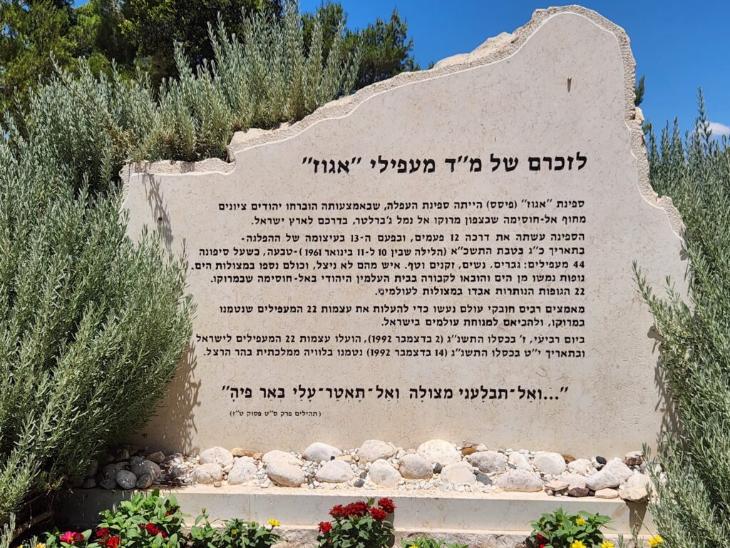 A monument to the victims of the sinking of Egoz, at Mount Herzl, Jerusalem. (Photo: Niv Baruch, PikiWiki, via Wikimedia commons)
Peres said that the government was united in the belief that the final will of those who died was that the mission continue.
Indeed, more than a quarter of a million Moroccan Jews have since made aliyah. Today, one million Israelis are of Moroccan descent.
The Egoz sank—but the longing for Zion did not.