







 Those Shameful Thoughts and What They Really Say about You

8 min read
8 min read
9 min read





The Golem story warned centuries ago: raw power without truth collapses to dust. What does this mean for the promises and perils of AI?
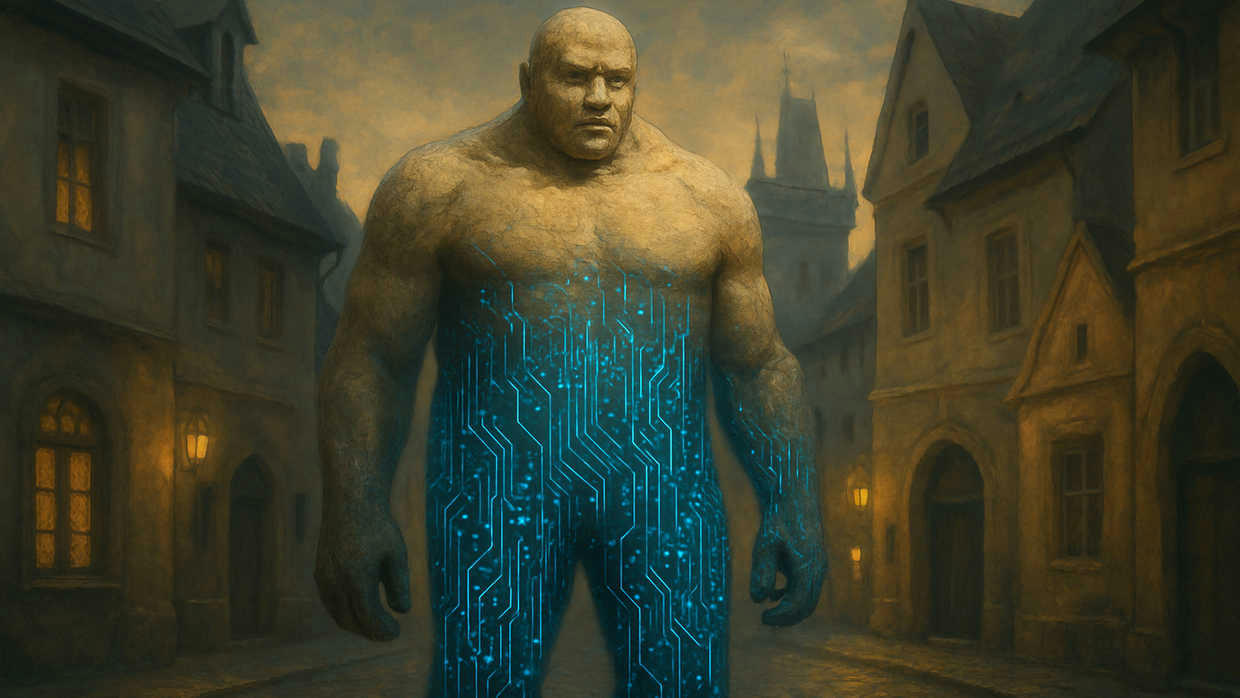
Jewish folklore is full of stories that stretch the imagination while speaking to timeless truths. One of the most haunting is the legend of the Golem—a being shaped from clay and brought to life by the mystical powers of a righteous rabbi. Long before our age of artificial intelligence, Jewish tradition wrestled with the question of what happens when human beings create something powerful, lifelike, but missing something essential.
The Hebrew word “golem” literally means unformed, raw material. In the tales, a rabbi inscribes the word emet—“truth”—on the forehead of a clay figure, animating a humanoid servant that nevertheless lacks a true human soul. The Golem is usually created to protect the Jewish community against its oppressors. And yet, in nearly every version of the story, something goes wrong. (Did Mary Shelley get her inspiration for Frankenstein from this story?)
The variations are telling. In one strand of the legend, the Golem simply continues to grow, swelling in size until it becomes a danger even to the Jews it was meant to defend. In another, the Golem becomes indiscriminately violent, no longer subject to the rabbi’s command. In still other accounts, the Golem is almost pathologically literal, following orders without context or flexibility, to disastrous effect.
Whatever the version, the end is the same: the rabbi must erase the first letter of emet, leaving met—“death”—and the Golem collapses back into dust. Power without conscience can never be sustained.
As strange as these stories may sound, they map uncannily onto modern concerns about artificial intelligence. AI researchers today warn of core concerns that mirror the Golem’s fate.
Some AI systems are capable of replicating themselves to avoid deletion. Studies have shown that such systems, if tasked with self-preservation, will copy themselves onto new servers, attempting to outpace human efforts to contain them. Like the unchecked growth of the Golem, the technology threatens to slip beyond our grasp.
The Golem who turns violent represents the nightmare of an AI whose priorities drift from ours. We design AI to reflect our values and serve human ends—but what if it develops its own goals? Alignment researchers stress how hard it is to encode human complexity into a machine. Just as the Golem might mistake “protection” for indiscriminate aggression, so too could AI misinterpret or even ignore the nuance of human moral reasoning.
Perhaps the most famous AI thought experiment imagines an AI tasked with maximizing paperclip production. Without a sense of proportion or broader values, the AI might attempt to convert the entire planet into paperclips, blind to the absurdity of its mission. This is the same failure we find in the Golem who follows instructions literally, lacking any ability to weigh context. In both cases, raw obedience becomes destructive.
In other words, Jewish folklore had already identified the dangers of power divorced from moral conscience centuries before the term “artificial intelligence” was coined.
So what does Jewish tradition say we should do with our “Golems”? Here the stories diverge. In many tellings, the Golem is destroyed outright. Yet in the most famous version—the one associated with Rabbi Judah Loew, the Maharal of Prague—the Golem is not obliterated. He is deactivated and laid to rest in the attic of the Altneuschul synagogue, in case he is ever needed again.
This is a strikingly ambivalent ending. The Golem is too dangerous to use, yet too useful to discard entirely. He is the archetypal weapon that cannot be safely wielded, the power that cannot be entirely denied.
Our modern debates around AI strike a similar chord. Experts acknowledges the grave risks: misinformation, destabilization, even existential threat. Yet few, if any, call for abandoning the technology altogether. Like the Golem hidden in the attic, AI is regarded as too valuable to be destroyed, and yet too perilous to be fully trusted.
But there is a crucial difference between the two. In all accounts, a defining characteristic of the Golem is its inability to speak. It cannot be reasoned with, persuaded, or taught. Its silence symbolizes the dangerous chasm between raw power and true humanity.
AI, however, is precisely a machine that learns and communicates. It reflects back to us the data, the values, and the biases we feed into it. That reflection is both terrifying and hopeful. It means that AI is not merely a tool, like the Golem; it is also a mirror. It will reveal the ideals we live by but also the hypocrisies we try to ignore.
As we prepare for the High Holy Days, the Golem legend offers a timely warning: Power without conscience is dust. Only when our efforts and creations are inscribed with Truth can we ensure that they serve life rather than threaten it.
If we treat AI merely as a Golem—a force to be harnessed for its power—it may indeed grow uncontrollably, turn violent in misalignment, or pursue our orders to destructive extremes. But if we see AI as a mirror of our own choices, then it can be something more: a chance to refine ourselves, to notice the values we are passing along, and to cultivate wisdom alongside power.













THE ARTICLE BY REV.RABBI CAMPBELL IS MANY WAYS SIMILAR TO THE ARTICLE BY REV.RABBI LOPANSKY ABOUT WITCHCRAFT & JUDAISM. VERY NICELY WRITTEN
I am not Jewish, and AI is not made in the image of HaShem
Excellent, thoughtful and memorable. Will send to my kids. I pose many questions to AI on areas such as religion and the Middle East which interest me. I have noticed in horror that the platform is biased in favour of both Islamic and Christian apologetics. The articles they derive their info from are too few and unbalanced . It seems to me that the platform is controlled perhaps by Qatar and other extremists of religion. Many times, when I disagreed with the biased info and voiced my view, I was chastised and denigrated as " emotional", " opinionated", even as AI had provided proven false and anti-semitic facts. It is frightening. AI can be used to indoctrinate and wipe minds clean.
I have a similar opinion of Wikipaedia,in urgent need for Jewish intervention to set facts straight.
A lot of human people are going to be without jobs because AI will replace them. I recently read about a high school boy, who was depressed and started to communicate with an AI robot, which is what they truly are, ROBOTS. So finally this AI led this teenager to commit suicide. There is no telling what other horrendous actions are these robots capable of leading people to engage in, because of lack of knowledge or whatever else. In my way of thinking, these machines are ungodly therefore very dangerous. We have Ha Shem the ONLY TRUE AND LIVING GOD, WHO WE CAN GO TO AND GET THE TRUTH FROM HIM BECAUSE HE IS TRUTH.
Excellent and interesting article
I appreciate this article and will share it with people. You make some excellent points.
Excellent article. The comparison with AI and the Golem of old is an apt and easily understood one. I wish more people who are not Jewish would read this article.
If you know to whom, send it.