
 The Synagogue Was Attacked and Our Children Were Watching

6 min read
7 min read
9 min read
7 min read



10 min read


Herbert Heller survived Auschwitz, rebuilt his life in San Francisco, and spent his final years making sure the next generation never forgot. The Optimist tells his story.
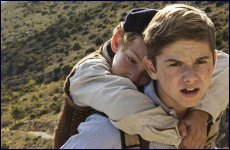
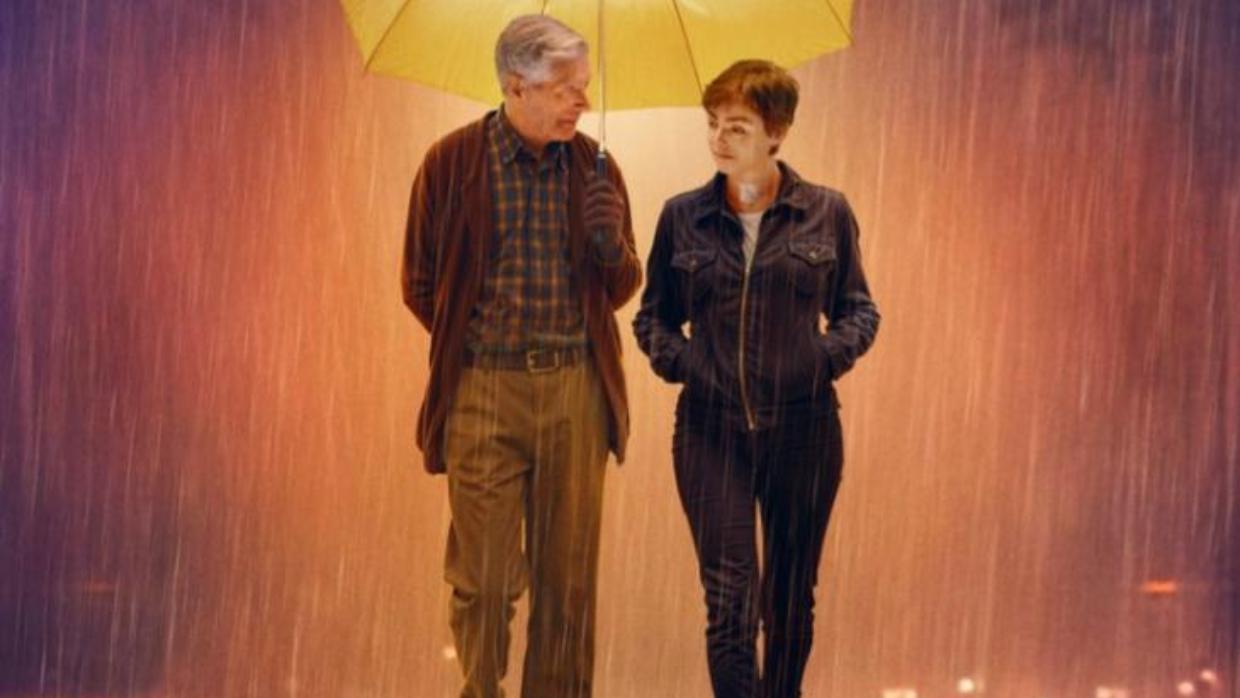
The Optimist, a powerful new film by San Francisco-area writer and director Finn Taylor, tells the story of Herbert Heller, a Holocaust survivor who spent his later years educating Bay Area teens about his experiences before his death in 2021. The film is aimed squarely at young people who may be encountering these harrowing details for the first time.
For most of his life, Herbert Heller never spoke about the horrors he'd endured as a teenager during the Holocaust. That changed in 2004, when he agreed to tell his story as part of the Bay Area Holocaust Oral History Project. After recording his testimony, he shared it with his daughters, then began speaking publicly in synagogues and other venues. Many of his talks were delivered to children in schools, where he found ways to make history land with younger audiences.
The film captures that gift. In the movie, Herbert (played by Stephen Lang, of Avatar) agrees to tell his story only to Abby (played by Elsie Fisher, who starred in Eighth Grade), a shy teenage volunteer working with an oral history project. Herbert senses that Abby carries her own deep pain and strikes a deal: he'll share his history if she agrees to open up about hers.
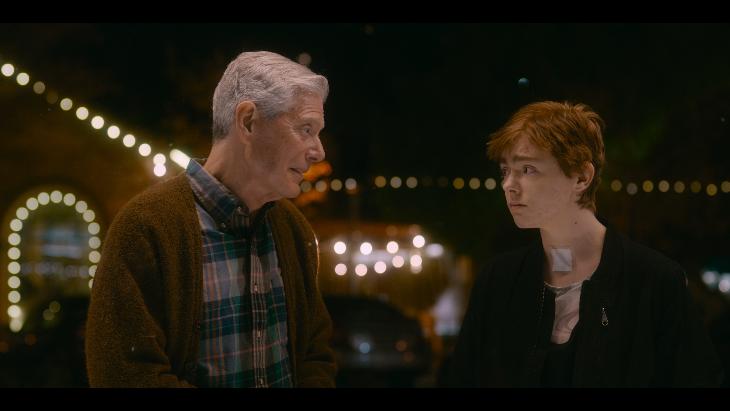 Stephen Lang and Elsie Fisher
Slowly, these two wounded people begin to find peace together. In the process, The Optimist makes the Holocaust newly relevant to today's teenagers, framing it not just as tragedy but as a source of strength. "I've been in the worst place on earth," Herbert tells Abby in the film, before assuring her that it's possible to find the will to keep living and loving despite everything.
Herbert was born in 1930 in Teplice-Sanov, a picturesque town in Czechoslovakia. His father Karel was an engineer; his mother Melanie raised Herbert and his older brother Heinz at home.
Jews had lived in Teplice-Sanov for centuries. When Herbert was growing up, the town had the second-largest Jewish population in Czechoslovakia, home to Jewish schools, kosher shops, a mikveh (ritual bath), and the Grand Synagogue, one of the largest in all of Europe. Since the mid-1800s, Jews had been equal and valued members of society. Jewish-owned businesses were woven into the fabric of the town.
That began to change in the 1930s, as pro-Nazi sentiment grew and Germany pushed to annex Czech territory. After Germany seized parts of Czechoslovakia in 1938, about 7,000 Jews fled Teplice-Sanov. Tragically, Herbert's family stayed, eventually relocating to Prague to join the larger Jewish community there.
Germany took those Czech lands with the blessing of Britain, France, and Italy, who signed what became known as the Munich Pact, giving Hitler parts of Czechoslovakia in exchange for his pledge to stop expanding. Britain's foreign minister called it "peace with honor" and declared he'd secured "peace in our time."
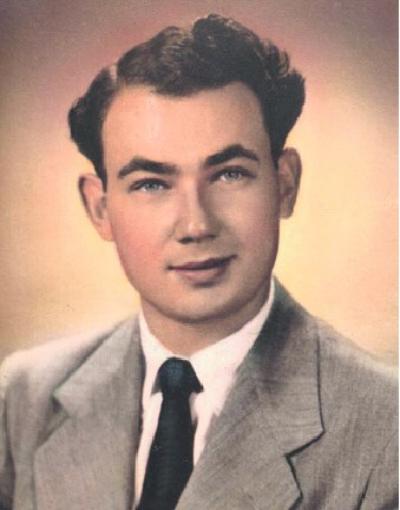 Herbert Heller
The pact was worthless. Germany pressured Czechoslovakia to splinter into smaller provinces, and in March 1939, seized western Czechoslovakia entirely. Six months later, on September 1, 1939, Germany invaded Poland, igniting World War II.
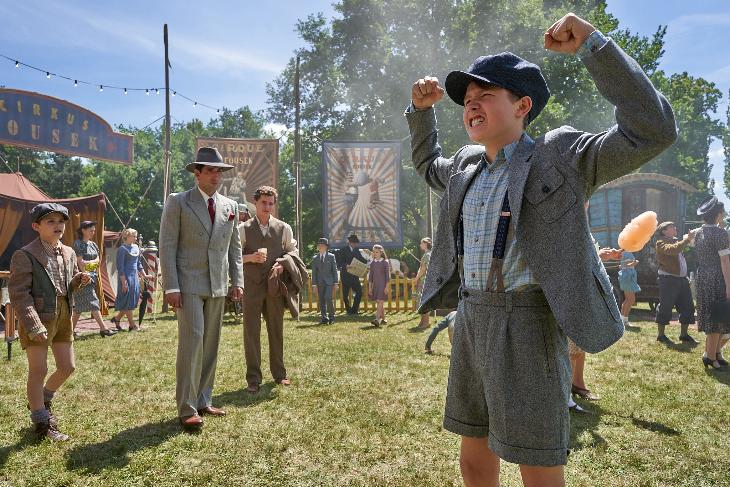
The Optimist shows antisemitism tightening its grip on Herbert's hometown. German authorities declared that "Jewish assets become the people's property," stripping Jews of any legal claim to what they owned. Jews were barred from government work and professional roles. Jewish children were expelled from state schools. Businesses were seized. The film shows Herbert's mother carefully sewing yellow stars onto the family's clothing, telling her children they should wear this Jewish symbol with pride.
In 1941, senior Nazi Heinrich Himmler ordered the construction of a holding site for Jews from across Czechoslovakia and Austria, which he called a "rubbish bin" intended to hold a million Jews. That site became Theresienstadt, a massive concentration camp that would imprison approximately 150,000 Jews, Herbert's family among them.
Theresienstadt was unlike any other camp in the Nazis' vast network of more than 40,000 concentration, forced labor, and death camps. It was, above all, a propaganda tool, designed to show the world the lie that Jews were being treated humanely. Tragically, international observers were willing to believe it.
Nazi Germany maintained the fiction that Jews were simply being relocated to Eastern Europe to work in factories and mines. Since it was obvious that elderly people and children couldn't perform hard labor, officials invented a cover story: those who couldn't work were being held in comfortable facilities. Some propaganda even described Theresienstadt as a "spa town" for elderly Jews.
The reality was brutal. Around 33,000 people died inside Theresienstadt from disease, starvation, abuse, and murder. So many died each day that by 1942, the Nazis built a crematorium outside the camp walls capable of reducing 200 bodies to ash daily. Survivor Inge Auerbacher, who was imprisoned there as a child, later wrote:
Conditions in the camp were harsh. Potatoes were as valuable as diamonds. I was hungry, scared and sick most of the time. For my eighth birthday, my parents gave me a tiny potato cake with a hint of sugar; for my ninth birthday, an outfit sewn from rags for my doll; and for my tenth birthday, a poem written by my mother.
The roughly 15,000 children sent to Theresienstadt were forbidden from attending school, yet prisoners organized secret lessons anyway. There was also a clandestine lending library, theater performances, lectures, and concerts.
But Theresienstadt's primary function was as a way station to the death camps. Of the approximately 150,000 prisoners sent there, only a few thousand survived.
There was one brief pause in the deportations: June 1944. The Danish branch of the International Red Cross, concerned about Jews disappearing from Nazi-occupied Denmark, requested permission to inspect a camp. German authorities agreed, offering up Theresienstadt. For weeks beforehand, guards and prisoners repainted buildings and planted flowers. More than 7,000 prisoners were sent to their deaths in the weeks before the visit to ease overcrowding.
 On June 23, 1944, two Red Cross officials toured the camp alongside Nazi commandants and declared that the Nazis were treating Jews well. Any rumors to the contrary, they concluded, were false. The moment they left, deportations to Auschwitz resumed.
In 1944, Herbert, his brother, his parents, and hundreds of other Jews were packed into a cattle car so crowded they could barely breathe. "When the doors slammed shut and you heard them nailed down," Herbert later said, "you just knew that the next stop was not going to be good."
They arrived in Auschwitz disoriented and terrified, forced to line up before Josef Mengele, the senior Nazi official known as the "Angel of Death," who decided on the spot who would be sent to the gas chambers and who would be kept for slave labor. A Jewish prisoner nodded toward a massive chimney belching black smoke and warned Herbert: "You see that chimney over there? You're going before Dr. Mengele, and if he doesn't think you're strong enough for hard labor, that's where you're going to wind up."
Herbert made a split-second decision. "We had to undress, and I was 15 years old, a skinny kid. I went before Dr. Mengele and I said in German, 'Ich kann arbeiten' (I can work), and I flexed muscles I didn't have." Mengele pointed him to the right. The other door, where most prisoners were sent, was marked "shower" and led to the gas chambers.
Remarkably, Herbert's parents and brother were also selected for labor. Herbert was placed in the same bunk as his father, and he later credited that closeness with keeping him alive. "My dad just gave me so much strength," he said, "telling me that the war will end, and we'll go back to Prague, and we'll have a car and life will be good again. And I really wanted to believe it. When your father tells you things and you want to believe it, you believe it."
Herbert worked in Auschwitz's first aid station, stocked with little more than flimsy bandages and aspirin, treating injuries that required far more. Inmates were murdered by guards for minor infractions. Some, broken by starvation and illness, ran into the electrified fences deliberately. "They just wanted to end their life," Herbert remembered.
Eventually, his father Karel and his brother Heinz were taken away and killed. Herbert never learned exactly what happened to them.
In January 1945, with Soviet troops closing in, Auschwitz guards began accelerating the killings. When it became clear they couldn't murder everyone in time, the Nazis forced roughly 60,000 prisoners to march west in brutal cold. Exhausted and ill, prisoners who fell behind were shot on the road. About 15,000 died before reaching their destination.
"There are just so many of us that are not able to walk anymore," Herbert recalled, "and those were put on the side of the road and then the trucks would come and they threw them on the truck and we would never see those anymore. They were shot somewhere."
Then Herbert spotted a sack lying by the road. He grabbed it and hid it under his clothes. Inside was a complete set of civilian clothes. That night, he pulled the civilian outfit over his camp uniform and slipped away to a nearby train station. Calling out "Mutti, mutti, wo bist du?" ("Mom, mom, where are you?"), he passed himself off as an ordinary German traveler.
He made his way to Prague and knocked on the door of a Catholic family who had been friends before the war. They took him in. "They burned the striped pajamas," Herbert recalled. The mother "put me to bed and I think I slept for two days." Knowing the number tattooed on his arm would expose him as a Jew, and that the family hiding him would be shot if he were caught, Herbert burned it off with acid.
Incredibly, Herbert's mother Melanie also survived Auschwitz. After the war, the two of them moved to California and settled in San Francisco. Herbert learned English, joined the Army Reserves, and worked at Macy's before opening his own children's clothing store in 1958. In 1956, he married Annette. Together they raised three daughters, though Herbert never breathed a word to them about what he had lived through. When his daughters asked about the scar on his arm, he told them he'd burned himself on the family's hot water heater as a child.
 That silence finally broke in 2004. Herbert had kept quiet all those years because he didn't want anyone's pity. An eternal optimist, as the film's title suggests, he used to say: "I always tell people how rich I am. I had a wife, three daughters, ten grandkids and a dog."
Herbert died in 2021 at the age of 92. His story couldn't be more timely. A recent study found that large majorities of Millennials and Gen Z lack basic knowledge about the Holocaust, and 10% don't believe it happened at all.
The Optimist is a powerful antidote to that ignorance, walking viewers through the timeline of the Holocaust through the eyes of one remarkable man, and showing how his story can speak directly to young people facing their own struggles today.