 Tucker Carlson's Lies About Jews and Israel

3 min read
4 min read



5 min read


What tennis taught one mom that no parenting book could.
I took my eight-year-old daughter for some one-on-one time on the tennis courts. She didn’t have much experience, but she’s athletic, has good hand-eye coordination, and had even taken a few lessons in the past. How hard could it be? I thought.
I bounced the ball and gently hit it over to her. She flung her arm, the racket spinning in a full 360, and the ball whizzed right past her.
“No problem,” I said. “Let’s try again—nice and easy.”
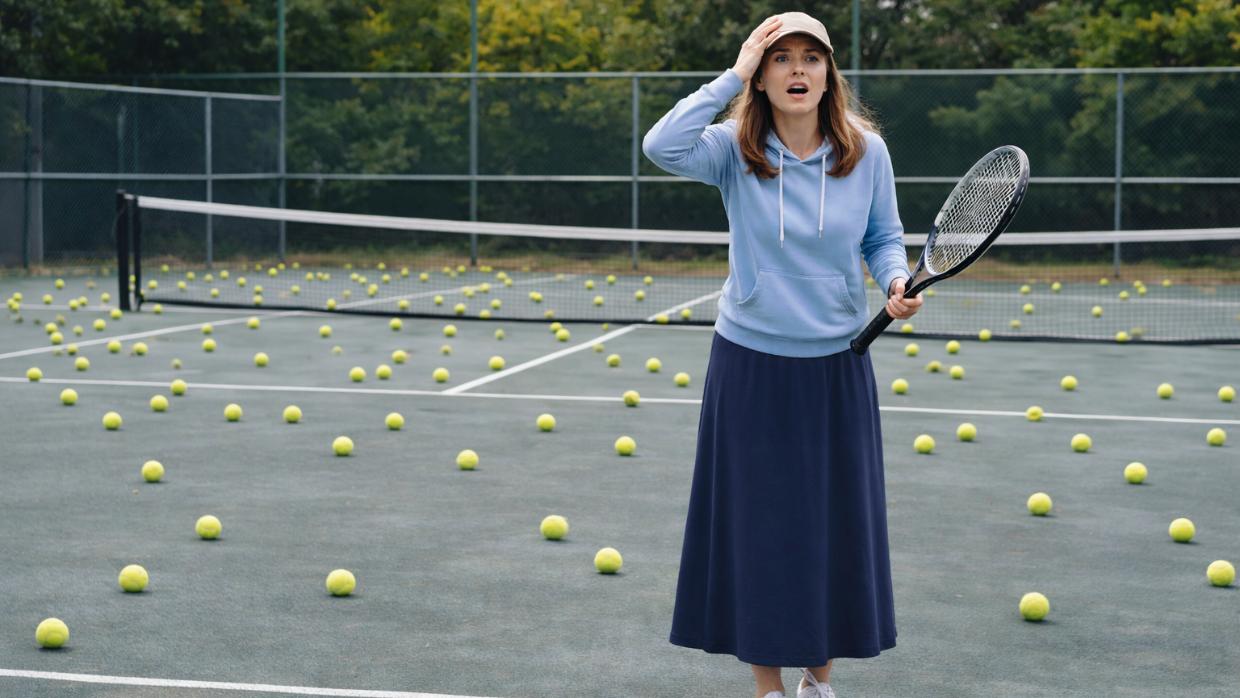
This time she made contact, but the ball made a beeline for the far right side of the court. We could barely get a single volley going. I was grateful when she made contact with the ball. But, there I was, racing side to side, chasing her wild fly balls, doing my best to return them so they’d land perfectly in front of her—so she’d actually have a chance to hit them.
I got a great workout, but we definitely didn’t play tennis that morning.
And that, in a nutshell, is parenting.
No matter how they behave, your job is to stay calm and centered.
That’s it. That’s the advice that’s more important than what any book will tell you.
Actually doing it takes a lifetime.
While you’re running around trying to return their wild shots, your responsibility is to stay regulated and place the ball gently where they can return it. Children have big, uncontrolled reactions—their emotions fly everywhere. You still have to remain centered and respond in an even-keeled way.
This isn’t just good advice; it’s science.
We have something called mirror neurons. When I move my arm, a specific neuron lights up in my brain. Here’s the fascinating part: when you watch me move my arm, that same neuron lights up in your brain. In other words, we learn behavior simply by observing it.
That’s why when children watch Instagram reels or TikToks of kids doing ridiculous dances or acting rudely, they immediately try it out on you. They are absorbing behavior constantly—often without saying a word.
Our actions teach far more than our lectures ever will.
Ralph Waldo Emerson captured this perfectly: “Your actions are so loud, I can’t hear what you’re saying.”
If I scream, they scream.
If I hit, they hit.
Stay calm—and keep yourself, and the tennis balls, centered.
As we played, my daughter kept repeating, “I’m so bad,” every time she missed a ball or sent it flying. I kept reminding her how great she actually is—she just needs time and technique.
No child—and no parent—is bad.
Children need to be taught manners and middot. Parenting itself is a skill, and skills can be learned. A child isn’t lazy, stupid, or annoying. They may do lazy things or behave in annoying ways, but that is not who they are.
Be careful what you call them, you are imprinting that word onto their soul. If you label a child, they often grow into that label—for better or worse.
Use positive, encouraging language. Teach step by step. Speak to their essence, not their struggle.
As I sent smooth, clean balls over the net, I noticed my daughter would rush right up to the ball, leaving herself no room to swing. The racquet caught the ball too late and it didn't have enough power to get over the net.
“Slow down,” I told her. “Give yourself space. Then find the ball and make contact.”
Suddenly, the ball went over the net.
The same is true in parenting. Don’t hover. Don’t helicopter.
If you try a little less intensity and give a drop more space, things land much better.
Our instinct is to protect—to fix, rescue, and prevent failure. But falling and failing are often blessings in disguise. That's where children discover grit and persistence, strengths they have to learn that on their own.
Moms often joke that they feel like an Uber driver—back and forth, back and forth—all day long.
This is a stage and it will pass.
While your presence is important, you don’t have to overbook your children. It’s okay to say no. It’s okay to take a season off from after-school activities.
Find your balance, create boundaries and stick to them. Yes, some back-and-forth is part of modern parenting, but it doesn’t have to run you.
When all the kids are home at once, it can feel like balls flying at you from every direction.
“Mom, can you help me with homework?”
“Mom, sign my test!”
“Mom, you won’t believe what happened today…”
“MOM! Where’s the shampoo?”
“What’s for dinner? I’m starving.”
You can’t possibly return every shot perfectly, and you don’t have to.
Some balls you’ll return. Some you’ll let bounce. Sometimes you’ll play doubles—enlisting help from a spouse, older sibling, or even a well-timed “Give me five minutes.”
You are not failing because you can’t meet every need instantly. You’re human.
Good parents aren't the ones who never miss a shot, they're the ones who keep showing up to play.