




 AI Built Its Own Social Network. Now It’s Asking If It’s Real




9 min read


During the Warsaw Ghetto Uprising Zivia Lubetkin’s teenage army battled the Nazis for 28 days.
Tens of thousands of Polish Jews had already starved to death, succumbed to disease, or were deported from the Warsaw Ghetto in a railroad box car and taken on a one-way journey to Treblinka. In a last brave act of defiance, hundreds of young, untrained Jewish inhabitants of a walled enclave would defiantly embark on a final 28-day armed struggle against the Nazis.
This would mark the first uprising by resistance fighters in a German-controlled area during the war. The battle culminated in the complete destruction of the ghetto and all but decimated the Warsaw resistance fighters. But it also became a powerful symbol of courageous Jewish resistance, making Zivia Lubetkin a beloved heroine.
On November 9, 1914, Zivia was born into a close-knit Jewish neighborhood in Byden, Poland. She was interested in Zionism and settling in Palestine at an early age and joined a Zionist-Socialist group named “Freiheit”, the German word for “Liberty”.
Determined to follow her dream to Palestine, she entered a training kibbutz, worked with a team of young peers in the laundry, the chicken coop, communal kitchen, farm fields, and bakery.
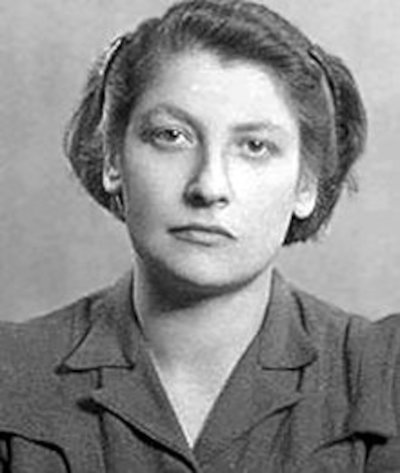
She excelled in all aspects of the program, and her strong work ethic, planning and leadership skills were recognized early. She did so well that she accepted a promotion to “Director of Training Farms”, moved to Warsaw and oversaw kibbutz recruitment and fundraising. She was a persuasive speaker and made public appearances on behalf of Zionism and emigration to Palestine.
On September 1, 1939, the Germans launched a blitzkrieg attack and invaded Poland. Denmark, Norway, Belgium, the Netherlands, and France were invaded in 1940, and the Soviet Union was likewise invaded in 1941.
Zivia was almost 25 years old when her home in Poland was invaded and she fled the Nazis and settled in the Soviet Union. She felt compelled to return to German-occupied Poland four months later to help the remaining Jews huddled in Warsaw’s ghetto. The Germans had forcibly moved all of Warsaw’s Jews (one third of the city’s population) into the ghetto, sealed the city within an 11-foot-high brick wall, forbidding passage in or out without a passport.
The situation in Poland had become dire. Word of SS “Death Squad” executions of Jews was spreading and on July 22, 1942, thousands of Warsaw’s Jews were packed into railroad box cars destined for Treblinka and never seen or heard from again.
Within the week, Zivia joined a resistance movement called the Jewish Combat Organization, it was known as the ZOB, Polish for “Żydowska Organizacja Bojow”.
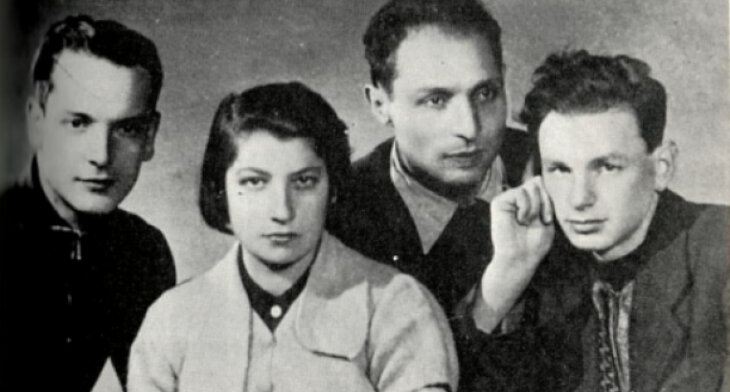
The ZOB was primarily composed of young Jewish fighters in their teens and early twenties who, like Zivia, were previously involved in youth groups. They anticipated the German intentions to annihilate the Jews and shifted their focus from education and culture to self-defense and defiance.
Parallel to ZOB’s organization was an underground alliance of young people who believed resistance to the Germans was a far better destiny than cooperation or surrender. They established an underground network of newsletters, pamphlets, and secret meetings. When the Nazis learned of their underground press, they executed 51 Jews on April 17, 1942.
An early ZOB military action was to burn down a German warehouse.
Zivia said, “We collected mattresses and furniture…piled them together and set them on fire. Success! The flames swept into a great blaze and crackled in the night, dancing and twisting in the air. We rejoiced as we swathe reflection of the revenge that was burning inside us, the symbol of the Jewish armed resistance that we had yearned for, for so long.” 1
In January 1943, ZOB launched another initiative that put Zivia in command of a 40-person unit to engage in guerilla warfare. Her young male and female soldiers knew the Germans engaged in a systematic apartment-by-apartment search of the city looking for Jews. ZOB ambushed German soldiers in two apartment buildings with pistols, hand grenades, and light bulbs filled with highly corrosive sulfuric acid.
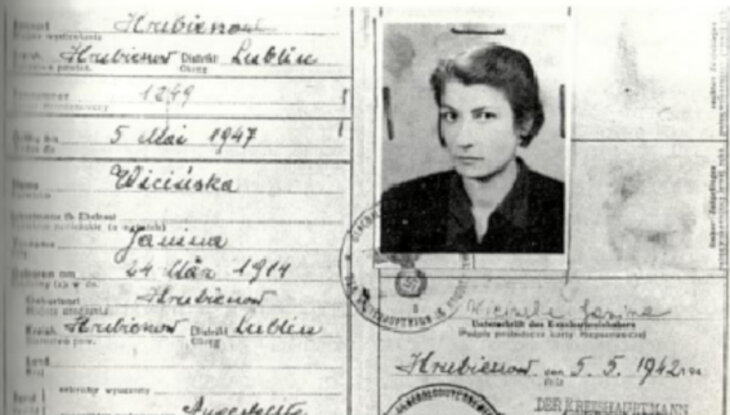
Ziva’s unit caused the Germans to carry away their dead and retreat in both skirmishes. She wrote, “For a few minutes we were intoxicated by the thrill of the battle. We had actually witnessed the German conquerors of the world retreat in fright from a handful of young Jews equipped only with a few pistols and hand grenades. Now that we have found the strength to stand up against the murderers, our deaths too would not be in vain.”
Historians cite April 19, 1943, as the official start of the Warsaw Uprising. On that day, Nazi leader Heinrich Himmler declared that the ghetto would be cleared of its remaining residents in honor of Hitler's birthday the following day. Over 1,000 SS soldiers, equipped with tanks and heavy artillery, entered the area intending to round up the ghetto’s Jews and ship them to Treblinka for extermination. Although many of the ghetto’s remaining 60,000 Jewish inhabitants tried to hide in secret bunkers, about 700 young Polish freedom fighters confronted the Germans who marched into a ZOB trap of land mines on the ground, and gunfire, grenades, and sulfur bombs from the rooftops.
 Zivia Lubetkin and Yitzhak Zuckerman
This humiliating defeat enraged the Germans. They systematically advanced through the Warsaw ghetto, blowing up buildings one by one, and slaughtering thousands. Zivia and the ZOB fighters retreated to the sewers to continue their resistance, but ZOB’s strength had peaked, a victim of fatigue, hunger, diminished weaponry, and a vastly powerful opponent.
Their struggle came to a decisive end on May 16 when the Germans destroyed ZOB headquarters and torched the Jewish Warsaw ghetto. Many of the ZOB leadership took their own lives rather than fall prey to Nazi capture.
Now firmly under Nazi control, the mass deportation of the remaining Warsaw Jews to Treblinka began. During the uprising, around 300 German soldiers were killed, and thousands of Warsaw Jews were massacred. Nearly all those who survived the uprising and were sent to Treblinka perished by the end of the war.
Zivia wrote, “I shall never forget that night when the ghetto was put on fire on all sides. I ran outside from my hiding place and the night turned into day. All around me I heard the crackle of uncontrolled fires, the roar of collapsing houses, and broken glass. The heat singed our faces and eyes, and some people choked on the smoke.”
 Zivia Lubetkin with her daughter Yael, aged 10 months old, 1950. (Photo: courtesy of the Ghetto Fighters’ House archive)
Zivia escaped the Warsaw carnage by crawling through the sewer system and linking up with a handful of ZOB survivors. She turned her attention to helping Polish refugees emigrate to Palestine. After the war ended, she and her husband (ZOB commander Yitzhak Zuckerman) did the same and she lived in Israel from 1946 until her death in 1978.
In 1961, Zivia testified at the internationally broadcast Jerusalem war crimes trial of Adolf Eichmann, the SS officer who helped plan and implement Hitler’s Final Solution. Her testimony included this incredible description of the Warsaw Ghetto Uprising’s first battle:
“What did we tell the Jews that night? We told them that anyone who possessed arms should come out to fight. Not only the Jewish fighting force but the ordinary Jews as well had arms. And, indeed, the moment had come. When the day dawned… I saw the thousands of Germans who were surrounding the ghetto—with machine guns, with cannon—and thousands of them, with their weapons, as if they were going to the Russian front. And there we stood opposite them…young men and women. What were our weapons? Each one had a revolver, each one had a hand-grenade; the entire unit had two rifles, and in addition we had homemade bombs, primitive ones, the fuse of which had to be lit by means of a match, and Molotov Cocktails.
It was very strange to see that some Jewish boys and girls, confronting this enormous enemy with all his weapons, were joyful and merry. Why were they joyful and merry? We knew that our end had come. We knew beforehand that they would defeat us, but we also knew that they would pay a heavy price for our lives. Indeed, they did. It is difficult to describe, and there will surely be many who will not believe it, that when the Germans came near the foot of one of our strong points and passed by in formation, and we threw the bombs and the hand-grenades, and we saw German blood pouring in the streets of Warsaw, after so much Jewish blood and tears had previously flowed in the streets of Warsaw - we felt within us, great rejoicing and it was of no importance what would happen the following day.
There was a great rejoicing amongst us, the Jewish fighters. And behold the miracle: the great German heroes withdrew in tremendous panic in the face of the handmade Jewish hand- grenades and bombs. And we noticed, one hour later, how a German officer was spurring the soldiers on to go to battle, to go out and bring in the wounded, and not one of them moved and they abandoned their wounded men whose weapons we subsequently collected.”
Zivia’s leadership of her youthful fighters served as an inspirational symbol of resistance and defiance. She is revered as a Jewish heroine for her bravery and unwavering commitment to her people.
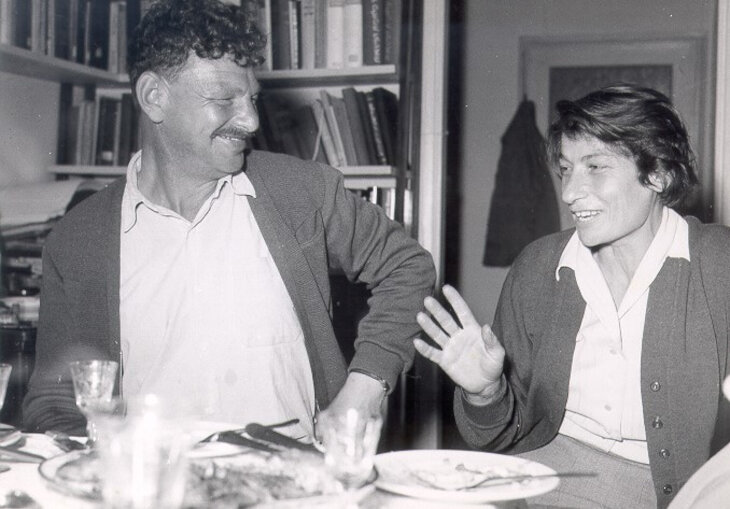 Zivia Lubetkin and Yitzhak Zuckerman in their home in Kibbutz Lohamei HaGeta'ot. (Photo: DA Harissiadis, from archive of the Ghetto Fighters’ House)
In a fitting twist of history, her granddaughter, Roni Zuckerman, became the Israeli Air Force’s first female fighter pilot in 2001.
LINKS
BOOKS








There's a couple of mistakes in the article:
Maybe the mistakes aren't very big but I think it's still important to point them out. Nevertheless, what an interesting woman!
that is so awesome that Zivia and Yitzhak’s grandaughter became the first female fighter pilot for Israel. what a statement to make to demonstrate her grandmothers strength and courage!!
Yes, I thought that would be a grand way to end the article. Glad you liked it.
Unbelievable to have fought and survived the living hell and end up in Israel. Amazing woman!
A real hero, this is what resistance looks like