








 The Red Cross’s Jewish Problem

8 min read
13 min read
4 min read
9 min read





Israel’s struggle to recover the bodies of its fallen is more than a military effort — it’s a moral and spiritual imperative rooted in faith and family.
Even amid the nation’s joy at the return of 20 living hostages from Gaza, closure remains elusive as Israel faces the mission to bring home for burial the bodies of those still held in Gaza.
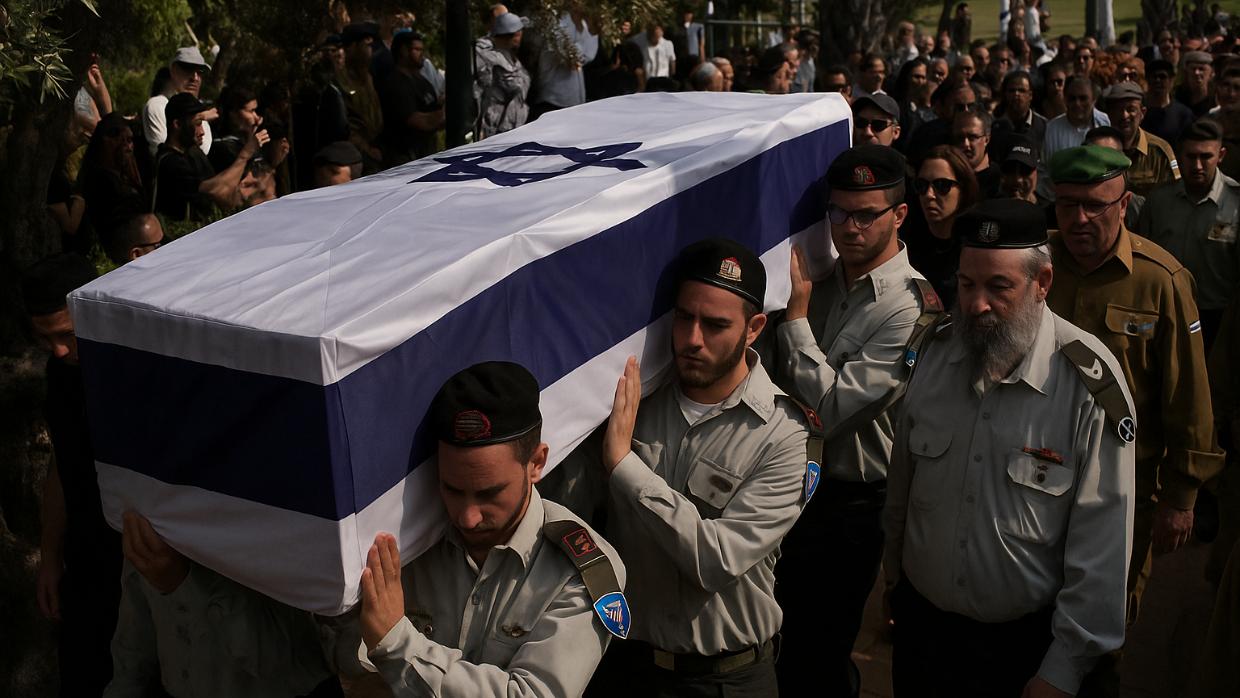
This week, that mission took painful form as the bodies of Omer Neutra and Itay Chen, two American-Israeli soldiers killed in their tanks on October 7, were finally laid to rest, alongside Hadar Goldin, whose remains were held by Hamas for eleven long years.

These funerals, with an outpouring of grief and solidarity, became national moments of unity — reminders that every soldier, every soul, is family. Yet the struggle continues. Hamas still withholds the bodies of three Israelis and one Thai citizen, exploiting their memory as a grotesque bargaining chip in its cruel psychological war.
Why does retrieving the bodies and burying them in Israel matter so much to the Jewish people – religiously, emotionally, and collectively? The answer reveals four essential lessons about life itself:
1. Sanctity of the Body
The body is more than just a physical shell; it is a partner for the Divine soul – a holy vessel through which we fulfill our mission in this world. Without the body, the soul cannot fulfill its earthly purpose.
Even after death, the body retains holiness and is to be cared for with dignity. This is why Jewish law insists on dignity of the deceased – prohibiting cremation, delay in burial, or public display.
Upon death, the soul goes through a process of separation from the body, returning to its destined place in the spiritual world. Burial allows the soul to disengage from the physical realm and find peace in the spiritual one.
The biblical axiom – “For dust you are, and to dust you shall return” – mandates that the body return gently to the earth, entrusted back to its Source, completing a sacred cycle.
Yet until proper burial, the soul remains in a state of suspension – hanging between two worlds, unable to fully rest. To leave a body unburied is to leave a soul’s journey incomplete.
2. Burial in the Land of Israel
As related in this week’s Torah portion (Genesis ch. 23), when Sarah died, Abraham purchased a family burial plot in Hebron. Ever since, Jews have longed to be buried in the Land of Israel. The biblical Jacob, nearing death in Egypt, obtained a promise from his son Joseph to bring his body back to Israel for burial (Genesis 47:29).
Prof. Simcha Goldin, Hadar's father, said at the funeral, “At the moment of redemption from slavery in Egypt, Moses brings Joseph's remains to be buried in Israel. He does so because of the promise made generations ago."
Generations since echo that value. Till today, when Jews are buried abroad, it is customary to sprinkle a bit of soil from Israel into the grave – an unbroken link to our eternal homeland.

For Omer Neutra and Itay Chen, burial in Israel has a special layer of meaning. Having left the comfort of America to defend the Jewish people and the Land of Israel, they now rest in its soil.
Upon the recovery of Omer Neutra's body, his father Ronen quoted the biblical prophecy: "There is hope for your future, God says, and the children shall return to their land" (Jeremiah 31:17).
3. Emotional Healing
Burying the dead is called chesed shel emet – “true kindness” – because it can never be repaid. Yet beyond a kindness to the deceased, burial provides psychological and emotional restoration for the living.
When a loved one’s body is held captive, the mind cannot fully accept the finality of death. Unable to fully mourn and heal, families remain in a perpetual nightmare.
In the words of Itay’s father, Ruby Chen, during those two years of waiting the family was held emotionally captive in Gaza – “trapped, our grief eternally suspended, our emotional wounds bleeding, our mourning stuck in limbo.”
Moving forward, the gravesite provides a vital physical anchor – a place to cry, to remember, and to weave the deceased’s memory into life’s ongoing narrative.
4. The Jewish People Are One Family
The Jewish people are one family, connected to the pain of everyone yearning to bury their loved one. The return of bodies from Gaza is a spiritual mission that restores equilibrium to Israel’s collective conscience – a declaration that every life counts and every story is honored.
This covenant of mutual responsibility is rooted in the ancient pledge, “Kol Yisrael areivim zeh bazeh” – all Jews are responsible for one another. This gives rise to a national promise that “no one is left behind” – not in the field, and not in memory.
In a world that often treats life as disposable, Israel’s insistence on bringing home its dead is also a Kiddush Hashem – a sanctification of God’s name – demonstrating to the world the preciousness of life.
Hadar Goldin, an accomplished artist and budding Talmudic scholar, wrote:
“In the course of our daily lives, we focus primarily on the outside world and feel the impact of our surroundings, but we seldom glimpse into our own soul... If I choose to pursue fleeting pleasures and passing thrills, I miss the opportunity to discover the source of continuous joy: my own soul.”
As long as even one Jewish martyr remains unburied, our mission is incomplete. Those who gave their lives on October 7 are cherished national symbols. May their memory be blessed.










Nice thoughts. But does this really mean that the souls of Jews who are, for example, killed in a major fire or are drowned at sea remain forever in "a state of suspension" and never complete thir journey?
Thanks for this deeply moving text. Since my childhood all my life I have been crying in my heart for my loved grandmother. I was her firstborn grandchild and she invested lots of hope for the family future in me. Before my eyes she was taken away and later burned out under shoah. Some years I suffer by nightmares in the time when she lost her life just like if she was somehow spiritually homeless and expecting I will do something for her to return home... I am not able to bury her... Helena (Prague)
Everything the Rabbi wrote is 100% correct, but according to the halacha, do soldiers have to die in order to bring dead soldiers home? Redeeming captives is an enormous mitzva, but at any price? It is not popular to ask these questions, but having a son and a son-in-law who have served for more than 300 days in reserve duty in Gaza and Lebanon, and knowing what they have to say about this, I feel I am allowed to raise the issue. It's not simple.
There is also the necessity of fully defeating Hamas; the two are not unconnected.
Thank you Rabbi Simmons for expressing so clearly why bringing our loved ones home for burial matters so profoundly to the Jewish people.
I spend many of my waking hours working with LastKindness.org, an initiative created in response to the rising rate of cremation among American Jews — helping more people learn about the importance and meaning of Jewish burial, a dignity that belongs to every Jew, regardless of background or level of observance.
Israel’s commitment to bringing each soul to rest reminds us just how sacred that value truly is.
Point 2 is not fully relevant here if Gaza is Eretz Israel. Naturally, a proper funeral is important and the grave has to be accessible.
In the Gemara (Ketubot 111a) it says:
Rav Anan taught, “Anyone buried in the Land of Israel is considered as though they were buried beneath the altar, for it is written, ‘An altar of earth (adamah) you shall make for Me,’ and elsewhere it is written, ‘His land (admato) will atone for His people.’”
For those who cannot be buried in the Land of Israel, the Chevra Kadisha (those who prepare Jews for burial) use small packets of sand from Israel to bring its holiness and atoning power to the deceased. The Chevra lovingly sprinkle this holy sand on and around the body according to local custom.
It is not always possible to be buried in Israel, so Israel is literally brought to the deceased. This practice is yet another example of the beauty and holiness embedded in our traditions.
Amen!