 A New Holocaust Film Every Young Person Should See



11 min read


Her grandmother ran back from the line of the dead three times and chose life. Bari has been running toward it ever since.
There's a ring Bari Erber always wears on a necklace. It belonged to her grandmother. Engraved around the long necklace are the names of Bari's seven children, A through G, one for each. It's the kind of detail that tells you everything about who Bari is: a woman who carries her past and her future on the same hand, who understands instinctively that legacy isn't something you inherit, it's something you build, generation by generation, choice by choice.
To understand Bari, you have to go back. Not to the Upper West Side of Manhattan where she was born, but to a wealthy Hungarian Jewish family in Transylvania that, like so many, didn't believe the Holocaust was coming for them. Until it did.
At Auschwitz, Bari’s grandmother took a job working for Dr. Josef Mengele, the man known as the Angel of Death.
Bari's grandmother was 17 years old when the Nazis invaded Hungary. She was taken first to Bergen-Belsen, then to Auschwitz, with her younger sister, who was already sick. At Auschwitz, she made a decision that would define her family for generations: she took a job working for Dr. Josef Mengele, the man known as the Angel of Death. Mengele's office was right next to the kitchen, and every night on her way back to the barracks, she could steal potato skins to feed the people sleeping beside her, including her sister, who had no number, no official record, no protection. She kept that secret and kept her sister alive.
Three times, Bari's grandmother was pulled from the line of the living and sent to the line destined for the gas chambers. Three times, she ran back. If you were caught running, you were shot on sight. She ran anyway. Better a chance at life, she said, than no chance at all.
She survived. She came to America on a marriage license, the only way in. She divorced, rebuilt, and eventually met Bari's grandfather, a Moroccan Jew who had fought in the French Resistance and then answered the call to help establish the State of Israel, fighting with the Haganah from 1946 to 1949. He detoured through Manhattan on his way to find his family in Montreal. He never left. He met Bari's grandmother. The rest, as Bari puts it, is history.
When asked how he could trust her to pay the loan back, she said: write down the numbers on my arm. I give you back every penny.
What followed was a family built from almost nothing, no language, no suitcase, no safety net. Bari's grandmother borrowed $30,000 to buy brownstones on West 75th Street, and when the lender asked how he could trust her to pay it back, she said: write down the numbers on my arm. I give you back every penny. She paid back every penny. She cashed her German reparation checks and kept the money in envelopes by the door, handing it out to anyone who needed it. "This is blood money," she told young Bari. "It's to help other people." She lived on what she had. Everything else went out the door.
That open hand. That instinct to give. That refusal to be knocked down for good. This is what Bari was born into.
But inheritance doesn't guarantee a smooth road.
Bari's mother lost her own mother to cancer at 13, a goodbye delivered with almost no support, no therapy, no organizational infrastructure to help a child absorb that kind of grief. She married young, a first-generation Holocaust survivor's son carrying his own unprocessed trauma, and had Bari quickly. By her mid-twenties, she'd been diagnosed with cervical cancer, undergone a full hysterectomy, divorced, and fallen into hard drug addiction.
By her mid-twenties, Bari’s mother had been diagnosed with cervical cancer, undergone a full hysterectomy, divorced, and fallen into hard drug addiction.
It was 1985. Courts gave mothers custody first. So Bari, five years old, and her younger brother went to live with their mother. What Bari remembers of that apartment is fragmentary but visceral: the windows, the kitchen, things being cooked on the stovetop that weren't food, other people in the house, the absence of anything that felt like childhood. She remembers leaving her grandmother's house in a station wagon. She remembers elevator rides. She remembers visiting her father and asking, quietly, if she had to go back.
Her father and grandmother fought to get them home. There were court appearances, a child advocate appointed to represent what Bari actually wanted. What she wanted was to be a normal child. By six, she was back in Manhattan full time, living with her father, already making peanut butter and jelly sandwiches for her little brother. Already, without anyone assigning her the role, the one holding things together.
Her father was 28 years old, raising two kids alone, carrying his own wounds. He showed up. He came to every basketball game. Her grandmother made dinner every night, and they sat down together as a family. It wasn't the picture-perfect childhood, but it was held together by people who refused to let it fall apart.
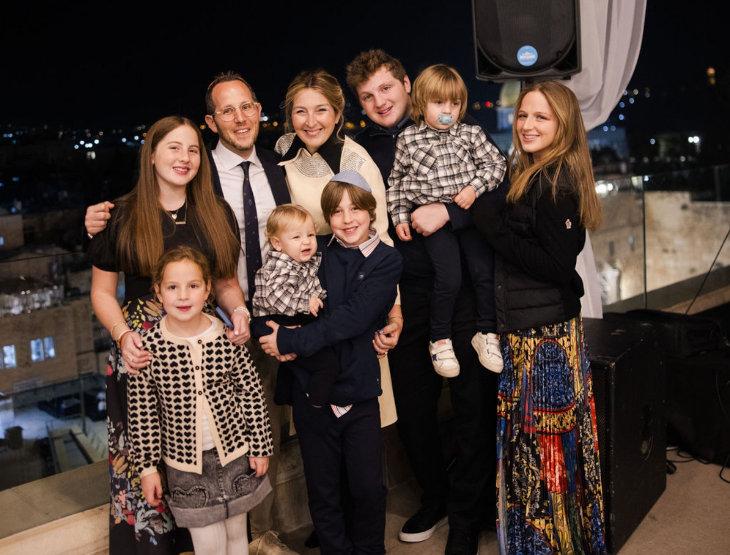 The Erber Clan
Bari wasn't going to become a statistic. She knew it somewhere in her bones. She didn't drink, smoke or touch drugs; addiction ran so deep in her family that she simply wasn't going to give it a foothold. She played basketball and stayed focused. She was bright, funny, a city kid with a single-parent household in a world where that still made you an outlier. She watched people judge her for things that had nothing to do with who she was, and she filed that away too.
She went to Israel for two and a half years after high school, earned her college degree online through Thomas Edison State University before online college was common, then went on to pursue a master's and doctorate in education. She taught early childhood. She was already, in every direction she moved, trying to understand how people learn, how they heal, what they need, and what happens when they don't get it.
Then she had her first daughter, Kelly, and she couldn't find a hair clip she liked. So she made one. Her mother-in-law told her she was out of her mind, that she had a doctorate and shouldn't be making barrettes. Bari told her if she could make $10,000 in the first year, she'd consider it a real business. Her mother-in-law said she'd walk to the bank naked if that happened. By December of that first year, Bari's accessories were already in Fred Segal, Baby Company, and a dozen other boutiques. She never collected on that bet.
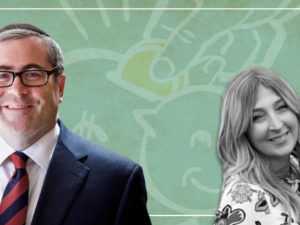
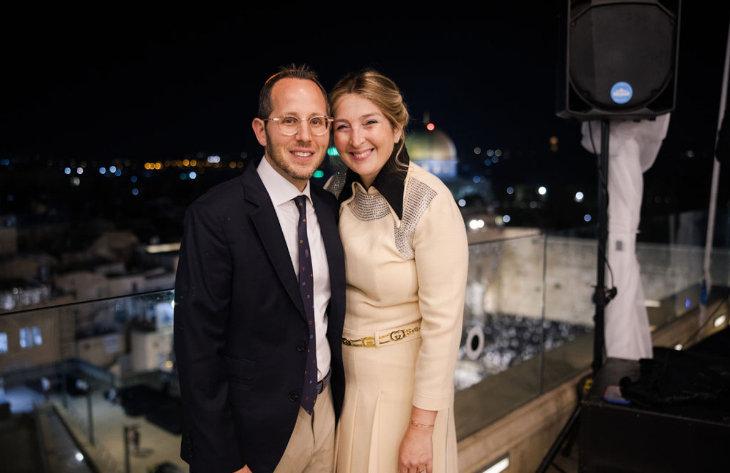 Bari and Dani Erber
What started at her dining room table with nine workers, three babies underfoot, and a heat press in the bassinet became a global brand. The business grew because Bari grew it, alongside her husband Dani, pounding the pavement, building relationships, refusing to put product in Saks or Neiman Marcus because she didn't want to be at the mercy of seasonal markdowns. End-of-season inventory goes to charity, to organizations like Yad Leah and CHOP (Children's Hospital of Philadelphia), to children's hospitals, to kids who need something pretty when the world has given them very little else.
What started at her dining room table with nine workers, three babies underfoot, and a heat press in the bassinet became a global brand.
She will tell you the business was never really the point. The business was the vehicle.
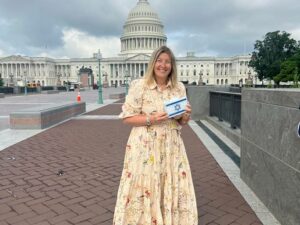
Today, Bari is a significant Jewish philanthropist, though she'd probably argue with that framing. She doesn't write checks from a distance. She shows up. She's in hospitals and army bases and resilience centers. She's at the Gaza border, four months after giving birth to her seventh child, baby in a carrier, because she needed to be there and she needed him to be there too. When soldiers spotted the baby and carried him into a tank without telling anyone, she wasn't panicked. She knew he was with them. She understood, even then, what a baby can do for a person who has seen too much.
After October 7th, she helped lead missions to Israel focused not on grief but on hope, on where the Jewish people are going. She works with hostage families. She sits with bereaved parents. She funds resilience centers for communities on the Gaza border who have lost everything and are rebuilding anyway. She helped build EFG, Gesher (meaning "bridge"), the Erber Family post-high school gap year program at Aish, because she believes that the future of the Jewish people depends on whether 18-year-olds understand they have a responsibility to it.
And she commissions Torah scrolls. Her husband made a promise years ago to keep writing them, one by one, for as long as he could. The first went to their synagogue. The second to his late grandfather. The third to the family of Aish's CEO, Rabbi Steven Burg, in honor of his father who had passed. The fourth for their son's upsherin (a traditional first haircut). Then October 7th happened, and the fifth Torah was written for the families of two soldiers killed when their tank was attacked on its way into Gaza. The sixth is being written now for a secular Israeli woman who lost her son in the war and is building a synagogue in Tel Aviv in his name, a woman who will tell you she didn't choose this path, it chose her, and who gets up every day and spreads hope anyway.
Bari held a Torah-writing event at the Nova music festival site, the field where hundreds of young people were massacred on October 7th. She turned it into something else that day: a barbecue, dancing, singing, families holding a Torah like it was a baby and weeping and feeling, for a moment, that something was being built where something had been destroyed. A Torah, she says, is a light. It has carried the Jewish people through every exile, every expulsion, every attempt to extinguish them. It will outlive all of us. That's the point.
Bari is fully observant, keeps Shabbat, and will tell you that 25 hours without her phone is her favorite time of the week. Her Judaism is about that light, the one her grandmother refused to let go out in the barracks at Auschwitz, the one Bari carries into hospitals and army bases and Nova massacre sites and gap year classrooms and her own home, where seven children are learning, by watching her, what it means to show up for the world.
She'll be the first to say she's not a saint. Design season makes her impossible to be around, by her own admission. What she will tell you is that she tries very hard not to miss things for her children and is intensely hands-on as a mother. She doesn't keep a calendar on her phone. She overcompensates as a mother, she thinks, because hers wasn't there, and she can't fully separate where the love ends and the overcorrection begins. She doesn't have a perfect relationship with her own mother, and she speaks about it with a precision that comes from years of sitting with something painful and choosing not to be destroyed by it.
What she has instead is this: a grandmother's ring on her necklace, a fire that has never gone below a simmer, and the unshakeable conviction that if you have the ability to help, you have the responsibility to help. Not someday. Not when you're ready. Now, with whatever you have, with your sleeves rolled up and, if necessary, a baby in your arms.
Her grandmother ran back from the line of the dead three times and chose life. Bari has been running toward it ever since.
Watch Jamie Geller’s conversation with Bari Erber: