

 The Shofar: Beyond Words





Big resolutions collapse; tiny ones don't count. Here's the resolution strategy built into the Jewish calendar itself.
Rosh Hashanah is often called the Day of Judgment, the day we stand before God and ask for another year of life. It's also the day we show up with big plans for who we want to become. Ten days later, on Yom Kippur, we commit to real change.
And then, almost every time, it falls apart.
This isn't a uniquely Jewish problem. It's a human one. We come up with a sincere, inspired vision for who we're going to be, and the moment the inspiration fades, so does the resolution.
Judaism diagnoses two specific mistakes behind this pattern and offers a fix that's built directly into the structure of the Jewish calendar.
The first mistake is going all in. In a moment of inspiration, we imagine sweeping change: everything we could fix, everything we could become. It feels amazing in the moment. But that vision only works while the inspiration lasts. The next day, sometimes the next hour, the feeling is gone and the vision collapses under its own weight because we were never going to sustain it.
The second mistake is the overcorrection. Burned by past failures, we scale down to something tiny and "realistic," like one blessing said with focus, once a week. But we didn't ask God for an entire year of life just for that. It's not enough to match the size of the moment.
Both instincts are actually right. You need the big vision and the small step. The key is a wordplay embedded in Hebrew itself: the word for change, shinui, shares a root with the word for year, shana. Real change takes a year.
So the big vision shouldn't be about who you want to be tomorrow, or even in ten days. It should be about who you want to be a year from now. And the small, immediate action isn't the whole goal, it's the first step on the road there.
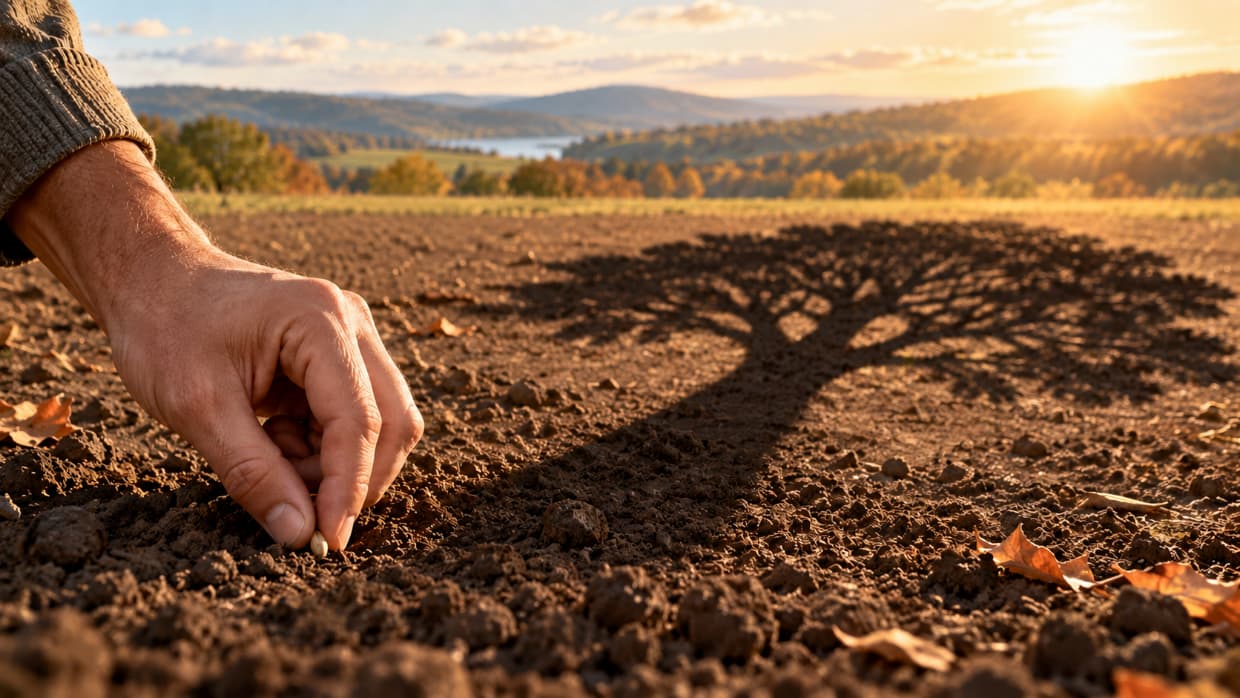
This lines up with the season itself. In the northern hemisphere, autumn is when farmers plant seeds. Spiritually, we're doing the same thing. A seed holds potential, not a finished plant. So on Rosh Hashanah, right after the shofar is sounded, we declare Hayom Harat Olam, "today is the conception of the world." Not the birthday, rather the conception. We're standing before God as He recreates the world, and we're planting the seed of who we want to be 12 months from now.
Over the following week, the Ten Days of Repentance between Rosh Hashanah and Yom Kippur, we work through the practical details. Some changes can happen immediately, like apologizing to someone we've hurt. Most will unfold over the year. Traditionally, we take each of those seven days to focus on a different area of life, seven areas that together cover most of who we are, and identify what actually needs to change.
By the time Yom Kippur ends, we've reviewed all seven areas and chosen one, or maybe two, to actually start moving on.
Right after Yom Kippur, we take that list and move into the sukkah, the temporary hut Jews build for the holiday of Sukkot. The symbolism is deliberate: like the Israelites who left Egypt for temporary dwellings, we're announcing that we're setting out on a journey. We celebrate the vision of the person we're becoming, and the seed we planted on Rosh Hashanah is now in the ground.
From there, the growth is monthly, not annual. Each month, we revisit the list and ask: what's one small step I can take now?
Say your goal is to stop speaking badly about people. Realistically, you can't flip that switch overnight. So maybe your first month's resolution is a single half hour a day, say 2:30 to 3:00, when you're fully committed to not speaking negatively about anyone. The next month, you extend it to an hour, then two. Another month, instead of adding time, you might read a book on the subject, or join, or start, a group working on the same thing.
Through the winter, from the outside, you look the same. But something is developing underneath. You're pregnant with your next self.
Here's where the Jewish calendar itself mirrors this idea. Although the year number changes at Rosh Hashanah, that holiday actually falls in the seventh month of the Jewish year. The first month doesn't arrive until six months later, at Passover. In other words: conception happens in the fall, but birth happens in the spring.
That's exactly how the Jewish people came into being, at the Passover seder, the night we became a nation. And like any birth, that new self starts out fragile and undeveloped.
From Passover to Shavuot is seven weeks, mirroring childhood: a period of maturing, culminating in a bar or bat mitzvah moment where we recommit to the Torah. Then comes summer, the "teenage" stretch, where the struggle to actually live out the vision intensifies. Not coincidentally, this is the season of the Three Weeks, when the greatest tragedies in Jewish history occurred.
Full maturity arrives by the Hebrew month of Elul, the month leading into Rosh Hashanah. Elul is itself an acronym for a verse from Song of Songs, Ani L'Dodi V'Dodi Li, "I am my beloved's, and my beloved is mine." It's the point where the vision planted a year earlier has matured enough to re-enter a relationship with God, and the entire cycle begins again with a new seed.
Walk into Rosh Hashanah with a real vision, not for tomorrow, but for who you want to be a year from now. Then walk out with one small, doable step in that direction. Growth isn't supposed to be instant. It's supposed to be a year-long process of struggling, maturing, and slowly becoming who you're capable of being.
May we all merit visions worth pursuing, the steps to get there, and a blessed year ahead.