






 The Fall of the United Kingdom




5 min read


Ladino bound Sephardic families and traditions for centuries. Nearly lost to history, it’s now finding unexpected revival through teens and global efforts.
Two hundred years ago, the melodious sounds of Ladino floated through the bustling markets of Istanbul and echoed in the quiet courtyards of Greece. It was sung in lullabies and woven into prayers. It bound scattered Jewish communities across the Ottoman Empire and beyond. Some call Ladino the Sephardic counterpart to Yiddish—what Yiddish was to Ashkenazim, Ladino was to Sepharadim.
But what exactly is Ladino, and why has it nearly vanished?
Although Ladino’s roots trace back before the expulsion of the Jews from Spain, it was only after 1492 that it emerged as a distinct Jewish language. Derived from Old Castilian Spanish and enriched with Hebrew, Greek, French, Turkish, Aramaic, and other tongues, Ladino became the voice of Sephardic exile.
When King Ferdinand and Queen Isabella ordered Jews to convert or leave Spain, many chose exile. They dispersed throughout the Ottoman Empire—in Greece, Macedonia, Turkey, and North Africa—as well as in Europe and the Americas. In fact, the first Jews to arrive in America in 1654 were Sephardic.
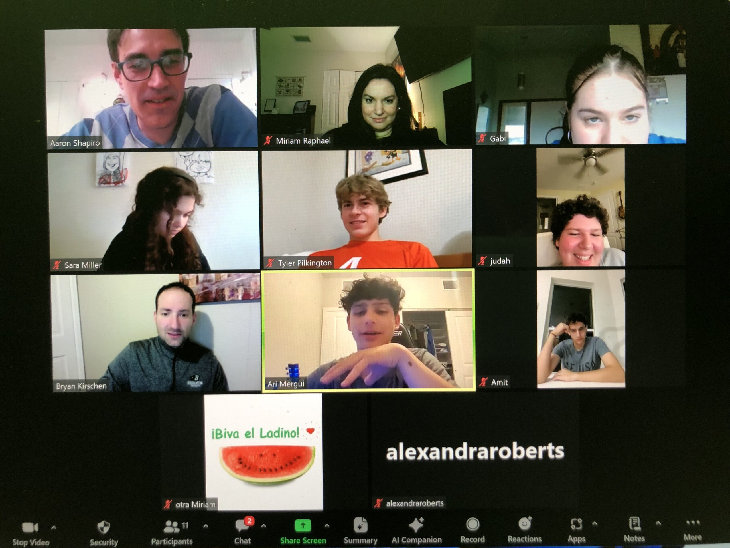 Teens learning Ladino online.
Over the centuries, Ladino preserved vocabulary and grammar long forgotten in modern Spanish, evolving into a bridge language that united far-flung Sephardic communities. It carried not only conversation but also literature, folk tales, and religious texts. Rabbi Yaacov Culi’s Me’am Loez, first published in 1730, was a groundbreaking commentary in Ladino—the first major Jewish commentary not written in Hebrew or Aramaic—opening sacred learning to an entire community.
How did a language so deeply woven into Sephardic life decline to the point of near extinction? The unraveling was gradual, shaped by wars, migrations, assimilation, and modern nation-building.
The Balkan wars and the disintegration of the Ottoman Empire scattered Ladino speakers into new host countries, each with a dominant language and little tolerance for linguistic diversity. Families adapted by shifting to French, Turkish, Italian, or other tongues.
Even in Israel, Ladino faced challenges. Hebrew was embraced as the unifying national language, and Ladino, seen as old-fashioned, was often not passed down to children. Within two generations, in many Sephardic households, Ladino slipped from everyday use.
The most devastating blow came during the Holocaust. While history often centers on the destruction of Yiddish-speaking Ashkenazi Jews, Sephardic communities suffered as well.
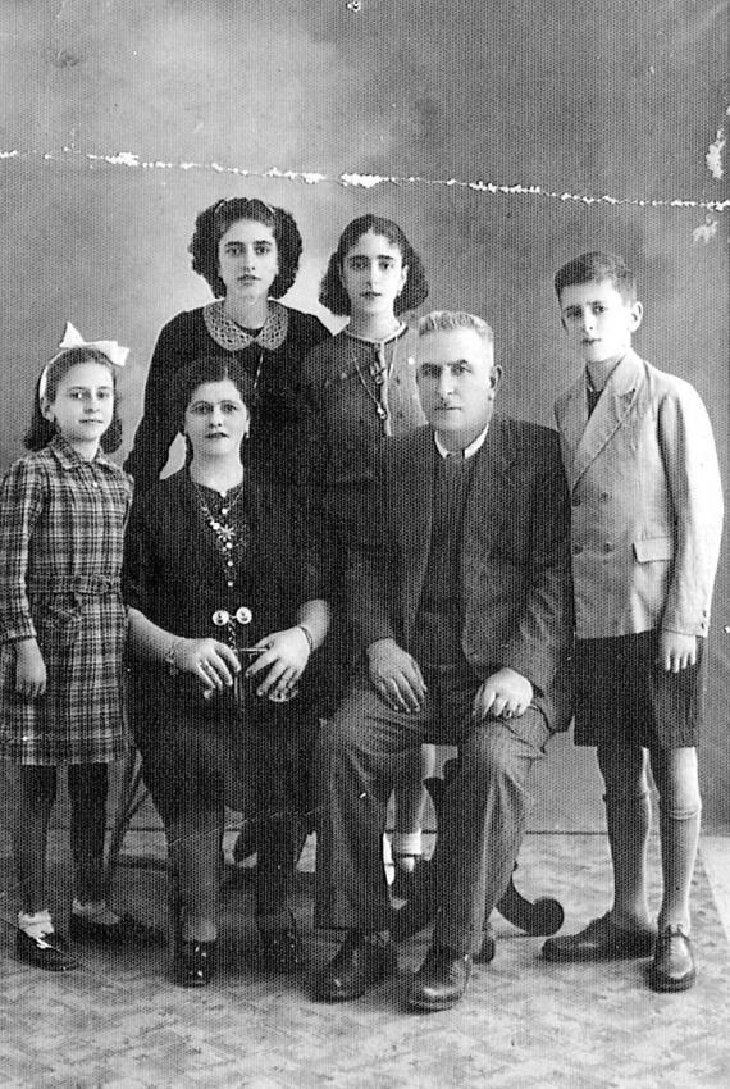 The Hasson family of Rhodes from 1935 before they were deported from Rhodes (Yad Vashem)
Before the war, Sephardim were a smaller, more scattered minority. Ladino-speaking centers in Greece, Yugoslavia, Macedonia, France, and Italy were targeted and destroyed. On the island of Rhodes, for example, 2,000 Jews were deported in 1944 on what became the longest transport of the Holocaust—a 1,500-mile journey lasting nearly three weeks. Only 151 survived. In total, historians estimate that some 150,000 Ladino-speaking Jews perished.
Though the number was smaller compared to Ashkenazi losses, the proportional impact was catastrophic. The cultural centers that had sustained Ladino were extinguished, and the scattered survivors no longer formed the critical mass needed to keep the language alive.
By the early 21st century, it was impossible to ignore: without intervention, Ladino would vanish. In 2002, UNESCO declared it an endangered language. Fifteen years later, the Royal Spanish Academy created a Judeo-Spanish branch in Israel to help preserve what it called Ladino’s “rich and profound cultural legacy.”
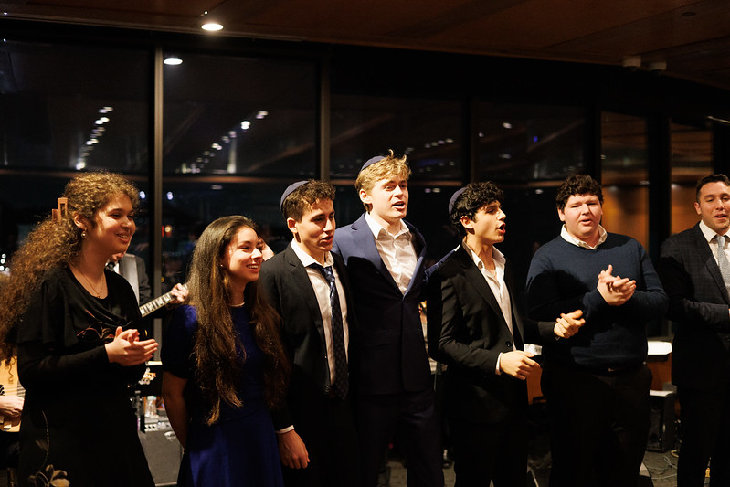 Youth leaders singing in Ladino at The Sephardic Brotherhood gala
Universities such as Tufts, the University of Washington, Binghamton, and Harvard have developed programs to study and preserve the language. Community groups and online platforms have also become gathering places for learners. During the pandemic, many Sephardic seniors began teaching Ladino virtually, unexpectedly sparking renewed interest among younger generations.
This revival took an especially unexpected turn in 2022, when a group of Jewish teenagers in South Florida formed the Ladino High School Club of America (Bivas). Their mission was to revive Ladino and raise awareness of its decline among their peers.
Through Torah study, Sephardic cuisine, Shabbatons, and cultural celebrations, the club has drawn teens from across the United States. Roughly 40% of its members are not Sephardic but Ashkenazi, Mizrachi, or unaffiliated—drawn by the vibrancy of Sephardic traditions. Within a year, members joined from Seattle, Los Angeles, Atlanta, Philadelphia, Rochester, Miami, and the Northeast.
Their efforts attracted the attention of The Sephardic Brotherhood, the oldest Sephardic organization in America (founded in 1916), which now sponsors the club. Together, they are creating leadership opportunities and connecting teens to Sephardic identity in innovative ways.

The club’s next Shabbaton will be held on September 19 at Philadelphia’s historic Mikveh Israel synagogue (founded in 1740, the fourth-oldest in America). The colonial-themed retreat will explore the overlooked history of Sephardic Jews in the American Revolution, linking Sephardic heritage to the United States’ upcoming 250th anniversary in 2026.
Today, Ladino stands at a crossroads. Declared endangered, yet experiencing sparks of revival, it has a fragile but real second chance. With global efforts, intergenerational learning, and the passion of Jewish youth, the language of Sephardic lullabies and prayers may once again find its voice.
If you would like to know more about The Ladino High School Club of America and the Colonial Shabbaton and how you can register for it, please visit www.Bivas.org














Ladino will go extinct unless it is passed onto the next generation. Ladino is a very important part of the Jewish narrative and I commend these young Jewish leaders for trying to preserve it.
Many years ago, I completed a PhD in Spanish history. Many of my sources were founded in London's British Library (then called the British Museum). I would often find Ladino texts bound together with collections of Spanish pamphlets and plays. I was fascinated and always read them - delaying the completion of my thesis, but greatly enriching my mind.
Do you already have an archive of texts which includes 18th-century publications?
Thank you.
Good news to hear that Ladino is not forgotten. I remember my uncle (z"l) singing the Pesach service in Ladino for us.
A second and last story. Back in the 60's I was reading a magazine, which I think was Scientific American. One of the articles was relating that scholars were studying Ladino spoken by Sephardic Jews so they could document how Spanish had been spoken in fifteenth century Spain. I was in my early twenties and had never heard of Ladino before then.
Many years ago I read an autobiography by the Nobel laureate, Richard Feynman. One year Feynman was preparing for a sabbatical in Rio de Janeiro. He hired a tutor to teach him Portuguese. When he finally was on the plane to Brazil, he heard a couple of business men speaking in the seats in front of him. He decided to listen in, not to be nosy but to test his understanding of Portuguese while on the flight. He couldn't seem to understand them at all. When the plane landed and people were standing in their seats, he told the men that he was listening in to their conversation to test his knowledge of Portuguese and it was a total failure for him. The two chuckled and said that they were Jewish and they were speaking Ladino to each other.
Yes! This is taken directly from his book, "Surely, you're joking Mr. Feynman". One of my favorite reads.
Yes, Miriam. He was both a genius in his field and also quite a character as one learns when reading that autobiography.
Wonderful that Ladino is being rescued from the flames of history!!!
Kudos to the Ladino club! So great to see their enthusiasm.