




 Antisemites Spit on my Grandson at Miami Beach




11 min read


The Nuremberg Trials changed how humanity defines justice. Learn why their legacy remains vital in an age of denial and distortion.
The Nuremberg Trials were a turning point in human history — the moment when the world first declared that an international tribunal would hold individuals to account for their actions during wartime. For the first time, “crimes against humanity” entered the global vocabulary, forever changing how nations view justice, morality, and responsibility. No longer would those who committed atrocities be able to hide behind the defense that they were merely following orders.
Nearly eight decades later, as historical awareness fades and denial spreads, revisiting Nuremberg isn’t just an academic exercise — it’s a moral imperative. The trials remind us that law can confront evil, that truth must be documented, and that justice, however delayed, is possible. Understanding what happened in that courtroom helps us defend the principles of human dignity and accountability that the modern world depends on.
The new film Nuremberg – directed by James Vanderbilt and starring Russell Crow as senior Nazi Hermann Goering and Rami Malek as US Army psychiatrist Douglass Kelley who becomes obsessed with the nature of evil as he evaluates Goering and other Nazi’s standing trial –reignites a vital conversation about justice, truth, and moral responsibility. In a world where denial and distortion of history persist, Nuremberg reminds us that facing evil with accountability remains one of civilization’s greatest tests.
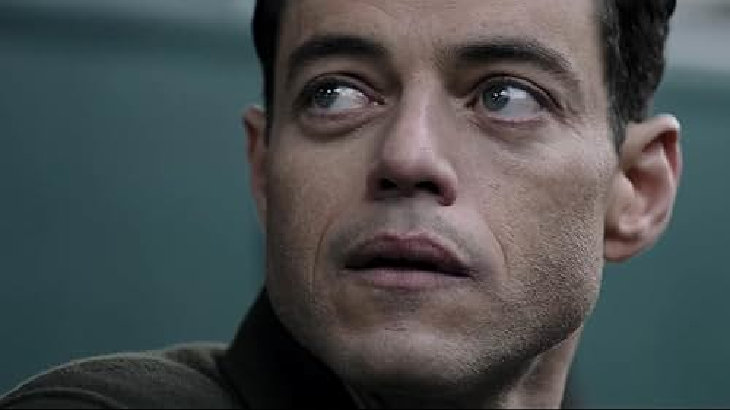 Rami Malek portrays Douglass Kelley in the film Nuremberg
Here are ten key facts that help explain why the Nuremberg Trials remain one of the most important events in modern history.
In the summer of 1945, as World War II drew to a close, the victorious Allied powers created an “International Military Tribunal” (IMT) to prosecute “the major war criminals of the European Axis”. (A second IMTFE, or IMT of the Far East prosecuted war crimes by Japanese forces.)
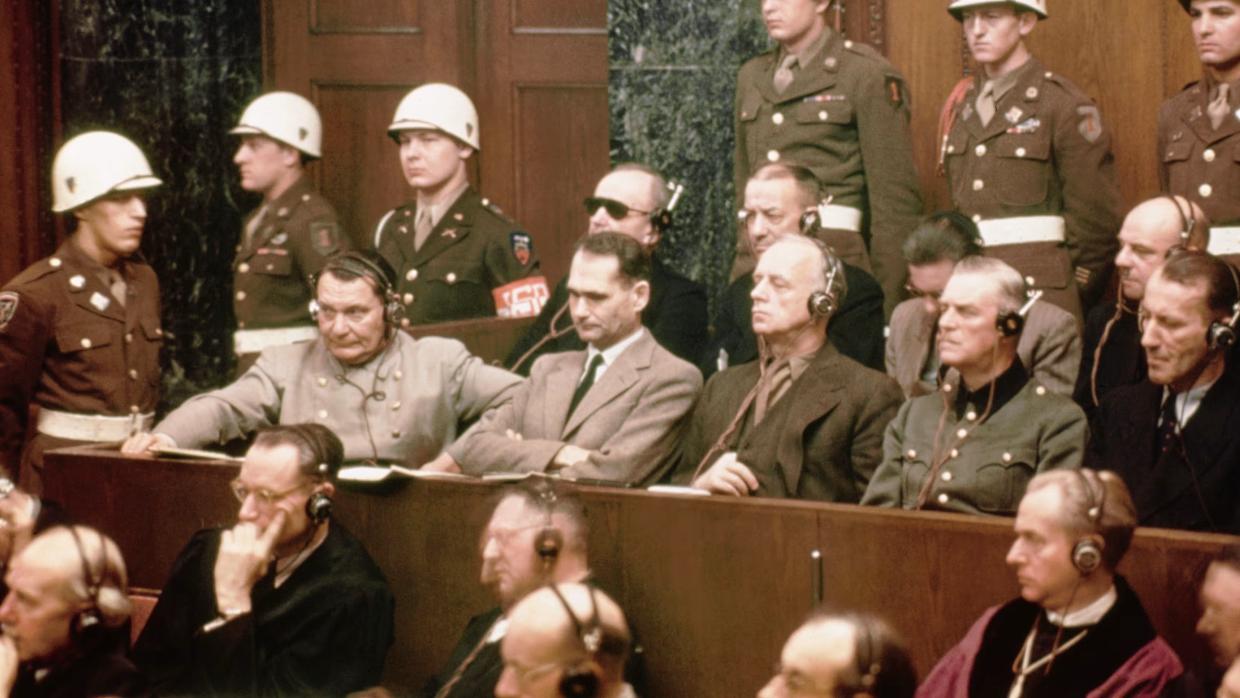
The IMT’s first trial began in October 1945 and concluded one year later. In this groundbreaking trial, a team of British, French, American and Soviet judges and prosecutors tried 22 senior Nazi officials and seven Nazi organizations for horrific crimes. Defendants included Rudolf Hess, Hitler’s deputy; Joachim von Ribbentrop, German’s Foreign Minister; Albert Speer, Germany’s Minister of Armaments who institute a wide-ranging slave labor program; Alfred Rosenberg, who ruled Nazi Germany’s occupied Eastern Territories; and Hermann Goring, head of the Luftwaffe. In addition, Nazi organizations such as the SS and the Gestapo were put on trial.
Two Nazis who were charged in the Nuremberg Trials never made it to court. Robert Ley, head of the German Labor Front, took his own life the day before the trial began. Gustav Krupp von Bohlen und Halbach, the head of the Reich Association of Industry, was deemed too ill to stand trial (though he was brought to court in later proceedings). Both men were responsible for the enslavement, torture, starvation, and agonizing deaths of millions of people during the war.
Faced with the Nazis’ unprecedented cruelty, Allied leaders began making plans to try Nazi leaders while the war was still being fought. One milestone in the quest for justice was the 1943 Declaration of Atrocities, signed by US President Franklin D. Roosevelt, Soviet Premier Joseph Stalin, and British Prime Minister Winston Churchill, which promised to bring Nazis to account should the allies win the war:
The United Kingdom, the United States, and the Soviet Union have received from many quarters evidence of atrocities, massacres and cold-blooded mass executions which are being perpetrated by Hitlerite forces in many of the countries they have overrun…those German officers and men and members of the Nazi party who have been responsible for or have taken a consenting part in the above atrocities, massacres and executions will be sent back to the countries in which their abominable deeds were done in order that they may be judged and punished according to the laws of these liberated countries of free governments which will be erected therein….
In 1945, it was decided to hold the first trials of Nazi officials in the German city of Nuremberg, which had been the site of some of the largest pro-Nazi rallies before and during the war.
The Nuremberg Trials were the first time in recorded history that judges from four nations presided over a trial together. Britain, France, and the Soviet Union each sent two judges; the United States sent three judges. (Only one judge from each country had voting powers.) Lord Justice Geoffrey Lawrence from Great Britain served as the Chief Justice in the trials.
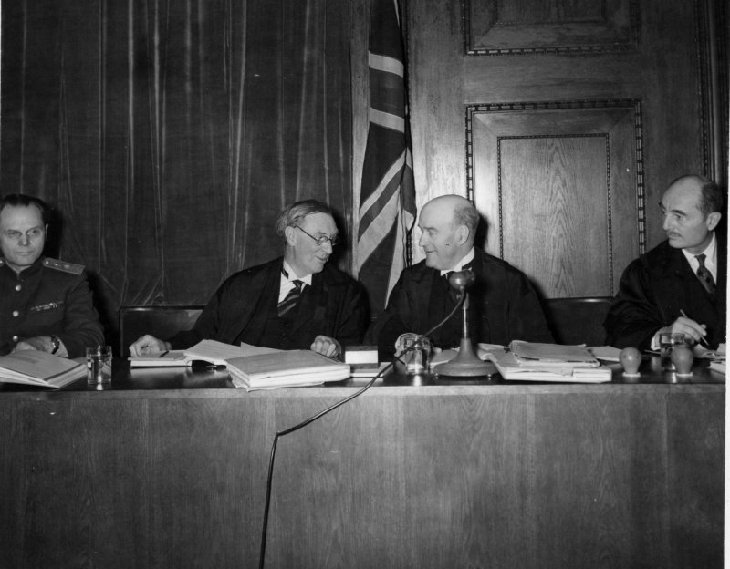 Judges at the Nuremberg War Crimes Trials. From left to right: General Ion Nikitchenko (Russian judge), Sir Norman Birkett, Sir Geoffrey Lawrence, and Francis Biddle (United States judge).
In 1945, consecutive translation was the norm: translators would listen to a speaker, then translate their words, line by line. Given the enormous scope of the Nuremberg Trials, this method was far too slow.
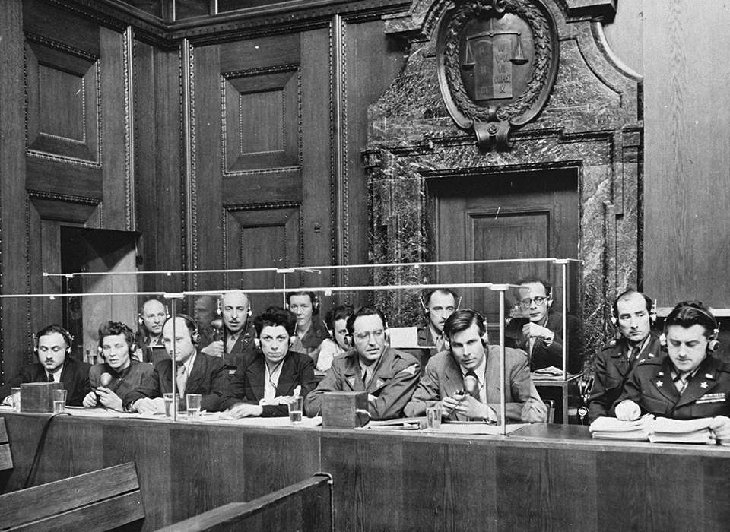 Translators at the Nuremberg Trials
Using cutting edge technology produced by IBM, the Nuremberg Trials broadcast testimony to a team of over 100 translators who translated what was being said into English, German, Russian, and French. Additional translators in Polish, Yiddish, and other languages stood by to help when needed.
Since the translators could only translate 60 words a minute, far slower than most speech, each microphone in the trial was fitted out with two lights: one yellow and one red. When translators wanted speakers to slow down, they flashed the yellow light; they could also ask speakers to pause by flashing the red light.
A major departure during the trials was the decision to try individuals, not states, for war crimes. The prosecution was led by Justice Robert H. Jackson, a US Supreme Court Justice who flew to Nuremberg to prosecute these historic trials.
It was crucial to Justice Jackson that the defendants did not hide behind national law to defend their actions. The fact their heinous crimes they committed were legal and even celebrated within Nazi Germany was no justification. The Nuremberg Trials established the principle that there is a higher law of human action. In his opening speech to the court, Justice Jackson noted that in Nuremberg, “the real complaining party in this trial is civilization.”
Raphael Lemkin, a Jewish legal scholar who’d escaped from Europe, helped prepare the US case for the Nuremberg Trials and invented the term Genocide.
Born in 1900 in Poland, Lemkin became a lawyer and advocated for laws protecting the rights of minority groups. He warned that the Ottoman Turkish genocide against Armenians in 1915 could be repeated against other groups. Lemkin escaped Poland after the Nazi invasion, moved to the United States, and found work documenting Nazi atrocities for the US Government. When Lemkin arrived in Europe in 1945 for the Nuremberg Trials, he found out that 49 members of his family had been murdered by the Nazis.
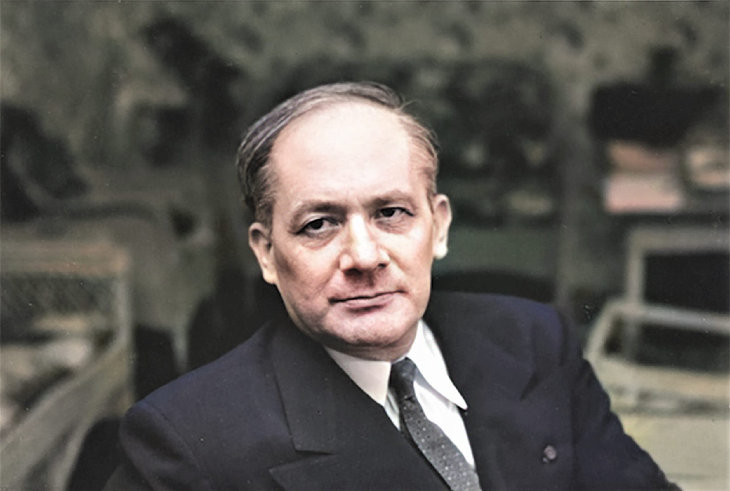 Raphael Lemkin
Lemkin coined the term “genocide” in his 1944 book Axis Rule in Occupied Europe and was able to get the word entered into some charges at the Nuremberg Trials. His definition was:
By ‘genocide’ we mean the destruction of a nation or an ethnic group. This new word, coined by the author to denote an old practice in its modern development, is made from the ancient Greek word genos (race, tribe), and the Latin cide (killing)...
Although Jews and other groups such as Gypsies had been marked for “extermination” and decimated by the Nazis, no defendant at Nuremberg was charged with genocide. Crimes fell under three broad categories.
“Crimes Against Peace” included charges that defendants planned, prepared, and initiated a war of aggression. (The fact that the Soviet Union had been allied with Germany at the beginning of the war before switching alliances caused some tension during the trials.)
Defendants were also accused of War Crimes, defined as “murder, ill-treatment or deportation to slave labor or for any other purpose of civilian population of or in occupied territory, murder or ill-treatment of prisoners of war or persons on the seas, killing of hostages, plunder of public or private property, wanton destruction of cities, towns, or villages, or devastation not justified by military necessity.”
A final category of charges included Crimes Against Humanity: “namely, murder, extermination, enslavement, deportation, and other inhumane acts committed against any civilian population, before or during the war, or persecutions on political, racial, or religious grounds…”
Over the course of nearly a year, for 216 court sessions, witnesses recounted the horrific crimes they’d witnessed. One typical day, for example, the court heard the testimony of “citizens M.F. Petrenko and N.T. Gorbacheva, who lived near Babi Yar,” the site where Nazi and sympathetic Ukrainian civilians murdered 100,000 people, mostly Jews. The witnesses “stated that they had seen how the Germans threw babies into graves, and buried them alive with their dead or wounded parents. One could see the surface of the ground. This marked the last struggles of the alive who were buried.”
Another typical piece of evidence was given by Rudolf Hoss, the commandant of Auschwitz.
“I was ordered to establish extermination facilities at Auschwitz in June 1941. At that time, there were already in the general government three other extermination camps: Belzek, Treblinka, and Wolzek… I visited Treblinka to find out how they carried out their extermination. The Camp Commander at Treblinka told me that he had liquidated 80,000 in the course of one half year. He was principally concerned with liquidating all the Jews from the Warsaw Ghetto. He used monoxide gas, and I did not think that his methods were very efficient. So when I set up the extermination building at Auschwitz, I used Cyclon B…It took from 3 to 15 minutes to kill the people in the death chamber…To know when the people were dead because their screaming stopped….”
When the verdicts for the Nuremberg Trials were read out on October 1, 1946, three defendants were acquitted: German banker Hjalmar Schacht, a close ally of Hitler who participated in a failed assassination attempt against Hitler in 1944; Franz von Papen, who helped pave the way for Hitler to assume power; and Nazi propagandist Hans Fritsche.
Four defendants were sentenced to prison terms between ten and twenty years: submarine commander Karl Donitz; Hitler Youth leader Baldur von Schirach, Armaments Minister Albert Speer, who also participated in a plot to assassinate Hitler; and senior Nazi leader Kostantin von Neurath.
Former submarine commander Erich Raeder, Economics Minister Walther Funk, and Hitler’s former deputy commander Rudolf Hess were all sentenced to life in prison. (They did not serve their life sentences: Rader was released in 1955; Funk was released in 1957; and Hess took his own life in 1987.)
Twelve defendants were sentenced to death: Hans Frank, who ruled occupied Poland; Wilhelm Frick, Germany’s Interior Ministry who helped create Nazi Germany’s race laws; Alfred Rosenberg, who served as Germany’s Minister for the Eastern Occupied Territories; Ernst Kaltenbrunner, chief of the Gestapo and Einsatzgruppen killing teams; Joachim von Ribbentrop, Nazi Germany’s Foreign Minister; Fritz Sauckel, an architect of Germany’s slave labor program; Alfred Jodl, head of the Wehrmacht; Arthur Seyss-Inquart, a senior Nazi who ruled over occupied Austria, Poland, and the Netherlands; Martin Bormann, Secretary of the Nazi Party; and Hermann Goring, Hitler’s one-time second in command.
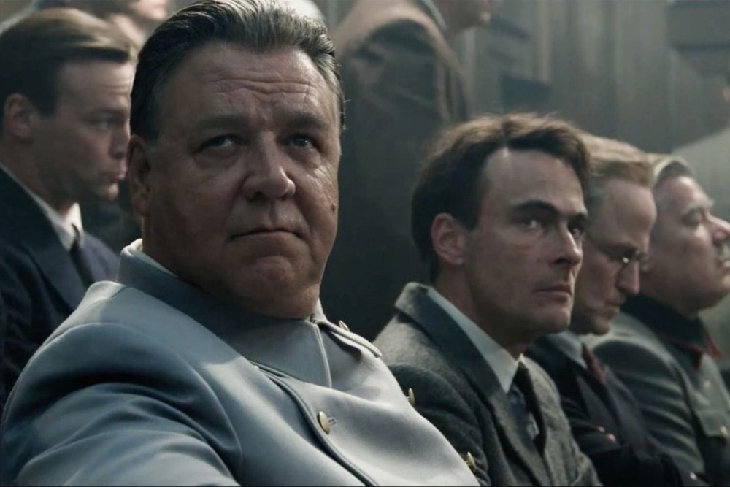 Russel Crowe portrays Hermann Goering in the new film Nuremberg
Ten of the guilty prisoners were executed. Martin Bormann was found guilty in absentia; he likely took his own life at the end of the war and his remains were found years later in Berlin. Hermann Goering, the subject of the new film Nuremberg, took his own life the night before his scheduled execution. He’d told confidantes that he felt his sentence of hanging wasn’t a dignified death.
Between 1946 and 1949, legal teams from the US, Britain, Soviet Union and France carried out another dozen trials of senior Nazis at Nuremberg. The first among these began in December 1946. Known as the “Doctors’ Trial,” this proceeding heard evidence against 23 German doctors accused of crimes against humanity. Other joint trials in Nuremberg focused on Nazi killing squads, the SS, industrialists who used slave labor, and senior members of Nazi Germany’s military and government.
Ignorance about the Holocaust is at an all-time high. One recent poll found that half of all young people in the United States were unable to categorically state that the Holocaust is not a myth. Worldwide, only about half of all people have even heard of the Nazi Holocaust.
In the face of so much disinterest and outright denial, it’s more crucial than ever to educate ourselves about the Holocaust.










Very interesting. I guess the Allies did their best to arrive at "justice" of some type. You can only kill one Nazi, even though he may have killed hundreds, etc. If there is a "God" I hope he has created a special type of "Hell" for these murderers, including the ones that managed to avoid punishment. "Human justice" just doesn't go far enough. As for the "non-believers" of the Holocaust, they should have their eyes removed, since they don't use them! Lots of evidence out there to read/look at.
Unfortunately, a lot of Nazis ( Y " S) escaped justice, the country of Israel put Eichmann ( Y " S) on trail and he was hung, burned and his( Y " S) ashes went into the sea, all the terrorists now should also have the same end, now Israel and Jews are accused of genocide which is false, our enemies want to make genocide against Jews and Israel, there is a movie about the " Nurenberg Trials " but a lot manged to escape and had no consequences for there crimes against humanity there were 6 million Jews and 5 million others, but mostly they concentrated on murdering Jews, even when the Nazis ( Y " S) were losing the war, and the Muslim Arab terrorists are no better but they flipped it around which is called projection, because they want to make genocide against the Jews and Israel
Right after the Holocaust, around May 5 1945 the world should of learnt it in schools, also Dwight Eisenhower filmed a liberated concentration camp, and also at in archives that were films from concentration camp from Alfred Hitchcock a director from films were found recently, also Holocaust Survivors were interviewed plus there are in different colleges and 8n Israel Yad Vashem, to learn about the Holocaust I don't have to learn about the Holocaust because my mom( obm) was a Holocaust Survivor ( obm) and anyone that survived the Holocaust was a eye witness to uou
Where can one find the movie Nuremberg?
I used to have a channel on TV that had old classic movies , maybe it was called TMC classics which gave the movie the Nurenberg Trials it must of been in their movies archives, and showed it on occasion, I wonder how you can get this information, how do write to them, to get the movie unfortunately there are no blockbuster where you can rent movies, I wonder if libraries carry the movie or a school that learns how to make films carry the movie, you have to make research how to get hold of the movie, Good luck on your search, I think the host of TMC classic movies is Jewish
Interestingly, one of those executed, Julius Streicher, was not mentioned in the article. He was responsible for producing the virulently antisemitic periodical, Der Stumer (the Stormtrooper). While he did not directly harm anyone, his antisemitic propaganda had a profound influence on the population of Germany and helped make it acceptable to slaughter Jews. The sad reality is that if this material were published today in the United States, it would be protected by the first amendment. The US Supreme Court addressed this issue in the 1960's. Even though the opinion expressed concern with the vicious antisemitic material under review, the Court still found it protected. While the US has a very strong judicial system and constitution, there is still a great deal to be worried about.
NEVER FORGET the atrocities against the Jews. I was born in Germany, grew up in USA, and have always had a deep sense of sadness for the WAR CRIMES committed by the Nazis!!!
Churchill said if we do not learn from history we are doomed to repeat it. What are these young people learning in school? I am a child of survivors. I live with it everyday. my parents brought me up with emunah (faith) otherwise I donʼt know how I would survive. Also, President Roosevelt bbwas just as guilty. He knew about the trains going to Auschwitz and refused to bomb the tracks.
I agree with you, I am also a child of a Holocaust Survivor( obm)
By the time the US entered the war, Pearl Harbor had been attacked and US opinion was focused on defeating enemies. The defeat of the Nazis saved Jewish, European, and American lives.
A few addenda to this excellent summary - the Nazis on trial were a minute number of the murderers who were willing participants in the atrocities; a larger number of collaborators stood trial in the USSR and other East Block countries who were far less lenient than the judges at Nuremberg. All too few were caught and escaped justice. The fact that the Nazis relied on a large contingent of volunteers from Spain to Sweden is also a "forgotten" issue; many of them were members of the SS and, among others, concentration camp guards and committed atrocities similar to their German "brothers". I am aware that these and many other details were not included in this movie but they deserved at least some mention, if only to inform the largely ignorant public.
I saw the movie last night. I would not have missed it. I married into a survivor family. The stories my beloved father-in-law told me remain in my heart. My children and grandchildren are aware of the price that our families paid. My husband was the first Jewish boy born in the dp camp, Poking. We will never forget and try to educate those who don't understand. Thank you for this heart wrenching movie.
Very informative and I think everybody needs to be taught about this and what happened. That way it won’t happen again, but the way things are going in our society, I’ve never seen it so bad against us. I never thought I’d see it like this, but we will survive we always do.
Unfortunately, history has proven to be an ineffective teacher; nevertheless, we have no choice but to pursue justice while keeping in mind that though human justice can fail, Divine justice does not.
I guess it's ok for world leaders to say, we're not going to interfere with the Nazis killing of Jews, that's not our business. When the war is over, if we win, then we'll make those responsible for the genocide are held accountable. This article presumes that we shouldn't focus on that hypocrisy.
With statistics like those written at the end of the article show that we are doomed to see another Holocaust again. I have heard it said that Rashi wrote in the Talmud that he did not think the Jews would survive the Crusades. Again and Again they rise up to try to extinguish us. Shortly before going to the Mikveh, at the end of my conversion process, a "Rabbi" asked me to imagine I was living during the Holocaust and I was there as they rounded up Jews (including me) to be put in cattle cars on Trains, would I deny being Jewish? The question through me for a loop, I thought about what would be if I had my own child or children with me. What would I do to make sure they survived? As these thoughts went through my head, I realized that I could not and would not answer this "Rabbi".
Nitpick — “Ignorance about the Holocaust is at an all-time low.” I don’t think this is what Dr. Miller means to say.
That statement is a verifiable fact!
You need to state the verifiable sources.
Check out the links in Dr. Miller's article, which is only one of the many polls available.
For secular young people whose main (or only!) source of info is the rot they read on social media, we shouldn't expect any better, I suppose.
Ignorance about the Holocaust is at an all-time high. One recent poll found that half of all young people in the United States were unable to categorically state that the Holocaust is not a myth