Click here to buy
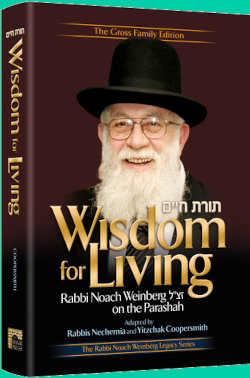
Wisdom for Living
Rabbi Noah Weinberg on the Parashah



9 min read


The Torah says, "The Children of Israel were armed (chamushim) when they went up from the land of Egypt" (Shemos 13:18).
Rashi explains, based on the Midrash, that the word "chamushim" means “divided by five (chamishah).” In other words, one out of five Jews left Egypt, while four-fifths died during the three days of darkness. Earlier, in Parashas Bo, on the verse, "And there was thick darkness over the entire land of Egypt for three days" (10:22), Rashi notes: "Because there were among the Jewish people of that generation wicked people who did not want to leave. They died during the three days of darkness, so that the Egyptians would not see their downfall and say, 'They too are being smitten like us.'"
This is an incredible statement. Four-fifths of the Jewish people wanted to stay in Egypt. Four-fifths of the Jewish people had assimilated so deeply that even though they understood that Hashem sent Moshe to take them out of Egypt, they preferred to stay in the land that oppressed them. This was after eight plagues that even Pharaoh and his advisors recognized were coming from the Almighty, as they stated, "Etzba Elokim hi – This is the finger of God."
Despised by the Egyptians, the vast majority of Jews nonetheless viewed themselves as part of the fabric of Egyptian culture. They were worshiping their idols, attending their theaters, visiting their museums – completely submerged in their culture.
It makes you pause and wonder: if Mashiach were to come today, how many Jews outside of Israel would pack their bags and leave their homes and businesses to come to the Holy Land, even if we knew it was the Almighty telling them to come?
Assimilation cuts very deep. It dulls the soul, seeps into our bones, and causes us to lose our bearings.
What was the merit of the one-fifth of the Jewish people who did leave Egypt? The Sages say that in the merit of three things our forefathers left Egypt: they did not change their clothes, their names, or their language. Chochmas Adam (89:1) explains:
Becoming close to [the nations] causes us to learn from their actions, as it is written, “But they mingled with the nations and learned their deeds” (Tehillim 106:35). Therefore, our Creator commands us to separate ourselves, as it is written, “And I have separated you from the peoples (Vayikra 20:27)."
[See also Vayikra Rabbah 32:5.]
The Jews in Egypt used their Hebrew names. They wore clothing that clearly identified them as Jews, perhaps a yarmulke or tzitzis. And they did not change their language; they spoke Hebrew. But they were completely assimilated, as the Sages say, “These [Egyptians] are idol-worshippers and these [Jews] are idol-worshippers" (Zohar 2, 170b). They were uncircumcised.
"The land became filled with them" (Shemos 1:7): the persecution was triggered by the Jews becoming part of the nation, going to the theaters and circuses (see Shemos: With Fury Poured Out). Yet they did not change their names or their clothing, and they spoke Hebrew.
The Sages tells us that this was their saving grace. Eighty percent of the Jews died in Egypt. The one-fifth that came out was saved because they held onto their Jewish identity by the skin of their teeth. How could they have assimilated to such a degree but still kept their unique names, language, and clothing? What made them cling to that?
In 1977, during the height of the Cold War, when the Soviet Union was boycotting Israel, the Maccabi Tel Aviv basketball team was playing against CSKA Moscow, the team of the Red Army, in the European Cup semi-finals. The Russians refused to play in Tel Aviv and they also refused to grant visas to Israelis to play in Moscow. In the end they compromised and played in a small town in Belgium. It was an emotionally charged game, infused with symbolic meaning.
While Israelis were glued to their television sets watching the pivotal game, Russian Jews in the Soviet Union who had never been to Israel and knew next to nothing about Judaism found themselves rooting for the Israeli team as well. They could not read Aleph Beis, but they identified with the Israeli team as being "our team."
Imagine Maccabi Tel Aviv playing against an American all-star team in Staples Center, or Israel's national soccer team playing in Brazil. Would the local Jews in these stadiums cheer for the opposing Israeli team in front of their friends and thousands of other spectators, or would they root for their home team? It’s not so clear. But in the Soviet Union, where dissidents had to risk their lives to learn Torah and study Hebrew, Russian Jews proudly identified with the Israelis who represented their people, even though it was only in the context of a non-Jewish sporting event. (By the way, the Maccabi Tel Aviv team beat the heavily favored and mighty Soviets 91-79.)
Did they have the Jewish education to understand what it really means to be Jewish? No, but they knew they were Jewish, they knew that Jews had returned to their homeland and built a country against all odds, and they were proud of it. Most of them could not at that time articulate what exactly they were proud of, but holding on to that tenuous pride was their saving grace. Because they were proud to be Jews, they wanted to know what being a Jew really means. Their vestige of Jewish identity propelled them to learn Torah and speak Hebrew.
The Sages (Zohar, Parashas Yisro) tell us that the Children of Israel in Egyptwere on the forty-ninth level of tumah, on the verge of spiritual annihilation. The reason that one-fifth came out of Egypt was because even though they were totally assimilated, they were proud to identify themselves as Jews. They kept their names, their clothing, and their language. Bedecked in their kippahs and shtreimels, Shmulik and Zelig conversed in Hebrew as they watched the Egyptian Olympics.
According to the Midrash, the Jews in Egypt were redeemed in the merit of not changing their names, their clothing, or their language. Why was this merit necessary? Throughout the Jewish people’s stay in Egypt, the tribe of Levi spent their days immersed in Torah. They steadfastly observed the mitzvos they had been given, including bris milah. Shouldn't the merit accrued by the tribe of Levi have been enough to save the rest of the Jewish people?
The same question arises in connection to the Rambam's description of the history of idolatry and Avraham Avinu's revolutionary teaching of monotheism. The understanding of One God, as the Rambam explains, was about to be extinguished as the Jewish people languished in Egypt. He writes:
When the Jews extended their stay in Egypt, however, they learned from the [Egyptians'] deeds and began worshiping the stars as they did, with the exception of the tribe of Levi, who clung to the mitzvot of the patriarchs – the tribe of Levi never served false gods.
Within a short time, the fundamental principle that Avraham had planted would have been uprooted, and the descendants of Yaakov would have returned to the errors of the world and their crookedness. Because of God's love for us, and to uphold the oath He made to Avraham, our patriarch, He brought forth Moshe, our teacher, the master of all prophets, and sent him [to redeem the Jews]. After Moshe, our teacher, prophesied, and God chose Israel as His inheritance, He crowned them with mitzvos and informed them of the path to serve Him, [teaching them] the judgment prescribed for idol worship and all those who stray after it.
(Hilchos Avodah Zarah 1:3)
The Rambam states that even though the tribe of Levi clung to the mitzvot and never served idols, the clarity of monotheism was about to be uprooted from the world, had the Jews not been redeemed right away.
It is clear from here that when Hashem judges the Jewish people He looks at the nation as a whole. It is not sufficient to have one distinct part of the klal, the nation, holding steadfast in their commitment to Torah and mitzvot. Even though the tribe of Levi was a bastion of Torah learning, they could not save the Jewish people in Egypt when the nation as a whole was on the brink of irreversible assimilation. It was the merit of the nation just barely clinging to their Jewish identity through their names, clothing, and language that redeemed them.
The vibrant Torah community is the heart of our nation; without that life force we cannot survive. But all Jews are interconnected, forming parts of an integrated whole, and God assesses the spiritual health of the entire Jewish people. No part can sever itself from the whole.
Never in Jewish history have there been more people learning Torah full time, but at the same time assimilation is wreaking havoc on our people. We are losing untold numbers of Jews. We cannot sanguinely take refuge in the teeming yeshivas where, thank God, the sound of Torah learning, reverberates. God is looking at the Jewish people as a whole and He sees millions of Jews, the vast majority of our people, on the brink of extinction.
Every Jewish neshamah, soul, is precious to the Almighty. Every intermarriage is a tragedy that hurts like parents losing a child. Hashem yearns to save His people. He is expecting us who appreciate His Torah and mitzvot to reach out to our brothers and sisters. Otherwise we will become swept up, God forbid, in whatever measures Hashem deems necessary to straighten out His people. If the love for our fellow Jews burns strongly in our hearts, we can defeat the tide of assimilation. The Almighty, and all of humanity, is counting on us.