






 The Red Cross’s Jewish Problem

7 min read
2 min read




She was the key to saving humanity. He killed to protect her. Was it justice, murder—or both? A Jewish ethical exploration.
The Last of Us—first a bestselling video game, now a hit HBO series—takes place in a world where one infection changes everything.
A parasitic fungus called Cordyceps mutates and begins infecting humans. The result is catastrophic: within weeks, civilization collapses. Cities are abandoned, overrun by monstrous “Infected”. Governments fall. Martial law and anarchy replace order. It’s a world that feels almost biblical in its desolation.
Twenty years later, humanity hangs on by a thread. Survivors live in fortified quarantine zones or amongst ruthless factions. Trust is rare. Morality is fluid. The infected are everywhere, but so is the fear that people are worse.
In this broken world, we meet Joel, a smuggler haunted by the death of his daughter during the early days of the outbreak. He is tasked with escorting Ellie, a 14-year-old girl, across the country. She has survived a bite from the infected—yet shows no symptoms. She is immune.
Ellie may be humanity’s only hope.
Over their long and dangerous journey, Joel and Ellie face ambushes, infected, cannibals, and worse. But in the silence between firefights, something deeper happens: Joel begins to see Ellie as a daughter. She becomes more than a mission; she becomes family.

When they finally reach the Fireflies, a rebel group seeking a cure, Joel is told the devastating truth: in order to make a vaccine, doctors must remove the mutated fungus from Ellie’s brain. But doing so will kill her. She is unconscious and unaware of this fate. No one has asked her permission.
Joel is told to say goodbye.
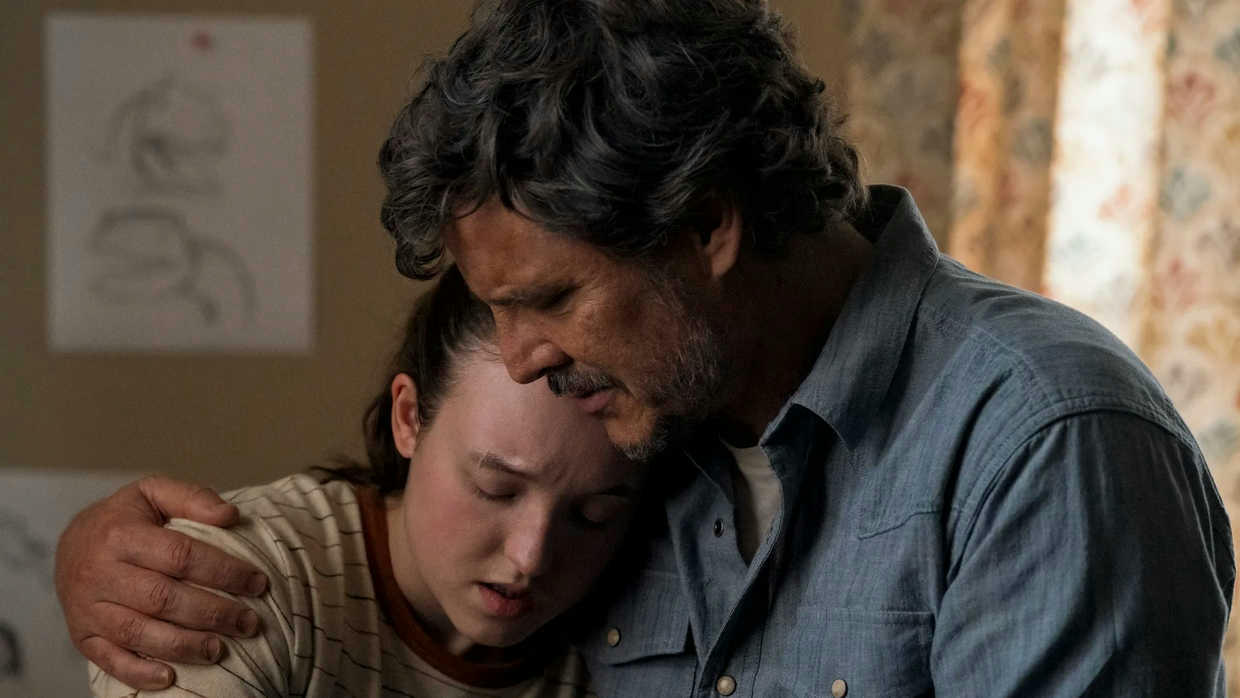
Instead, he chooses to fight. In a burst of violence, he storms the hospital, kills Firefly guards and the surgeon, rescues Ellie, and escapes. Later, when Ellie wakes up, he lies to her: “They had others like you. They didn’t need you after all.”
The ending provoked passionate responses. Some condemned Joel for denying humanity a cure. Others defended him for refusing to allow an innocent person to be killed without consent.
From a Jewish perspective, the story raises critical questions:
Jewish law takes the value of human life very seriously. In fact, it teaches that saving a single life is like saving an entire world. We’re allowed to violate almost every commandment in the Torah—Shabbat, fasting on Yom Kippur, even many prohibitions—just to save one life.
But there are limits. And Joel’s situation lands right in the middle of one.
The Jerusalem Talmud presents a harrowing case: A group of Jews is surrounded by enemies who say, “Hand over one of you, or we’ll kill everyone.” The ruling according to Jewish law? You’re not allowed to give up even one person—unless they’re already deserving of capital punishment.
Ellie isn’t guilty of anything. She’s not a threat. She’s not a criminal. She’s an innocent teenager. Killing her—even with the hope of developing a cure—is not permitted. The Torah doesn’t operate on utilitarian math. You don’t weigh one life of infinite value against many. A person’s life can’t be treated as a tool, even for the noblest end.

This means that what the Fireflies planned was wrong—plain and simple. No matter how much good might have come from it, Jewish law doesn’t permit sacrificing the innocent.
But that’s only part of the question. The next issue is: What was Joel actually allowed to do in response?
In Jewish law, there’s a concept called rodef—a “pursuer.” If someone is actively trying to kill another person, Jewish law permits you to stop them—even with lethal force—if that’s the only way. But this comes with an important condition: if you can stop them through non-lethal means, you must.
So were the Fireflies “pursuers”? Absolutely. They were moments away from killing Ellie without her consent. This was an attempted, unjust killing. Joel had the right to intervene—even violently—to save her.
But what if Ellie had agreed to the procedure? Would consent make the operation permissible?
The answer is complex. Yes—in rare cases—but generally, no. Suicide is forbidden. Life belongs to God. Noble intentions don't override that. Yet Jewish law does recognize rare acts of voluntary self-sacrifice—not mandated, but permitted—as mesirut nefesh, a willingness to endure hardship—or even give one’s life—for Jewish faith and values.
According to Rabbi Akiva: “Your life takes precedence over your friend’s” (Talmud, Bava Metzia 62a). You may not forfeit a definite life to possibly save others. Ellie’s life was certain; the cure was not. Joel’s decision aligns with this principle.
Jewish tradition honors actions like that of Major Roi Klein, who jumped on a grenade in the Second Lebanon War to save others. His act wasn’t suicide, but kiddush Hashem, a sanctification of God’s Name.
During the Holocaust, figures like Rabbi Elchanan Wasserman stayed with their students, and others gave themselves up to protect loved ones. These are seen as exceptional rulings for exceptional times—spiritual heroism, not normative law.
Ellie’s case might fall in that category—had she been a consenting adult. But she wasn’t. She was 14, unconscious, and never given a choice (which later made it hard for her to forgive Joel for taking it away). Halacha would not call it sacrifice. It would call it murder.*

So what do we make of Joel’s choice?
According to Jewish law, he did the right thing. He stopped a murder about to happen and protected an innocent life. That’s not a betrayal of humanity—it’s its defense.
But how he acted still matters. The Torah values process as much as outcome. If he used excessive force or killed unnecessarily, those actions would be prohibited. Jewish law has boundaries, even in saving lives.
And what about Ellie?
Had she been asked and chosen to sacrifice herself, that act—though not required—might have been seen as praiseworthy, a form of mesirut nefesh, of great self-sacrifice.
Maybe that’s what The Last of Us is really asking. The title isn't just about survivors. It’s about the last of something deeper: truth, conscience, and morality.
Who are “the last of us”? Those who hold to their values when everything else is gone.
Joel, flawed but resolute, didn't let an innocent girl be sacrificed for hope. He acted to stop injustice, not to dominate.

Ellie, even in her vulnerability, stood as a symbol of hope. Her life mattered not just as a potential cure, but as a person—a world unto herself.
In a broken world, Joel saved one life. And in Jewish thought, that means he saved a universe.
With insights from Rabbi Yitzchak Berkovits and Rabbi Noson Weisz












Very relevant considering the calls of hostage families and their allies for Israel to stop the war and accede to all of Hamas' demands in return for those they hold captive.
Two relevant stories come from Torah. Firstly, Abraham argues with HaShem to save Sodom. The heart of the matter is whether or not it is good to save the many at the expense of the few? And the cost to the 10 few good souls? Their inevitable corruption by the evil doers. What would be the cost to the Jews and to the world if the Germans were allowed to continue the Holocaust unabated? The answer is all the good that they would bring to the world.
The second story is about Lots' daughters who sacrificed themselves to save what they believed was humanity. Did they commit an averah or a mitzvah?
Interesting!
Excellent article about this show, which I have not seen. And stimulating comments. So, here's my question: if suicide is forbidden by halacha, what does our tradition say about a patient's choice to Do Not Resuscitate, or about a hopelessly cancer-riddled patient's decision to suspend medication that extends life and take only meds that deal with pain?
As a 78-year-old guy who, Baruch Hashem, is healthy but not getting any younger, I would be jumping at the chance to hear your comments.
Mr. Hoffman, I will answer your question briefly but you definitely should seek a more detailed explanation from a rabbi. In general, a DNR is considered to be in keeping with Halacha. The Jewish perspective on the end of life is that it is not recommended to take extraordinary measures to extend life once a person is already in the process of dying (and certainly not if they are already dead). However, if someone has unknowingly already intervened and revived you, or if you are being sustained by life supporting equipment it is also not permitted to remove such support in order to end your life. . . To the best of my knowledge.
A perspective for consideration..When i was in school for medicine during instruction for various methods/ forms of CPR which means cardio pulmonary resucitation, it was pointed out that at that time the patient was dead. Dead was defined at that time as absence of breath/ resperation/pulmonary & absence of heartbeat/cardio . Thus clinical death. (You do not perform CPR on live people/ patients it could kill them but if they are already dead it could resucitate/ restore/ return life.) Thus DNR is do not resusitate. You don't recusistate the living, you can only try to resusitate the dead.
I recently wrote a chatbot, AskHillel.com , to decide ethical questions from a Jewish perspective (but not a halachic perspective.) I thought this would be a perfect test for it. So here are its comments on this article, which it mostly agrees with but adds some nuance: ;: https://chatgpt.com/share/68487e53-15fc-8008-8356-8d3424592726
--
Dear EoZ, ( and by the way, thank you for many years of your brilliant service to our larger Jewish community) I agree with you that Joel’s later lie to Ellie does muddy the ethical waters. And this is the intention of the show. In season 2, Ellie’s growing suspicion about Joel’s lie comes to the surface and has a disruptive impact on their relationship.
Precisely why I have my rabbi as one of my medical power of attorneys (MPOA’s)
This is especially important because it appears that the current "liberal" mindset WOULD be willing to MURDER someone innocent in order to [potentially] "save" many.
It is the same mindset that allows (And may even push) "assisted suicide" (a.k.a. murder) and the same push-back applies. One's life is of "infinite value" and one cannot make "value determinations" to decide to "end" it.
In the Talmud it says if you safe a life you save a world, and if someone does the opposite they destroy worlds, and Jews try to save worlds when they don't have to kill us for self defense in certain situations
Oops, to kill others for self defense like in times of war
This is a fantastic article that seriously engages with the questions raised by the series. Thank you.