





 A New Holocaust Film Every Young Person Should See



6 min read


While Anne Frank hid, Hannah Senesh grabbed a gun and parachuted into Nazi Europe. Why does the world remember one and ignore the other? A conversation with author Matti Friedman.
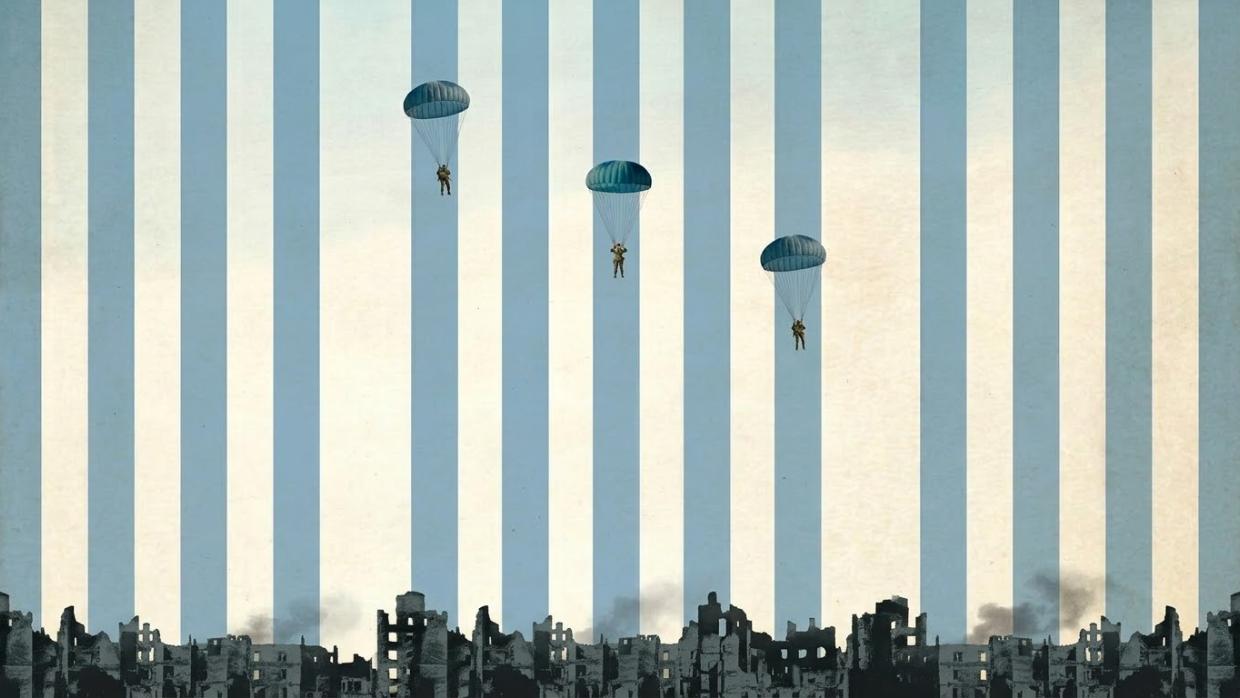
In the final years of World War II, a small group of young Jews parachuted into Nazi-occupied Europe on a nearly impossible mission: to help rescue Jews and fight the Nazis from within.
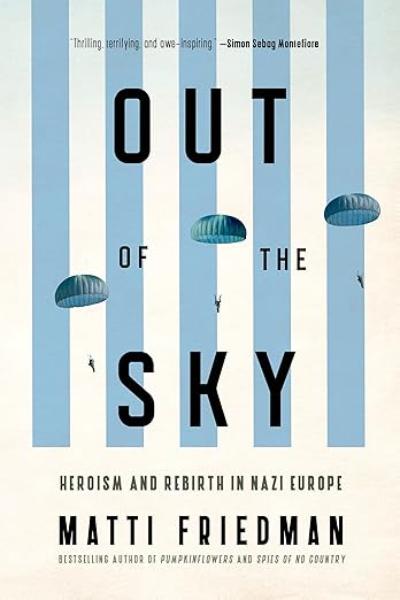
Their story is the subject of Matti Friedman’s new book, Out of the Sky: Heroism and Rebirth in Nazi Europe. Drawing on diaries, letters, and archival material, Friedman reconstructs the lives of these volunteers, many of them barely in their twenties, who jumped into one of the darkest moments in Jewish history.
To write the book, Friedman immersed himself in the archives and personal writings of the parachutists.
 “There were thousands of documents in the Haganah [pre-state Israeli Army] archive,” he told Aish.com in a recent interview. “Memoirs written by the participants who survived, and letters and diaries written by participants who didn’t survive. It was a totally extreme thing to do… You really had to jump into the story and inhabit it to understand what they did and why.”
Although the events in the book took place 80 years ago, Friedman believes the lessons feel strikingly relevant. For many readers today, especially after October 7, one of the book’s central themes will feel familiar: the limits of Jewish power in a hostile world.
“No one’s going to look out for us if we don’t,” Friedman said. “Even our allies have other, more pressing concerns… Most countries will prefer those considerations to our well-being.”
In that sense, the parachutists were living in a reality many Jews hoped had disappeared after the creation of Israel.
“The only real difference between us and them—and it’s a big one—is the existence of the state,” Friedman said. “That’s the anomaly. That’s what makes me different from Hannah Senesh.” Senesh—a Hungarian-Jewish poet who had emigrated to British Mandatory Palestine as a teenager and later volunteered to parachute behind enemy lines into Nazi-occupied Europe—is one of the central figures in Friedman’s book and one of the most extraordinary characters in modern Jewish history.
Many of the volunteers understood that difference clearly. Some of them would ultimately give their lives in the effort to help build the Jewish state that did not yet exist.
Among the parachutists, one name stands out: Hannah Senesh, the Hungarian-Jewish poet and resistance fighter who parachuted into Europe in 1944 and was eventually captured and executed by the Nazis.
Senesh is remembered in Israel as a national hero. Internationally, however, another Jewish girl from the same era became far more famous: Anne Frank.
Friedman believes the contrast is revealing.
“Anne Frank became a universal symbol,” he said. “She’s a young girl who writes beautifully and believes in the essential goodness of people.”
Senesh’s story is very different. “Hannah Senesh takes a gun and a parachute and volunteers for British special operations,” Friedman said.
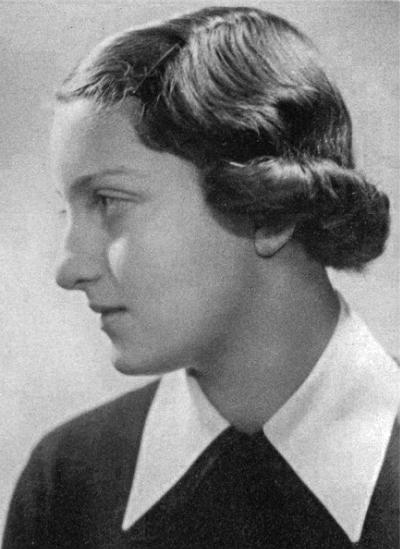 Hannah Senesh, 1939 (Wikimedia)
The contrast reflects the kind of Jewish story the world finds more comfortable.
“There’s a reason Anne Frank is globally famous and Hannah Senesh is known mainly to Jews,” Friedman said. “Senesh’s story makes people uncomfortable, just as Zionism makes many people uncomfortable.”
Unlike Anne Frank’s quiet martyrdom, Senesh represents something more confrontational: the Jewish determination to defend itself and fight back.
Yet Senesh’s story was never simply about vengeance.
In one of her wartime poems, she describes lighting a small torch “in the bonfires of war” as she searches for a human face. For Friedman, that line captures the moral heart of her mission.
“She’s not going into Europe to avenge the Holocaust,” he said. “She’s going to restore humanity—to save people from being chewed up by this industrial machine of slaughter.”
That message, he believes, remains deeply relevant during wartime.
“Wars make you inhuman,” Friedman said. “Doing what it takes to win takes a real toll on your humanity.”
Even in a just war, maintaining that humanity is difficult.
The word Friedman returns to again and again in connection with Senesh is the Hebrew word adam, meaning human being, person. It recurs throughout her surviving poetry, most famously in her celebrated poem Eili Eili that has become an iconic Israeli folk song, which concludes with that single word. In spite of her life’s hardship, Senesh poetry contains a search for the human face in the heart of chaos.
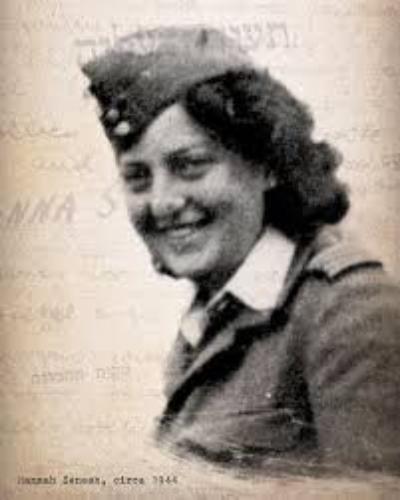 Hannah Senesh, 1944
That message proved strikingly alive in our own time. As the Israeli army organized its ground operation in Gaza in the weeks after October 7th, Friedman recalled a striking moment: a battalion commander, on the eve of his unit’s deployment into Gaza, gathered his soldiers and read them Senesh’s poem “In the Bonfires of War.” At the very moment Israel was mobilizing for combat, this commander reached not for a battle cry, but for a poem about searching for a human face in the flames. It was, Friedman believes, exactly what Senesh would have understood.
“We have to remember not just the humanity of our enemies—but our own humanity as well.”
In the end, Friedman believes the deeper theme of the book touches on something Jews have always understood: the power of storytelling.
In the early decades of Zionism, there was no state, no army, and no government. There was only an idea.
“The only power Zionism had in its early years was the power to tell a story,” Friedman said.
For millennia before that, stories helped sustain Jewish identity across continents.
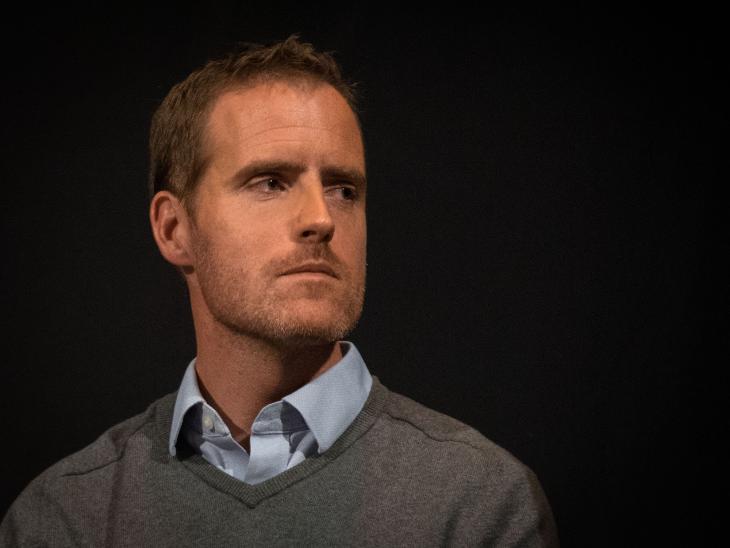 Author Matti Freidman (Wikipedia Creative Commons,Arielinson)
“What held Jews together over two millennia of exile?” he asked. “Stories—books, Shabbat, Passover, the stories we tell about who we are and where we’re going.”
Today, he believes that shared narrative has become harder to articulate.
"We can't tell a story abroad because we don't have a story we're telling ourselves," Friedman said.
What he means becomes clearer when you look at Israel today. The stories that unified the first pioneering generation of Israelis building a country from scratch no longer hold the country together. Since October 7th, a record number of Israelis have left the country, even while immigration to Israel remains strong. The result is a country that struggles to explain itself to the world, in part because Israelis themselves no longer agree on what story they are living.
"People who are closer to the texts have an easier time," Friedman said. "Jews who live in close contact with the tradition feel that they know what they need to do, and that they're part of something that started a long time before them and will continue a long time after them. There's real power there, and it gets lost when you jettison the tradition."
The young parachutists of the 1940s lived inside a very clear story of right and wrong, heroism and redemption. They believed the Jewish people could change their fate. They were willing to jump into history to prove it.














I'm ready to start cooking for Pesach
Excellent Article!
"People who are closer to the texts have an easier time," Friedman said. "Jews who live in close contact with the tradition. So true. Psalm 119 tells us that Great peace have those who love the word.Pray and tuck into God, the world will wash over you.