

 Embrace Your Jewish Identity





9 min read


GOOD MORNING! This upcoming Sunday night, December 14th, the holiday of Hanukah begins. I find it particularly fascinating that, after the Passover Seder, the holiday of Hanukah is the second most widely observed Jewish holiday. Sadly, this might be because many think Hanukah is just a Jewish version of Christmas. I have heard countless parents say some version of the following to their children; “No honey, we don’t celebrate Christmas – we’re Jewish and we have Hanukah.”
In last week's column we discussed the extraordinary survival of the Jewish nation through three millennia of attempted annihilations and persecutions. Of course, this is due to the will of the Almighty and a practical consequence of the strong superstructure of religious life put in place by the Torah. The story of Hanukah highlights this truism.
In many ways, the Greeks of antiquity were a very open-minded society and their goal – like every nation with an agenda of world domination – was to incorporate everyone else into it. In order to achieve this, they demanded that everyone conform to their vision of a utopian society, whether by guile or violence. Unfortunately, for the Jewish nation this meant abandoning Judaism, the Torah, and everything for which they stood. Sadly, many Jews became “Hellenized” and surrendered the religion of their forebears.
In the end, the story of Hanukah celebrates the triumph of the holy Torah and Torah ideals over paganism and secularism. But I have often wondered if many of those who celebrate Hanukah today would have actually chosen Judaism and a Torah way of life had they lived some 2,300 years ago.
In addition, Hanukah has a particularly unique aspect to it – one that is found nowhere else in Judaism, and the lesson it teaches us can be truly life changing. But first a little historical background:
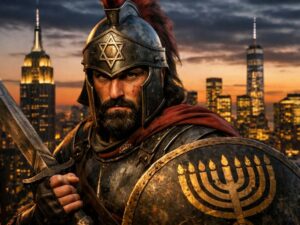
In 167 BCE, the Syrian-Greek and Hellenistic emperor, Antiochus Epiphanes, set out to destroy Judaism and incorporate the Land of Israel and its inhabitants into his empire. His soldiers descended upon Jerusalem, massacring thousands of people and defiling the city’s holy Second Temple with idol worship by erecting an altar to Zeus and sacrificing pigs within its sacred walls.
However, the evil Antiochus knew that a mere physical attack on the Jews would not accomplish his goal. He therefore mounted an attack on the very superstructure of Judaism. First, he prohibited studying and teaching the Torah. By prohibiting the study of Torah he was attempting to eliminate the spiritual backbone of the Jewish people.
He then issued a ban prohibiting the practice of three mitzvot (commandments): 1) Shabbat observance 2) Sanctification of the new month (establishing the first day of the month by testimony of witnesses who saw the new moon) 3) brit mila (entering the Covenant of Abraham through Torah-ordained circumcision).
Why are these three mitzvot central to the superstructure of Judaism?
Shabbat signifies that God is the creator and sustainer of the universe and that His Torah is the blueprint of creation, imbuing the world with meaning and values.
Sanctifying the new month determines the monthly calendar and the exact dates of the Jewish holidays. Without a functioning calendar there would be communal and religious chaos. Brit mila (circumcision) is a sign of the special covenant between the Jewish people and the Almighty. These three mitzvot form a foundation for the structure of Judaism. Without them our cultural integrity would quickly deteriorate and dissolve, and we would slowly assimilate and submit to the Greek culture.
A family of Jewish priests – Matityahu and his 5 sons, known as the Maccabees – weren’t having it. They started a revolt and three years later they succeeded in evicting the oppressors. The victory was a true miracle – on the scale of present-day Israel being able to defeat the combined forces of all of today’s super-powers (this might also explain why the emblem of the State of Israel is a menorah).
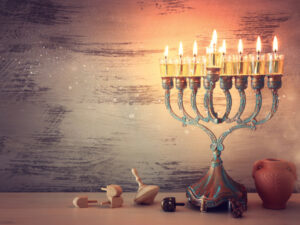
Once the Jewish people regained control of the Temple in Jerusalem, they wanted to rededicate it immediately. The symbol of this rededication was to be the lighting of the menorah on the newly recaptured Temple Mount, which was part of the Temple’s nightly service. In order to do this, they needed ritually pure olive oil. But only a single intact cruse of oil was found. This was just enough to burn for one day, however, they needed oil for eight days (the time it would take for new ritually pure olive oil to be produced). A miracle occurred and the single small jar of oil burned for eight days. Thus, the Temple was rededicated; in fact, the word Hanukah means “dedication” in Hebrew!
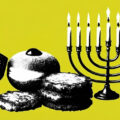
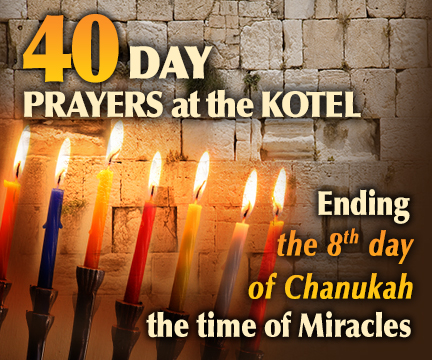
To commemorate the miracle, we light Hanukah candles (or better yet, menorahs filled with olive oil) for eight nights. The first candle is placed on the far right of the menorah with each additional night’s candle being placed to the immediate left. One says three blessings the first night (only two blessings each subsequent night) and then lights the candles, starting with the furthermost candle to the left (the newest addition). We light the candles near a window or in our doorways so that others may see them, in order to publicize the miracles that occurred on Hanukah.
We also have a custom to eat foods fried in oil (latkes, doughnuts, etc.) as a nod to the miracle that took place with the oil. Another tradition is for kids (and those young at heart) to play with a dreidel – a four-sided top with a Hebrew letter on each side referring to the miracles that took place in ancient Israel. It is generally played with money or chocolate coins. The game of dreidel recalls that when the Greeks prohibited Jewish children from gathering to study Torah, they pretended that their gatherings were to play a gambling game with a top.
But there is also a much deeper meaning to Hanukah as well. Hanukah, as we know, celebrates the victory over the Greeks who tried to eradicate the study of Torah and its values. One of the greatest differences between Greek culture and Jewish culture is how we view our relationships with others.
A defining element of the Hellenistic culture was that of athletic matches. This is very clearly highlighted by the value that the ancient Greeks placed on competition. In fact, perhaps the most enduring legacy that Greek culture has left the world is the Olympics and athletic competitions. In other words, the Greeks defined personal excellence by what they achieved in comparison to others.
The jargon of competition is so ubiquitous in our lives that we hardly notice how violent the descriptions are. One team “beat” the other. The word “beat” can easily be substituted with the words “slaughtered,” “killed,” “destroyed,” etc. This kind of attitude defines measuring one’s achievements not only by what you have accomplished but also through the demoralization of your opponent.
Of course, this is rather unfair as everyone was created with different strengths and weaknesses. It is for this reason that Judaism doesn’t believe in judging oneself in comparison to others. The only acceptable competition is challenging yourself to strive and achieve ever greater accomplishments.
When my father founded a day school in Miami Beach in the 1980’s, he emphasized that the prime educational goal was to motivate each child to develop to the best of their capabilities. He discouraged school wide competitions in the lower grades and mandated that the teachers and administrators grade each child by their achievements through personal effort and hard work.
Grades were not to be given objectively, but rather subjectively. A high grade should only be given based on how much a student achieved through personal effort. Meaning, a student who can easily memorize material should not be given an “A” for effortlessly recalling what others have to spend many hours studying. He urged his educational staff to make sure that every student was being challenged according to their capabilities and to grade them on their efforts.
This is because Judaism celebrates personal achievement as measured by one’s own innate capabilities, not by comparing ourselves to others.
This also has another amazing benefit: We can celebrate other people’s successes as well as our own because their achievements do not come at our expense. Life is not a zero-sum-game. In this way, we are not resentful of what others have attained as it doesn’t diminish us, and we can be genuinely happy for what they have accomplished.
That is why on Hanukah, when we are celebrating the triumph of Judaism over Greek culture, we are able to make a blessing when seeing others fulfill the mitzvah of lighting candles. We are internalizing the message that we are happy for another person’s achievements.
I want to wish everyone a most joyous Hanukah and may the lights of this holiday usher in an extended era of peace and tranquility. Amen.
Pharaoh dreams of cows and sheaves and demands for someone to interpret his dreams. The wine butler remembers Joseph’s ability to interpret dreams. They bring Joseph from the jail. Pharaoh acknowledges the truth of Joseph’s interpretation (that there would be seven good years followed by seven years of famine) and raises Joseph to second-in-command of the whole country with the mandate to prepare for the famine.
Ten of Joseph’s brothers come to Egypt to buy food; Joseph recognizes them, but they don’t recognize him. Joseph accuses them of being spies and puts them through a series of machinations in order to get them to bring his brother Benjamin to Egypt. Then Joseph frames Benjamin for stealing his special wine goblet.

Hanukah is the time of year when we teach our kids it’s okay to light lots of little fires in the house, revel in eating fried foods, and gamble.
For every soul in search of light
may they turn to the Almighty and be answered.
Dedicated by Mr. and Mrs. Cordes, El Paso, TX