







 Seven Reasons for Hope on October 8


13 min read
13 min read
5 min read
>20 min read





To Albert Camus, a hero is someone who can accept the bleak meaninglessness of life and press forward nonetheless. Is there no better option?
"The human spirit is absurd. The whole process of living is utterly unreasonable."
— Aldous Huxley
Perhaps the problem with us humans is that we think too much. Do cows interrupt their blissful bovine binging to ponder the meaning of existence? Do beavers ever gather at the top of their dams to pontificate about the intrinsic point in building something which - sooner rather than later - will turn into so many twigs floating down a river?
As far as we know, the answer is no. But as the existentialist philosopher, Alfred Camus, points out, humans consistently think, question, wonder, and seek meaning. Eventually, though, despite our efforts at euphemistically rephrasing, we have to face the (depressing) facts: Life consists of working so we can eat, eating so we can work, and then doing the same thing over the next day…and (face it!) the end of this dreary process is death.
While this may not bother the cows grazing in the field or the busy beavers building their dams, human beings find this so troubling that they spend much of our lives (and certainly all of their hours on Netflix and social media) desperately trying to escape confrontation with these ultimately unavoidable facts.
In Camus's thought, heroism is about having the courage to face this stripped-of-illusions-portrayal-of-life.
In Camus's thought, heroism is about having the courage to face this stripped-of-illusions-portrayal-of-life. Camus's hero, then, is the mythical Sisyphus, who was condemned by the Greek gods to endlessly roll a large stone up the mountain, only to have it plunge to the bottom and do it all over again each and every day.
Camus is especially interested in what went through Sisyphus's mind as he made his way down the mountain to pick up the rock yet again. He theorizes that while shlepping the heavy stone up the mountain, Sisyphus was probably too engaged in his work to wonder anything (like the rest of us, when we are immersed in our daily to-do list). But what was Sisyphus thinking on the way down the mountain--when he was presumably free to contemplate the pointlessness of his life with brutal honesty?
The usual avenues of escape were not open to Sisyphus since he knew the gods had condemned him to this for eternity. No flippant, new-age, 'it's all good'; no pseudo-mystical 'karma'; no pearly gates and chubby cherubs in the hereafter, could be roped in to make Sisyphus's narrative more bearable.
Sisyphus is Camus' hero because he ceased trying to milk meaning out of intrinsic meaninglessness. By walking back down the mountain to his fate, he was, in essence, embracing life-as-it-is with both hands, and Camus posits that because of that, he probably experienced true joy.
Indeed, for the thinking, self-aware person, it is hard not to laugh at the ludicrousness of the human condition. We scurry around, full of ourselves and our aspirations, oblivious to the fact that we are just a speck - like the one on Horton, Hears a Who's flower. Even in the happy event that we leave some small mark on the world, it is just a matter of time before - like a pebble in the ocean - we disappear - a few fancy swirls and oblivion.
As Jews, we are exquisitely attuned to the absurd - indeed, clarity of vision is often described as laughter in our sources. Perhaps because of our history - never setting down roots for too long, always somewhat on the periphery of mainstream society - Jews have held on to their sense of humor (sometimes black yet always there). But in Judaism, the punchline is different because of one word which changes everything: love.
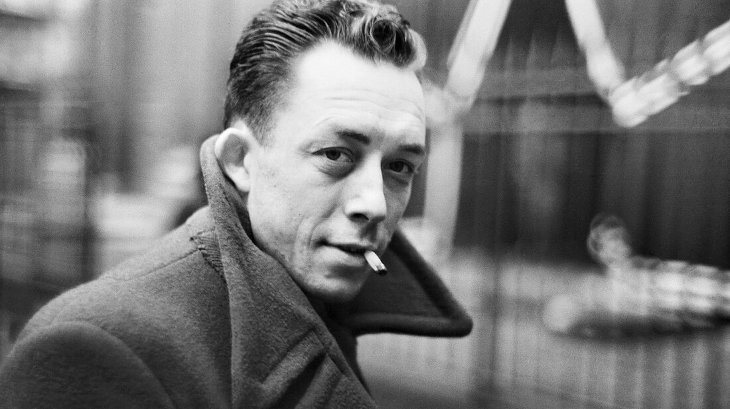 Albert Camus, Newyorker.com
If you have ever spent hours creating a gluten-free treat for a child with celiac disease or went to one more store on aching legs for the perfect shade of magenta for a gift or any equivalent investment of time, energy, and resources, you, too, are aware of how love infuses the mundane with significance.
While in the greater scheme of history, the gluten-free treat and the magenta jacket are inane and even absurd, within the context of your relationship with your loved ones, their significance is beyond calculation. Each mundane act done with love is another thread binding you to each other.
Because of this truth, Judaism is much less interested in what we accomplish than in who we become - as we trudge (or perhaps) dance up the mountain, carrying our heavy rocks. How we live our lives - all those mundane details - expresses our love for God. And God's expectation that we see the cosmic significance beyond the absurd -which both the busy beaver and the sanguine cow are probably oblivious to - is an expression of God's love for us.
Each mundane act done with love is another thread binding you to each other.
This is also why Torah study often focuses more on the practical than the theological or eschatological: returning the suitcase borrowed last year, moving the neighbor's bike under the roof when there is a sudden shower, and feeding one's cat before eating one's own breakfast may not seem spiritual yet (absurdly) they are.
Because while the suitcase, the bike, and the cat will shortly fade into oblivion and are insignificant in the greater scheme of things, who you become through these small actions - how much you identify with the Divine soul that makes you different than the beaver - creates the bond between you and the Infinite. This bond endures forever - love, connection, and relationship are the name of the game.
The burial place of the Biblical patriarchs and matriarchs in the city of Hebron is called "Mearat Hamachpeila," which means 'The Doubled Cave.' On the surface, the word 'double' refers to the fact that four pairs of married couples are buried there - yet, Jewish mystics, with their exquisite hearing, point out that the word 'double' is not a synonym for 'couple' or 'pair.' Double means the same thing twice and hints at the duality these Jewish greats lived.
When in love, each inane, absurd detail is infused with momentous significance - the very same act interacts simultaneously on two very different planes. As the parent making the gluten-free snack and the friend searching for the perfect shade can tell you, love infuses mundanity with beauty in the here and now.
In a deliciously ironic alchemy, Judaism transforms the absurdity of each mundane detail - each generic mountain, each ephemeral sweaty step, each transitory aching muscle - into the joy of love and connection - right here in this (absurd) world.












This person view on life sounds like Kohelet what we read on Succot, the good and the bad and make the most of life, just like it says in the book of Kohelet
Camus’ philosophy sounds like a modern update of ancient Greco-Roman stoicism. Camus was writing in the context of the horrific 20th century world wars. Many people faced despair. For those without a belief in an afterlife, confronting the horror of the world was unbearable.
I personally think that there’s something to the idea that we take (or don’t take) actions because they are right. Far more of our interactions in the modern world are with strangers. We don’t run red lights because we love those in adjacent cars; we don’t need to love them but we do need to obey traffic laws that are to the benefit of all.
I think the Torah commands (including commanding love of G-d and of one’s fellow man) regardless of individual emotion. And that’s a healthier approach to the world.
If the laws of physics still apply in Hell, then every time Sisyphus rolls his stone up the hill an infinitesimal bit of both hill and stone wear away, especially if he uses the same route each time. And in rolling back down yet another infinitesimal bit is worn away. So if he keeps this up eternally at some point he’ll find himself rolling a smoothly rounded stone up a smooth path. Still uphill, but a lot easier.
Pure Frankfurt School gibberish. This is straight out of the mind of Marcuse. Most of those guys started out as orthodox BTW. The apple didn’t fall far from the tree, apparently.
I love this exposition. I aspire to be Camus' hero. It's really about realizing that just because something is temporary doesn't mean it is without significance. "On a long enough time line, the survival rate for everyone drops to zero" (Palahniuk). After getting past the ego's reaction -- nihilism or hedonism -- we can accept and love what is for what it is. I think of the Buddhist monk tradition of meticulously building sand sculptures and then destroying them after display. Each moment is an invitation to perform a beautiful action (the treat, the bike, the cat) regardless of the perceived result.