
 The Three Urgent Challenges Jews Need to Confront This Year

12 min read
4 min read


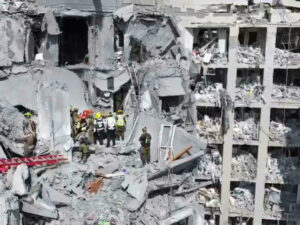
An Iranian missile attack destroyed Shanna Fuld's Tel Aviv home during the recent war.
In this deeply moving episode of Jamie in the Rova, I sit down with Shanna Fuld—journalist, podcast host of The Israel Daily, and survivor of an Iranian missile attack that destroyed her Tel Aviv home during the recent war.
Shanna shares the harrowing moment she heard the missile "whoosh past the window," felt her building sway, and wondered if she would survive. But this conversation goes far beyond that single terrifying night. We explore her journey to becoming an observant Jew who refused to compromise on Shabbat, her move to Israel, and how faith sustained her through impossible moments.
Jamie (Interviewer): And I heard the whipping of the missile—whoosh—past the window. And I knew that it was us.
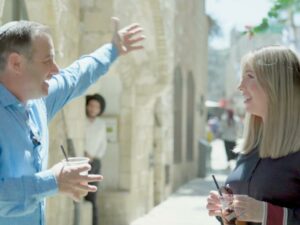
Jamie (Interviewer): Shana. Hi. How are you?
Shana: So good to see you. I was literally just about to grab a coffee. You have time to join me and then come to Aish?
Jamie (Interviewer): I always have time. I love it. Come. This is a great spot here.
Jamie (Interviewer): How often do you come in from Tel Aviv?
Shana: For work purposes, about once a month—maybe twice. And I always try to beat the system. But no matter what, it takes like 500 hours.
Jamie (Interviewer): Yeah, even with the fast train.
Shana: I think our cookies are amazing.
Jamie (Interviewer): Thank you.
Shana: Perfect. Thank you so much. Totally cold. Refreshing. Gorgeous.
Jamie (Interviewer): Something you said to me years ago—when I moved here and needed some words of encouragement—you talked to me about your vision: lights, camera, action. Having a full studio setup, and how digital media and social media changed the game.
Shana: Yeah—just upgrade with it.
Jamie (Interviewer): And you talked to me about the setup you built for yourself years ago. It really reframed things for me too.
Shana: I think in Israel, when you’re coming from any outside place, you need a strong element of creativity so you can do what you want to do in a way that works here. I always talk to olim who are transitioning. They’ll say, “I really want to do this,” or I just met with someone who works in finance and he said, “I can’t come here because I won’t be able to do finance.”
Jamie (Interviewer): —
Shana: I said, “Sure you can.” And then he said, “Where am I going to put my clients? I have very expensive clients—they need to live in a very expensive hotel. I need to put them up.” I said, “Why don’t you build it?”
Jamie (Interviewer): Oh, I like that—make a new hotel.
Shana: People say it’s challenging here. But I’d argue that because it’s a small country, people are very willing to be with you and your vision. If you share it with a few people… In New York you might need this and that, and approvals. But if you do things privately here, I see projects get underway from one day to the next.
Jamie (Interviewer): So inspired by that.
Shana: On June 16th, my home got completely decimated—destroyed—by an Iranian missile that touched down right outside my window. I really want to say: you’re catching me, Jamie, at a time in my life where I finally feel like a human again.
Shana: I was in the apartment building working on my podcast, The Israel Daily, where I give a briefing of what’s going on in Israel in the news.
Jamie (Interviewer): Were you podcasting live at that moment?
Shana: I had just pressed publish—my episode about the destruction in Bat Yam.
Jamie (Interviewer): Okay… a previous missile.
Shana: During those twelve days of war, every day more or less, there was a touchdown—there was a rocket or missile that wasn’t intercepted.
Shana: Tel Aviv feels like a war zone. But you can’t understand it unless you’re there. You have to see the destruction.
Jamie (Interviewer): I completely know it. That’s why we travel to the camps—Auschwitz—to see it. That’s why people travel now to the site of the Nova Festival. There’s something incredibly powerful about being at the place where devastation happened.
Jamie (Interviewer): So you’re there—and I am—so you really understood?
Shana: I was standing in my bedroom thinking, “What’s going to happen if it’s my home? What would that look like?” It’s crazy. I put my pajamas on, and as soon as I did, the siren rang out. I ran upstairs to my neighbor—she has the safe room.
Shana: And I heard the whipping of the missile—whoosh—past the window. And I knew it was us.
Shana: It exploded. I was holding my breath in silence. Everybody else in the room was screaming. But I went into problem-solving.
Jamie (Interviewer): You didn’t think for a second the building was going to come down on you?
Shana: I had so much faith in Hashem. I’m not kidding. I was sitting there holding my breath. The building—while it was tipping to the right—it moved right, and all I could think was, “We’re coming back to center… we’re coming back to center…”
Jamie (Interviewer): And when you said “coming back to center,” you meant the building swayed to the right and you were holding your breath for it to come back?
Shana: Yes.
Jamie (Interviewer): Do you remember The Jetsons?
Shana: Yeah.
Jamie (Interviewer): They lived on stilts.
Shana: I thought we were going to open the door and be on stilts—because we were on the fifth floor.
Jamie (Interviewer): I remember when someone said to me, “Maybe you should start a Facebook page.” And I was like, “Oh, really? Should I?” It became a point where I felt like I always needed to be “on”—on camera, on stage. You have times on and off… but social made it “always on,” 100%.
Jamie (Interviewer): In news, do you feel like it’s even more intense? Do you ever rest, turn off, disconnect?
Shana: I observe Shabbat.
Jamie (Interviewer): When did you start observing Shabbat?
Shana: When I was 21 or 22—after college, before I started working in the news. I messaged my manager after accepting the role and said, “By the way, I’ve become an observant Jew and I can’t work on Shabbat.” I did that because I know in the industry, people sleep next to their cell phones.
Jamie (Interviewer): 1999 to 2000—I was in entertainment news at CNN. Our assignment was the Billy Joel concert. We went to Madison Square Garden, came back, edited the package, slept half an hour on the floor. I remember getting rug burn on my cheek from that catnap—and then it was back.
Jamie (Interviewer): So you told her you’d become observant?
Shana: She was a Jewish woman—and she took great issue with it.
Shana: I had a Puerto Rican manager. He called me into his office and said, “I heard you keep Shabbat.” I said, “Yeah—but I can make up for it.” He said, “Stop. What if I offered you a role Sunday to Thursday and you never even have to step foot in this office?”
Jamie (Interviewer): Unbelievable.
Shana: I’m at CNN working for the entertainment news show Showbiz Today—live every single day at 4:30. I decide to start keeping Shabbat in December, when the show starts around four, so I could do everything except the Friday live show at 4:30. I went into my boss Scott’s office—I had to quit. He was a wonderful Jewish guy who basically said, “Good luck ever finding a job in the TV industry with this new shomer Shabbos thing of yours.”
Shana: Fast forward a month or two—I’m at HBO, invited to be on set at CNN. My Irish Catholic boss made every accommodation so I could leave early for Shabbat. I would work Thursday night—2, 3, 4 in the morning until then—but yeah. It’s such a parallel life.
Jamie (Interviewer): I know a lot of people with wall-to-wall jobs. Shabbat is their saving.
Shana: There’s a saying: more than the Jews keep Shabbat, Shabbat has kept the Jews.
Shana: I came to Israel at every opportunity I could. Every free trip—every something. I came on one trip for three weeks. At the end, we all had to share one thing we were going to take back into regular life. I blurted out, “I’m going to keep Shabbat.”
Jamie (Interviewer): Wow.
Shana: It was thirty people—so it really holds you accountable. When you say it out loud, it brings it into reality. And I’m the kind of person who follows through on what I say.
Shana: That girl to the right is dropping classes—essential classes. You can see the schedule. Anytime you come—Sunday, Monday, Tuesday, Wednesday, Thursday—11, 12, and 1. Different relationships, Q&A, self-development.
Jamie (Interviewer): What would be really nice is to be at the hotel with a little intention. A lot of times people say, “I came to Aish, I didn’t feel anything. I came to the Western Wall, I didn’t feel anything.”
Shana: To get the most out of these spiritual experiences, you have to spiritually prepare yourself too—take a few moments to take in the sights and sounds of Jerusalem from here.
Jamie (Interviewer): Wow. Oh my God—it’s incredible.
Shana: It’s a 360-degree view of Jerusalem.
Jamie (Interviewer): And it seems so relaxed today.
Shana: On any given day you can have something else happening. This is the Baba Michel dinner terrace—and I call it the dinner terrace of love. Because basically any given day here, somebody is getting engaged. It’s the hottest spot—the number one spot in all of Israel.
Jamie (Interviewer): They’re going to get engaged.
Jamie (Interviewer): Shana, we’re here at this place that God designated as the ultimate place for connectivity. You’ve been through so much in the last few years—and the last few weeks. What is your hope and prayer at this time, at this place?
Shana: I hope the Jewish people can continue to be united and band together. My big prayer is that the secular, the religious, the in-between—everyone can get along, and everyone can understand we can do so much good and be such a strong nation when we’re united.
Shana: I want everyone to look with passion and love on our neighbors—Jews and non-Jews. But when it comes to the security of the State of Israel… it’s been this way since the beginning of our peoplehood: we are brought to our knees when we are not united. To be a family divided is the most painful thing.
Jamie (Interviewer): You were there in Tel Aviv at that fateful Yom Kippur service right before October 7th—there was fighting, discontent, discord. We’ve been through the protests during the judicial reform. Post–October 7th there was tremendous unity… and I’m feeling the divide again.
Shana: I love that your prayer is unity. And I love that you remembered my experience bringing my community of olim through Tel Aviv to have an outdoor prayer on Yom Kippur—2023—and there were protests and demonstrations about the outdoor prayer. Thank you for remembering that, because that’s what I’m talking about.
Shana: October 7th happened right after. And here we are—we need to remember.
Jamie (Interviewer): The ultimate place of prayer and connection. So your prayer—and I’m going to join you—my prayer, our prayer, is for the unity of the Jewish people and the Jewish family.
Shana: Yeah. I love it.
Jamie (Interviewer): Should we take a picture to remember this moment?
Shana: Yeah.
Shana: I think two things they say about New York are actually about Israel. One is “the city that never sleeps”—Tel Aviv is really the city that never sleeps. I feel so safe there walking home at any hour. There are always people out. And I feel that on the streets of Jerusalem too.
Shana: It’s that same feeling of security and peace and comfort and relaxation here.
Jamie (Interviewer): I feel much safer here than I felt walking home in New York City, actually.
Shana: And the other thing is: if you can make it here, you can make it anywhere.