




 How Antisemitism Hides Online: Identifying Coded Jew Hatred


4 min read
4 min read
4 min read



8 min read


Amidst falling missiles, chaos and destruction, a powerful firsthand account of Beersheba’s darkest hours. An Aish.com exclusive.
Tuesday morning, June 24. In the final moments before the ceasefire takes effect, Iran fires ballistic missiles at Beersheba.
Air raid sirens wail. Moments later, a loud boom and the ground shakes as a missile explodes onto a 7-story apartment building.
The resulting shockwave sends flaming metal, glass, cement blocks and debris flying in all directions. Cars erupt in flames. Hundreds of windows are blown out.
Within minutes, Natan Neppe – officer in an IDF search and rescue unit – is on the scene.
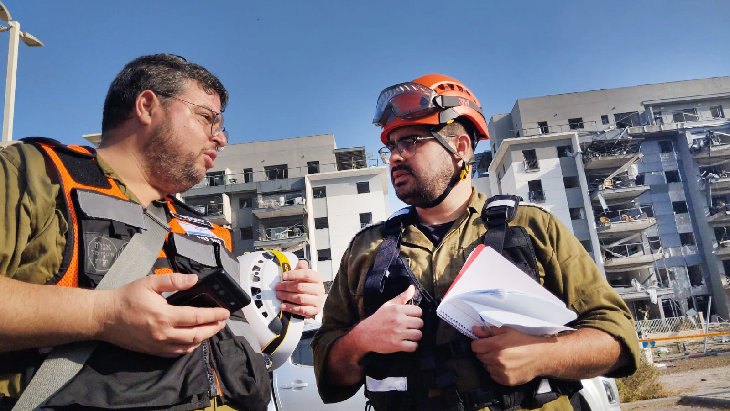 Natan Neppe on site of a deadly missile attack in Beersheba
Israeli “safe rooms” are designed to protect against the shockwave of explosions and flying shrapnel. But not a direct hit.
Four Israelis are killed in the attack: Eitan Zacks, an off-duty soldier; his mother, Michal Zacks; his girlfriend, Noa Boguslavsky; and in an adjacent apartment, Naomi Shaanan, a peace activist.
At the impact site in Beersheba, Natan’s team locates the bodies. They work under highly dangerous conditions. Walls and ceilings have collapsed, making it difficult to access the bodies.
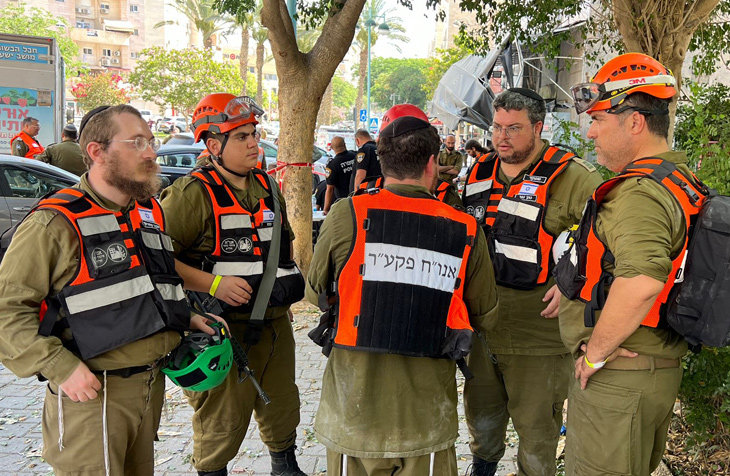 Natan and his team confer following the deadly missile attack.
They photograph the area and the bodies, then record detailed information: Circumstances of the attack; where the bodies were in the building; and identifying signs of victims’ age, clothing, eyeglasses, etc.
After extricating a body, they place it onto a stretcher, then precariously make their way down six flights of stairs – dodging glass, twisted metal and rubble.
They deliver the bodies to a mobile army command center set up at the disaster site for identification. “It's important to identify bodies as soon as possible, because families are waiting.”
Then it’s back up the stairs for more holy work.
In Jewish tradition, honoring the dead is a sacred obligation, rooted in the idea that the human body is a vessel to house the Divine soul. Even after death, the body must be treated with dignity.
Natan shares: “As I was carrying a stretcher with a dead body, I recited Psalm 91, which speaks of God's presence in the face of danger and protection of the soul’s journey after death. I was thinking about this person – at home, minding their own business, when a rocket comes from 2,000 kilometers away and murders them.”
According to Jewish law, any blood or remains must be collected for burial. “In an explosion like this, the bodies are not always in one piece. Body parts might be scattered around,” he explains.
Eight hours later, their uniforms damp with sweat and ash, Natan and his team are back at the army base for an assessment: How did we do? Did we miss anything? How can we be better prepared the next time? Do we need additional equipment?
They also meet with the army’s team of therapists, to speak about what they’ve seen and experienced.
“Emotionally, ours is not an easy job,” Natan says. “We need to prevent post-trauma. Especially for newer guys who have no prior experience with dead bodies.”
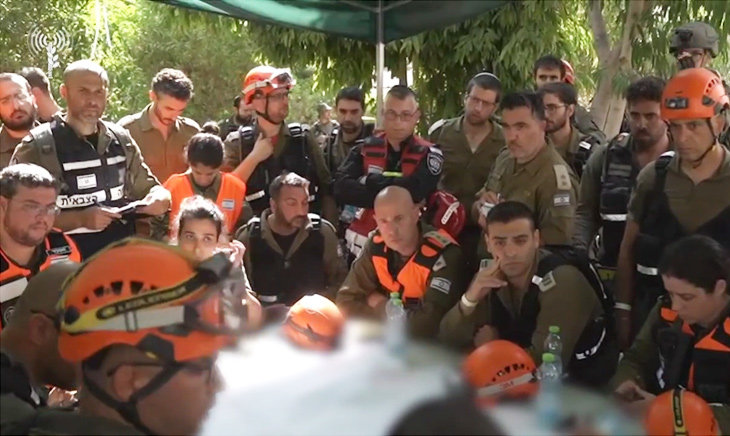 Amidst the chaos, Natan (seated, far left) convenes with IDF officers.
Natan, the child of Western immigrants, grew up on a moshav in Israel. Since 2011, he’s served in a battalion whose mission is rapid response to any mass casualty event: earthquake, building collapse, terror attack, etc. They utilize truckloads of equipment – including cranes and tractors – to extricate people trapped in destruction zones.
Natan, recently promoted to the rank of captain, commands a group of 16 reservists. He also serves as the battalion’s unofficial chaplain.
Natan’s first-responder unit is comprised solely of reservists whose sense of mission and identity drives them to run toward danger, not away from it.
“In civilian life, we’re just regular people. I'm a lawyer. One guy is a contractor, another is a teacher. We leave our families and put our careers on hold to do this work. Not because we like it, but because to help the Jewish people, we’ll do whatever needs to be done.”
Since October 7, Natan has spent 220 days in reserve duty. “My wife is very proud, backing me 100%,” he says. “Some soldiers don't tell their wives anything. But I’ve been very open with what I'm doing. We’re together in this, which is good for both of us. Knowing that she’s taking care of our children and home gives me the support I need to do this work with a full heart and clear mind.”
On the last five days of the war, Beersheba suffered four Iranian missile impacts.
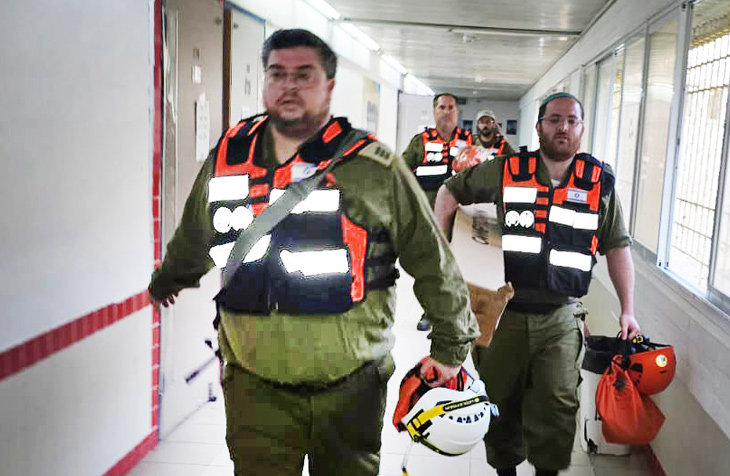 Natan and his team race through the corridors of Soroka Hospital.
On Thursday, June 19, a missile hit the roof of Soroka Medical Center, southern Israel’s main hospital. The two top floors – used for pediatric and ophthalmology patients – were completely destroyed.
Natan, arriving quickly on the scene, enters the hospital to find chaos: Roof panels collapsed. Water pipes exploded. Fire alarms blaring. Pieces of glass still falling. The sterile hospital air turned a rancid mixture of chemicals, smoke, and dust.
Natan raced to the collapsed floors, expecting to encounter multiple casualties.
Yet… nobody was there. Just hours earlier, Israeli authorities – anticipating that the hospital could be targeted – had transferred all patients and staff to protected underground facilities.
“If anybody had been on those floors, they’d be dead.”
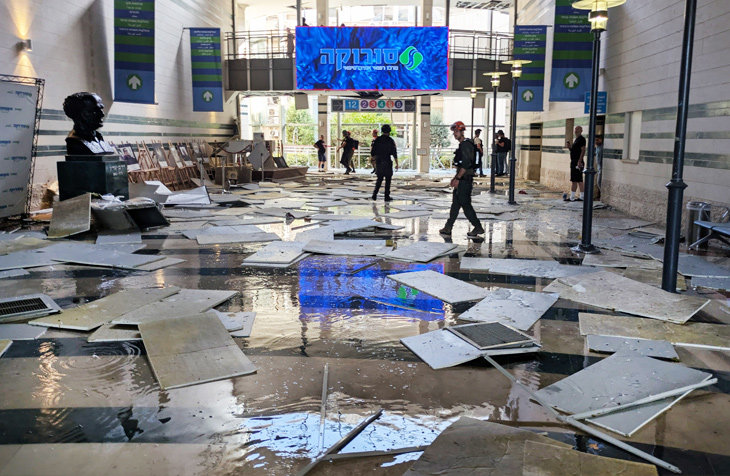 Natan at the hospital devastation.
Natan and his team combed the hospital corridors, evacuating patients – in various states of shock and confusion – to an emergency room that doubles as a bomb shelter.
Amidst the chaos, Prime Minister Netanyahu arrived on the scene, as did President Herzog.
Less than 24 hours later, at 5 a.m. Friday morning, an Iranian missile struck a road in Beersheba, creating a massive crater just 20 meters from a row of seven-story apartment buildings.
Natan, his boots still dusty from the previous day, rushed to the scene. All the apartments facing the street suffered heavy damage. Yet miraculously, all the residents were in bomb shelters and nobody was hurt.
 Scene of destruction at Friday morning’s attack on Beersheba.
“Had the missile hit directly, it’d be a whole different story,” Natan says. “The whole building would have collapsed. The fact that nobody was seriously injured or killed is an open miracle.”
That afternoon, Beersheba was hit again – the third impact in less than two days. The impact damaged residential buildings and ignited fires. Several civilians were injured, yet none killed.
Throughout the 12 days of war, a potential series of mass-casualty disasters became miraculous near-misses. Israel lost 28 civilians — each an entire world. Yet IDF intelligence had projected thousands of fatalities in a full-scale conflict with Iran. Iran sent over 1,000 drones to Israel and all were intercepted except one – a 99.9% success rate. Hundreds of missile launchers were destroyed by IDF warplanes – many in real-time as they were being readied to launch.
Considering the scope and ferocity of the war, it's almost beyond belief that the toll was so low.
Natan has searing memories of the fateful day of October 7, 2023. His unit was summoned to their army base 25 minutes from the Gaza border. During the first 48 hours, a stream of army vehicles arrived, one after the other, delivering hundreds of dead bodies – kibbutzniks, foreign workers, and Hamas terrorists.
Natan and his team went to work identifying each body. “Some of the terrorists were dressed like soldiers, and we needed to prevent any mix-up,” he explains.
“Many of us had never seen a dead body before. Suddenly in one day we’re dealing with hundreds of bodies in various conditions – mangled, burned, decapitated. It was very meaningful, but not easy. Emotionally, there was no training for this. I can still smell the death.”
In the days and weeks that followed, Natan and his team conducted search parties to locate people missing from the Nova party. “We walked for miles and miles, in fields and forests, looking for any remains.”
Next, they collected ashes and bones from the hundreds of incinerated cars. They vacuumed every car, put the remains into bags, and buried the bags in a cemetery. “It was difficult but holy work,” he says. “I saw more than I wanted to.”
These attacks – and Israel’s commitment to preventing casualties – highlight the moral contrast between a nation that sanctifies life, versus the jihadi culture of death that targets residential buildings and hospitals.
For his dedication, bravery, compassion, and professionalism, Natan received a special IDF citation of excellence.
“We’re always on alert,” Natan says. “Something can happen at any moment. We're ready to go.”
Times of Israel Video: Flight through one Iranian missile impact site in Tel Aviv










My prayer is that God Almighty will protect Israel and the IDF Soldiers and everyone working to keep Israel safe. And that God will heal there emotional scars. God bless Israel and its people.
This was a beautiful story about a true missionary of mercy. I was totally wrapped into it. Respectfully, unfortunately the third to last paragraph, "These attacks – and Israel’s commitment to preventing casualties – highlight the moral contrast between a nation that sanctifies life, versus the jihadi culture of death that targets residential buildings and hospitals.) really doesn't fit into this tribute to the brave soldiers of these units.
G-d bless Natan and his group!
I am ao impressed by the courage and kindness displayed
Thank you for this article. We have a great deal to be thankful for, not the least of which is people who risk their lives to save others, as well as to bring the deceased to kever Yisroel.
AS a medic I've seen los of death, but it does add up after awhile. Granted I've not seen wanton, gratuitous death as y'all see... my prayers are to God for y'all!
<My First Cousin,Natan Neppe, i am very proud of him, a normal family man that has just qualified as a lawyer ,has a wife and kids at home and still goes out in the face of danger to honour our dead.