





 A New Holocaust Film Every Young Person Should See




12 min read


Researchers have discovered many Japanese rituals and festivals that appear to mimic Jewish traditions.
It would be hard to find today a society more different from Israel than Japan. Israel is located at the crossroads between East and West, while Japan is located at the farthest edge of the East. Israel is situated at the junction of three continents – Japan is an island. The Japanese value obedience and rote learning, while Israelis value innovation and chutzpah. The Japanese are quiet – Israelis loud and argumentative.
These differences serve to amplify the amazement at the evidence of a common ancient past.
Japan's indigenous religion is called Shinto and most Japanese identify with it to some degree or another. Shinto is both polytheistic and animistic, revolving around supernatural entities called "kami" that are believed to inhabit all things, including the forces of nature. Today there are over 100,000 Shinto shrines throughout Japan, serving a population of 130 million people.
Polytheistic Shinto and monotheistic Judaism would seem to have little in common. But upon closer examination, researchers have discovered many Japanese rituals and festivals that appear to mimic Jewish traditions. These discoveries have led to rapidly growing interest and a plethora of books on the subject. A group of Hebrew University scholars even visited Japan to investigate the claims and came back amazed. In October 2020 a mystery novel was published in Japan called, The Code of Amaterasu. It quickly became a best seller and received 7,000 positive reviews on Amazon. The novel was so popular that Japanese Prime Minister Kishida read it in the summer of 2023. In the novel, the main character uncovers a wealth of evidence tracing Japan's incredible hidden history to ancient Israelites who came to the country some 2,700 years ago. Meanwhile, Tokyo TV broadcast a special two-hour documentary on the subject.
Here is a selection of remarkable connections between Judaism and Shintoism
The Suwa Taisha is one of the oldest Shinto shrines in Japan. In the middle of April, the Ontohsai, an ancient Shinto festival, is held there annually. During this festival, a boy is tied with a rope to a wooden pillar. A Shinto priest then comes with a knife preparing to kill him and even cuts off the top of the wooden pillar. But finally, a messenger (another priest) comes and releases the boy, saving him.
This is reminiscent of the Biblical story of the Binding of Isaac, where Abraham is commanded by God to sacrifice his son, but an angel stops him just before he completes the task.
The Japanese call this "the ritual for the Misakuchi-god". "Misakuchi" contains with in it the name Isaac, Yitzchak in Hebrew. It seems the Shinto worshipers at Suwa Taisha made the Jewish forefather Yitzhak into a god, probably due to the influence of idol worshipers.
Behind the Suwa Taisha shrine is a mountain called Moriya San, which means Mount Moriah, where the Binding of Isaac took place. The local god is called "Moriya no kami," which means, the "God of Moriah." The Suwa-Taisha shrine was built to worship the "God of Moriya."
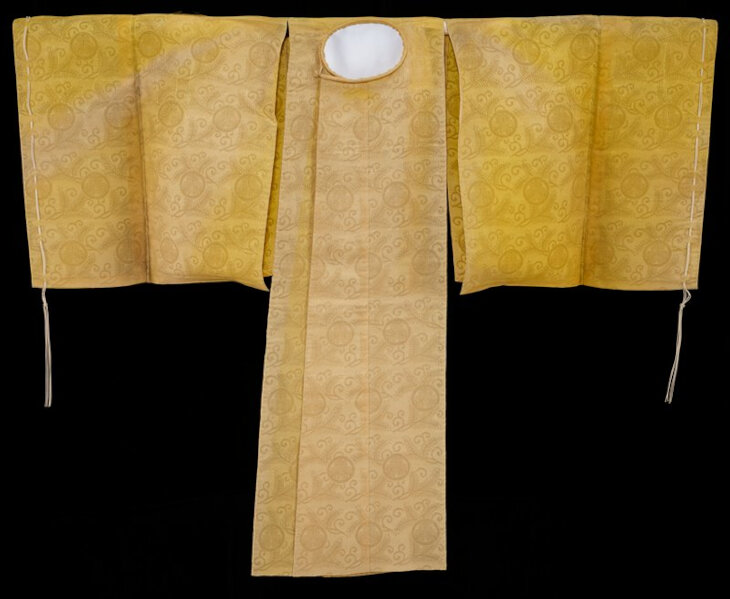
Many Shinto ritual objects resemble Jewish ones. Shinto priests wear a robe called a “Kariginu”, a cornered garment that has white tassels 20-30 centimeters long (about 10 inches) placed in the corners, similar to Jewish tzitzit fringes, as the Torah says, "Make them fringes in the... corners of their garments throughout their generations" (Deuteronomy 22:12).
The Yamabushi are practitioners of Shugendo – a Shinto sect that incorporates asceticism and elements of Tantric Buddhism. They traditionally lived in Japan’s mountainous regions. The famous Ninja, a class of magician-warriors, developed out of Shugendo priests. The Yamabushi wear a small black box called a "tokin", that is tied to the head with a black cord, resembling Jewish tefillin. The size of the tokin is almost the same as the Jewish phylactery, but its shape is round and flower-like. Israel and Japan are the only two countries in the world that use a black forehead box for ritual purposes. “Tokin” and “Tefillin” also share the same first and last letters.
Furthermore, the Yamabushi blow on a big seashell horn - the Horagai conch, reminiscent to the blowing of the shofar, a ram's horn. The way the Horagai is blown and the sounds it makes are similar to those of a shofar. Because there are no sheep in Japan, it makes sense that the Yamabushi would use seashell horns instead of ram’s horns.
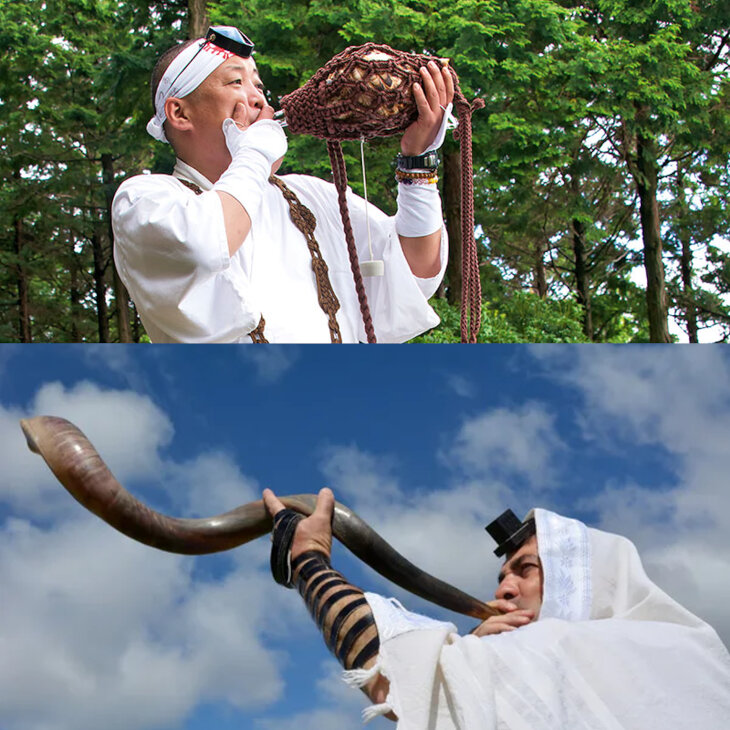 Above, Yamabushi wearing Tokin and blowing on Horagai; below, a Jew wearing Tefillin blowing a shofar
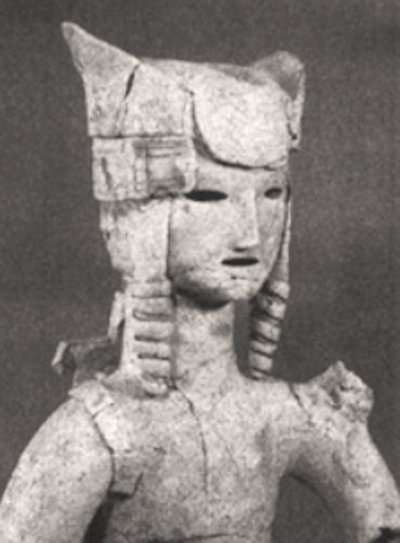
There is also an ancient Samurai hairstyle that resembles peyot, Jewish side locks. It’s called “Mizura”. It is unique to Japan, not appearing in either China or Korea.
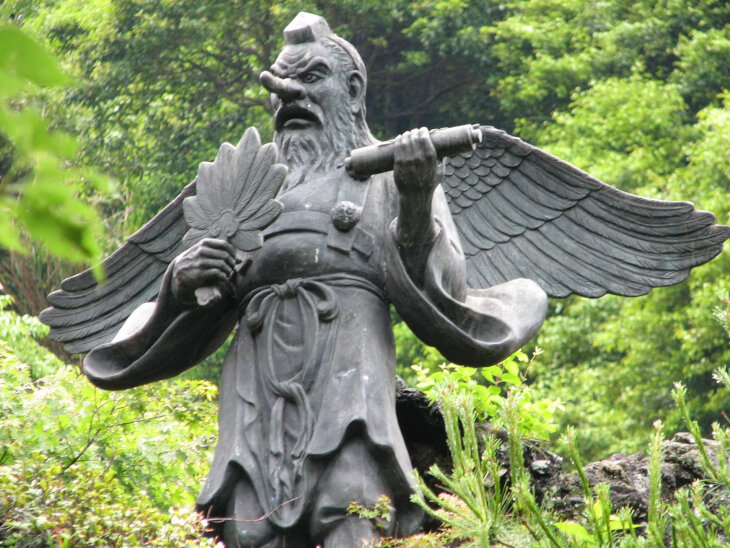
Tengu are legendary flying humanoid demons with superhuman powers. They supposedly dwelt in Japan’s mountainous regions. Tengu are associated in particular with the Yamabushi, the mountain ascetics who practice Shugendō. They were believed to be teachers of Shugendo priests. With their long noses and long beards, the Tengu look strangely foreign compared to traditional Japanese renderings of Asians. They are also frequently depicted wearing the Yamabushi Tokin. Incredibly, the Tengu were said to pass down “Tora-no-Maki” scrolls (literally Tora scrolls) to priests who completed their training. All these varied elements together suggest a Jewish source to the Tengu.
The Shinto have an ark that resembles the Ark of the Covenant called the Omikoshi.
The Ark of the Covenant had two statues of gold angels (cherubim) on its top. These heavenly beings had outstretched wings like birds. The Japanese Omikoshi has on its top a gold bird called "Ho-oh", an imaginary bird and a mysterious heavenly being. The Ark of the Covenant was entirely overlaid with gold. The Omikoshi is also overlaid with gold, either partly or entirely. There are even Omikoshi with seven branched candelabras on them – similar to the Temple Menorah.
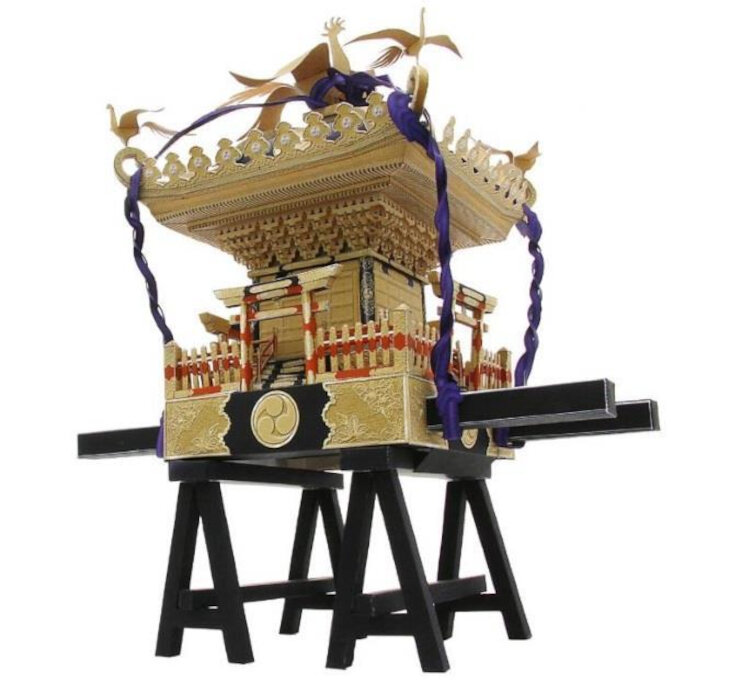
The Ark of the Covenant was carried on the shoulders with two poles, as the Bible says, "The Levites carried the Ark of God with poles on their shoulders... in accordance with the word of God" (Chronicles 15:15). The Japanese also carry the Omikoshi on their shoulders with poles. When the Japanese carry the Omikoshi they yell out “Essa! Essa!” The word is meaningless in Japanese, but in Hebrew it means “lift” or “carry”. Before carrying the Omikoshi, Shinto Priests will immerse themselves in sea water to purify themselves, then wear white robes, as the color white is considered holy.
The Omikoshi is often led in a festive procession that resembles the celebration King David held when he brought the ark back to Jerusalem. “So all of Israel brought up the Ark of the Covenant of the Lord with shouts, with the sounding of rams’ horns and trumpets, and of cymbals, and the playing of lyres and harps” (First Chronicles 15:25-28). It is customary for large processions of Japanese to sing and dance to musical accompaniment in front of the Omikoshi.
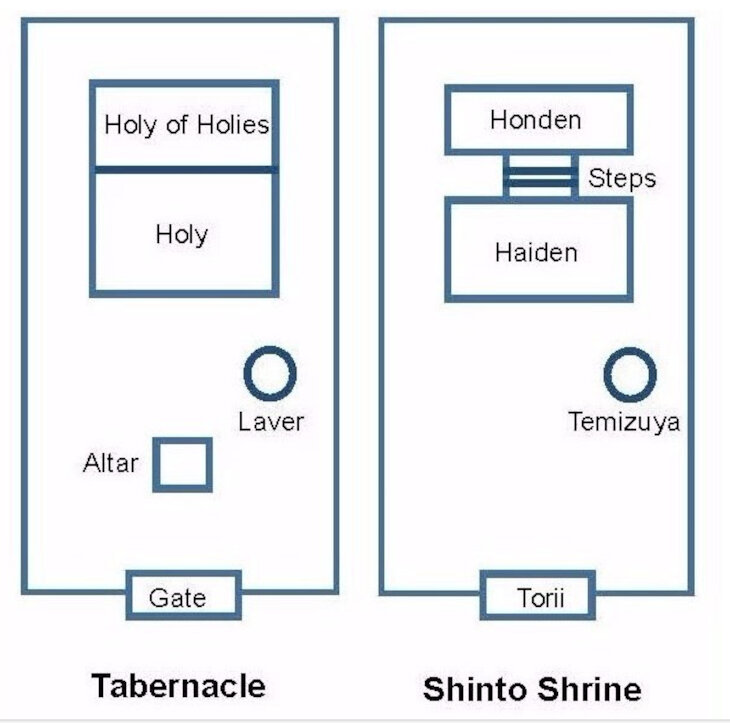
Shinto Temples and the Jewish Temple not only share architectural similarities, but also similar dimensions. Both had a Holy and Holy of Holies. In Shinto Temples there are even steps leading from the Holy to the Holy of Holies, which is located slightly higher, just as it was in Solomon’s Temple. Neither Temples contained idols within them. Even though most eastern shrines do have idols, Shinto shrines do not.
In the center of the Holy of Holies of a Shinto shrine, there is a mirror, sword, or pendant which Shinto believers do not regard as gods. In addition, in Shinto, gods are thought to be invisible. The Shinto High Priest would only enter the Holy of Holies once a year, like the Kohen Gadol, High Priest would on Yom Kippur. Before entering a Shinto shrine, it is customary to cleanse the hands and mouth at the Temizuya using cups. The Jewish Priests serving in the Temple would wash their hands and feet at the laver before engaging in service.
In Japanese mythology, the Imperial family and the entire Japanese nation are considered descendants of forefather and founder Ninigi. But Ninigi was not supposed to be the forefather. According to Japanese tradition, there was another who was to be appointed in his place. But while the other prepared and tarried, the younger Ninigi was born, came down from heaven and secured the role of founder of the Japanese nation.
In the same way, according to the Bible, it was Esau, Jacob's elder brother, who was firstborn and therefore set to become forefather of God's nation. But while Esau was hunting for deer, Isaac gave God's blessing to the younger Jacob, and he became forefather of the Israelites. Nor do the similarities between Ninigi and Jacob end there.
After Ninigi comes down from heaven, he falls in love with a beautiful woman named Konohana-sakuya-hime and wants to marry her. But her father asks him to marry her elder sister first. In the same way, the Torah relates that Jacob fell in love with beautiful Rachel. But her father, Lavan, tells Jacob that he cannot give the younger sister before the elder.
Furthermore, Ninigi and his wife Konohana-sakuya-hime bear a child named Yamasachi-hiko. But Yamasachi-hiko is bullied by his elder brother and has to go to the country of a sea god. There Yamasachi-hiko gets a mystic power and troubles the elder brother by starving him, but later forgives his sin. In the same way, Jacob and his wife Rachel bear Joseph, who is bullied by his older brothers. Taken to Egypt, he becomes viceroy to Pharaoh.
The Shinto also have a ritual that resembles an element of the Jewish holiday of Sukkot. Just as Jews wave the lulav branch, Shinto priests wave Sakaki evergreen branches. Often, prior to waving, they dip them in salt water and wave them in front of people in order to purify them from sin and uncleanness. Compare this to the practice of the Jewish priests who would dip the branches of the Hyssop tree into the red heifer compound and sprinkle unclean Jews with it, in order to purify them.
Eli Cohen was Israel's Ambassador to Japan between 2004-2007. A short while after Cohen was appointed, he was invited to visit the Suwa Taisha shrine. As the guide explained the shrine’s layout and usage, Cohen became amused by the coincides with the Jewish Temple. But the more the guide explained, and the more similarities he noticed, the more shocked he became.
“Everyone told me the Japanese were pagans with eight million gods. But then I realized that number was probably symbolic for a large amount and that 8 on its side is the symbol for infinity. Perhaps they were hinting in belief in a single infinite Creator.”
“Suddenly I began to look at things differently and saw the many similarities between our two peoples. Like the Jews, the Japanese see themselves as the Chosen People. Just as Jews look upon outsiders as “goyim”, the Japanese look upon outsiders as “gajin”. I am a Cohen, a member of the Jewish priestly sect. As is well known, Cohanim are forbidden to enter cemeteries (except for the funerals of their closest relatives) and forbidden to touch a corpse. Shinto priests are also forbidden to touch a corpse and rarely participate in funerals! A corpse is considered “kegare” (impure) - just as it is considered tameh (impure) in Judaism.”
Cohen ended up writing a book about the connections between Shinto and Judaism, which became popular in Japan. He believes the Japanese are becoming more aware of their Jewish roots and that one day Japan will have close relations with Israel – just as the US does. “They are our brothers,” he concludes.
If the Jews did somehow influence ancient Japan, how did they get there?
Among the Samurai sect, there is a tradition that their ancestors came to Japan from western Asia in 660 BC. 62 years earlier, in 722 BCE, the 10 tribes of Israel were defeated and exiled from the Land of Israel. Some believe that these Israelites, who traveled the Silk Road to the East and settled in China and Korea, were invited by the Japanese ruler to settle in Japan. The Samurai were the guards of the Japanese Emperor and the word shares the same letters as the Hebrew word for guard – “ShoMeR”.
The Japanese derive their name from the nation’s main tribe – the Yamato. The Yamato are the dominant ethnic group in Japan, comprising approximately 98% of the country's population. But the phonetics of the word has no meaning in Japanese. In Hebrew, Yamato is a combination of Yah (God) and Umato (people). In other words, Yamato means “the people of God” or “God’s nation”.
In recent years many books have been written by both Jewish and Japanese researchers on the ancient connections between the two peoples. These include:
Featured image above: Shaka Nyorai, ca. 1850-1925, the National Library of Israel











According to an acquaintance of mine, Japan's first emperor was from the tribe of Gad, but after he died, a dispute arose among the 12 tribes over who would be the next emperor.In the end, it was decided that a descendant of Moses from the tribe of Levi would become emperor, and he has remained so to this day.
There are many descendants of Aaron in Japan, but there are also many descendants of Moses.
Let's make it clear. This answes everything!
About the _Tengu_ 👺👺👺 etc:
- portrayed with long noses, red faces different than locals
- wearing black leather boxes strapped to the heads
- after student would complete learning they would present them with a secret scroll called _Tora NoMaki_ 📜 🤔
Ok, here is what really happened: there was a Bar Mitzvah celebration near Kyoto about 2 &1/2 thousand years ago and confused a lot of people. Yes, they also had_Shemira_ for security -> the Samurai. What about the red faces? Well, how can you have a Bar Mitzva without Lechaim?! 乾杯! 人生に感謝!
Just to be clear, nobody is claiming they are the lost tribe. It is not how it works, it is a cultural transmission. They eat tempura that originates in Catholic lent food brought by Portuguese. It does not mean they are a lost tribe of Catholics. They simply adopted a recipe.
All celts speak English and forgot their native languages. It does not mean they are some lost tribe.
All it takes one Jewish guy reaching Japan and telling them about the Temple, Jewish customs, festivals, garments, and for Japanese to like the idea and to adapt it. So DNA tests will be useless.
Though, if that Jewish adventurer was really respected, he could have been deified and is now being worshipped as a kami. It would be nothing new for us.
It is not so that "jews ended up in japan" or "japanese became israel", it is so that these people have common roots in the Toraijin migrations. Also see the Hata clan (minamoto+taira root) which founded Qin (this name is identical to Sin (moon) and Sinai (mount of Sin), Sin was originally a SUNgod; Su.En, directly linked to Thoth (asten; solar baboon). Later it became a moongod (just like Thoth) and equated with IAH (moon) also written Yah.
The word Yehudi for one comes from the egyptian word for Thoth; Djehuty.
I personally believe that the roots are polynesian (against mainstream ideas that taiwan populated polynesia) from its own cataclysm induced migrations becoming for one; the Mon' people.(malaysia), the key is etymology and mythology. Learn it. 😉
What do the Family DNA or root tests show? If it shows they're Jews, OK - if not, sorry!
Yes, we have been introducing and inviting Jewish scholars to Japan. But the issue is their Ashkenazi superiority stops to see which country is older. Japan has been doing similar rituals for 16,000 years since the Jomon era. Jomon people started Sumerian and then turned into Ancient Jews. The team tribes returned to Japan to follow the ancient Hebrew bible to "Go back to East". Jomon Japan is the origin of Ancient Jews, not Jews is the origin of Japan historically, to be clear. Respect.
No. People obviously believed in nature spirits and had sacred spaces, trees, rocks and such, but shrine Shinto with buildings was developed much later. You should now, some shrines do not have special buildings to house kami. Jomon people did not call themselves such. It is a modern term for their pottery style.
As a Japanese Americsn who has grown up exposed to both the Japanese and Jewish traditions, I am stunned by this insightful article.
Loved this article! Blown away by all the similarities between the two religions. All this is "just a coincidence"? I doubt it. As one of the world oldest religions Judaism's influence on other cultures is likely very wide. So much still needs to be explored!
I told a Japanese about this article.
He read it and chuckled.
In Isaiah 41:25 it explicitly states that He shall raise one up in the land of the Rising sun...
No, it does not.
Isaiah 41:25
"I have raised up one from the north, and he shall come:
from the rising of the sun shall he call upon my name:
and he shall come upon princes as upon morter
and as the potter treadeth clay"
"from the rising of the sun" means "the dawn" - not the land of the rising sun.
"the north" refers to Persia - not Japan.
The man referred to is Cyrus the Great - not any Japanese.
If you give a biblical reference, you must expect it to be checked.
In addition, a born Japanese must be the offspring of a Japanese mother, Japanese fathers do not validate a child as Japanese. Sound familiar?
One other thing, we know that Isaac stayed in the land but that the rest of his siblings and other progeny of Abraham went to the East to teach, and we know that Jeremiah went to the East to teach. Probably many others. I can't think of right now. Is anything more obvious than that?
I read this article with great interest.I have been working closely with Japanese people for about the last 15 years as a teacher. I have worked closely with about 180 students, on an individual basis. A lot of personal information and sharing always comes through. I have noticed that they make comments of a philosophical nature, "Buddha says".., which are verbatim out of the Torah and even the portion of the week. Their attitudes and ways that they treat others are elementary lessons in Torah study. They are truly concerned with the welfare of others more so than themselves. The words of their prayers and ritual habits re often exactly very similar to and they celebrate some holidays in the same way that we do, like Sukkot for example. I am very anxious to share this article.
I keep hearing claims that different people in different countries, are trying to say they may be from the 10 lost tribes of Israel, when will this mystery be solved when moshiach comes, will all the lost 10 tribes be found or not, there is a disagreement with the answer, if all of the claims of these people are true and are found then they would of to convert back to Judaism and then they will be a lot of Jews in the world
10 tribes constitutes a lot of people and it’s likely they spread out over the world, some settling in one place, others somewhere else, yet others traveling further and further from Eretz Israel. Initially they would probably have kept up a Jewish lifestyle but over time under pressure from their surroundings will have lost the meaning of their rituals.
Fascinating! I never knew any of this!
Some of the things discussed are common in many cultures. For example, the god who dies exists in xtian and Celtic mythology. Purifying the hands and other body parts exist in christening, Muslim prayer, catholic holy water. I would like to read the opinion of Shinto practitioners about this article.
Yes, but all of the ones you mention have Judaism as their roots.
Genetic testing of a variety of Jewish representatives and Japanese groups might provide strong evidence regarding the hypothesis. Meanwhile it makes for excellent reading, whether fact or fiction.
I found this article fascinating because of my personal experience. From June of 1962 to June of 1964 I was assigned to the 14th USASA Field Station which was located on Hakata Air Base, near Hakata, Japan. Hakata Air Base was administratively an adjunct of Itazuki Air Base, where the Jewish Chaplain was Rabbi Marvin Tokayer.
Certainly a plausible thesis. Perhaps more proofs are needed, but thinking outside of the box is refreshing. Mr. Laing is summarizing for us previous works that are out there. I am glad I read the article.
It's not so surprising that the Japanese copied/appropriated many Jewish customs/laws as did Christians and Muslims in their own ways. It is interesting why these customs exist in Japan and not say China but I'm sure that's been looked into. This is very apropos to the end of last week's sedrah (Chayei Sarah) "..to the concubine children..Abraham gave gifts... he sent them away Eastward to the land of the East" (Gen 25:6) which is explained in kabalistic sources as meaning he sent them wise teachings.
Why "copied/appropriated?" It sounds like some Japanese have Jewish origins. Christians & Muslims don't have anything like tefillin. Their religions EXEMPTED THEM from such.
Jomon Japan is much older than Abraham. It is about 16,000 years old and started Sumerian culture when they had to leave because of the Akahoya eruption, in BC7,000. 9,000 years ago. Then they spread. Ancient Jews brought Japanese rituals to establish Ancient Jewish practice and came back to Japan. We welcome those retuning Jews and put them as wisdom, instead of killing them. Timelines do not tell lies, not stories or perceptions.
Many different cultures around the world have independently developed language, mythology, philosophy, arts, etc. Commonalities exist because at the core all human beings share DNA, brain structures, fundamental universal experiences, and live among similar flora and fauna. We all experience gravity while seeing birds in flight. We all understand the meaning of pain, loss and mortality. We all seek comfort, stability, love.
This is the meaning of the saying, "Correlation is not Causation." The use of the "ma" sound to indicate one's mother occurs all over the planet. This neither proves nor indicates that different cultures influenced each other. It does, however, point to a common origin -- something shared in the experience of all children in regard to their mothers: suckling, and the movements of the mouth that babies use during this profound connected activity.
This is not to deny that similarities may exist between Judaism and Shinto. Or Judaism and Confucianism, for that matter. But these similarities are not because one group influenced the other. They are because, as the Torah clearly mentions, one God created all of us in His image.
Then tefillin-like objects would be present ALL around the world, yet it is only among these two groups. Your generalizations are ignoring details. I changed my mind when the Black African Lemba of South Africa's JEWISH origin story was supported by DNA supporting their Cohanic Yemenite Jewish origins. We need to PAY ATTENTION to ethnic origin stories & see how they are PLAUSIBLE instead of dismissing them.
100%.
I don't consider this "Proof" that these parts of Japanese culture came from Israel, but it is highly suggestive of the possibility, and a plausible explanation.
Every civilization, every religion has its own origin story. We think the Genesis is the right origin story. That's not the belief of everyone. It works for us. It's ours.
Saying that it is the only valid origin story is a little over the top. While it makes sense for us, it doesn't work for everyone (by a long shot).
Genesis is the written word of an oral history of indeterminate age. To my knowledge there are few written origin stories contemporaneous with their occurrence and they may raise their own questions (think the gold tablets of the LDS).
This seems to be a great topic for a PhD dissertation
Genesis is not of an indeterminate age. Latter Day Saints gold tablets were "discovered" by ONE person, not seen by anyone else which is the problem of ALL religions, except for Judaism whose Exodus from Egyptian slavery to Sinaic Revelation were witnessed by millions. No one else has that which is why Christianity & Islam are forced to replacement theology to legitimize their claims. Jim, you've not done your due diligence.
[films]
https://en.m.wikipedia.org/wiki/Angel%27s_Egg
here's angel's egg, it's kind of talmudic i've heard and i'm not sure, but the director is supposed to have said that he was a christian when he began and he wasn't when he finished
there's also these two, they're not japanese but they came out the same year with the same actress and an actor, i think they're meant to be the shinto-bhuddism thing in western film but whatever it's all the same, at least for me, and one i've watched [a lot] more than the other
https://en.m.wikipedia.org/wiki/Amateur_(1994_film)
https://en.m.wikipedia.org/wiki/Nadja_(film)
Not very convincing. A few pertinent corrections: There was no silk road in 660 BCE. In fact, there was no China at the time. The country emerged after centuries of internecine war led to the Qin Dynasty in 221 BCE. I'll be happy to reconsider this when actual archaeological evidence exists. A few somewhat similar customs hardly qualifies.
I guess the PM of Japan, Israel's ambassador to Japan, Rabbi Avichail and the professors at Hebrew university who believe the theory are not as smart as you are.
Perhaps you might want to re-read the article before commenting on my comment or on my intelligence. The Hebrew University professors concluded by writing a mystery novel. The Ambassador to Japan wrote a book with a hypothetical theses which the Japanese found fascinating. If you are convinced by all of this, that's great. I have found that there are many definitions of smart. There tends to be one definition of knowledgable. I am a retired professor of East Asian Studies, who is fluent in Chinese, Japanese and Mongolian.
Even w/o the silk road, there was some sort of international trade, which is all that was needed for King Solomon to send Israelite abroad to bring ginger & pepper & such back to his kingdom.
I was bar-mitzvahed in Tokyo in 1956. I recall visiting shrines and seeing priests wearing tzitzit and washing my hands with a cup - three cupfuls each hand. Also, Emperor Hirohito's brother, Prince Mikasaka often visited the shul in Tokyo and became friends with my father who for business reasons very often went to Japan. I met the prince - he spoke Hebrew. I believe that he (who was then den of the Christian Women's Univ. in Tokyo) was under the impression that the Japanese came from the ten tribes as tombstones were found in Japan with ancient Hebrew writing.
Can you provide a link to view that ancient Hebrew writing in Japan???
Ridiculous.
So a Jew says "The sky is blue" and then a Japanese says "The sky is blue", the Japanese was influenced by the Jew?
Japan is right on the other side of the globe from Israel, how the heck would any Jews have gotten there?
There were no Jews in Japan.
Japanese achievements were realised by the the Japanese alone.
Trying to appropriate the achievements of others is just madness.
All it will do is create resentment and anti-semitism.
Don't just dismiss new things out of hand. Try and think about it first. Most people also said that calling Columbus and Cervantes Jewish was ridiculous and now these are both accepted beliefs. If two thirds of the world follow the Jewish G-d via our daughter religions Christianity and Islam why is it so hard to believe that Jews exiled from Israel 2,700 years ago also influenced Japan? Tokyo TV broadcast a two hour special on the Jewish origins of Japan and the PM of Japan Fumio Kishida was recently seen reading a book which supports this very theory!
Columbus is reviled for the genocide of the Native Americans, do you really want to claim him as a Jew?
We are already blamed for the Transatlantic Slave Trade, do you really want to add the Genocide of the Native Americans to the list of crimes that the Jews are accused of committing?
What do the Native Americans have to do with the fact that Columbus was Jewish? We dont need to fear telling the truth. Stop being afraid of the gentiles - you have to have faith. Do you think the State of Israel could survive in a sea of 350 million Arabs if we were always scared of them. Do you think the Jews survived 4000 years because we were frightened children? Stop scaring yourself! Its forbidden to frighten the Jewish people!
No need to create new anti-semites.
The Democratic and Progressive raving mobs at American Universites are only too happy to accuse the Jews of Genocide.
Sorry to burst your bubble Robert but the antisemites never needed a good reason to hate the Jews. Stop blaming the Jews for antisemitism!
I don't.
I blame the Americans, the Democrats and the Progressives.
Not to worry, antisemites will never lack for things to blame Jews for - even things which never happened are joyfully added to the list.
And Japan was an ally of Nazi Germany and Fascist Italy. It’s certainly to Japan’s benefit to eschew that history in favor of ancient possible connections.
I heard a Japanese dipolamat, saved a lot of Jews during, the time of the Holocaust the whole, Mir Yeshiva was saved and ended up in China, and the Jews used the trans serbian railroad, to get out of Europe end up in Asia, and I heard a Japenese asked a Jewish Rabbi, why are the Nazis( may their name be eraded) botheringvJews the Rabbi answered we are both Asian and from the East, I heard it the story from a Rabbi that was in Japan on a Shabbton, it was a very interesting lecture
I believe that rabbi was the Amshenover Rebbe.
This article is NOT talking about ALL the Japanese people, just a subset. There are more than 60 commonalities that we share with the Pashtun of Afghanistan who call themselves "Bani Israel," making a VERY strong case for them being the 10 Lost Tribes, being in the right place (part of ancient Assyria in cities whose ancient names match the Talmudic designations of where the 10 Tribes were taken from Samaria 2600 years ago, such as Halah חלח). Yet, despite the TALIBAN coming from the Pashtun (because of extreme Wahabi pressure), that doesn't erase the evidence that they are of Israelite origin.
Well, Robert, people did have ships in those days and it is not beyond belief that exiled Jews sailed away not knowing where to go but ending up in Japan. They probably would have looked for a quiet, remote place to practice their lifestyles in peace. The Japanese being an intelligent people who recognize wisdom most likely took whatever they admired from these strange people and adapted it to their own lifestyle.