




 Three Things Every Jew Needs to Hear at the Seder This Year



10 min read


Dreidels, latkes, and donuts aren’t just fun—they’re coded history. Discover how spinning, frying, and lighting reveal Hanukkah’s deeper message.
Have you ever made a dreidel out of clay?
Didn’t think so, although I did once buy a beautiful, handmade ceramic dreidel in St. Petersburg.
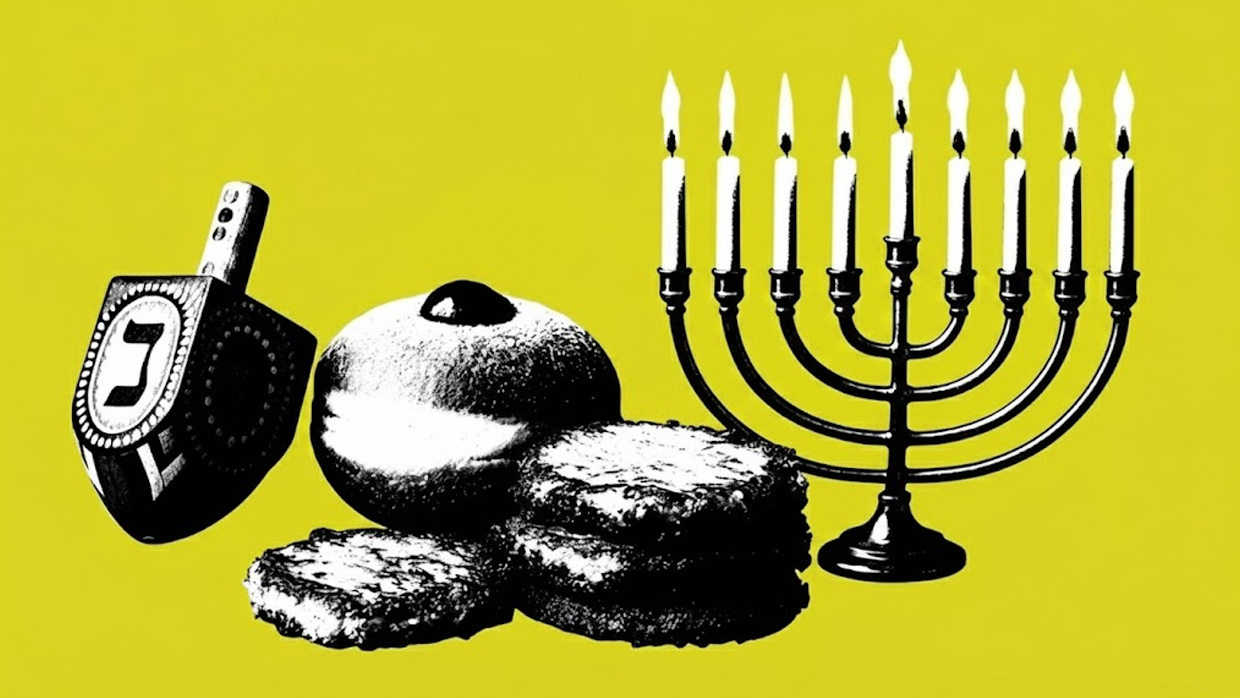
The Yiddish word "dreidel" comes from the German word "drehen", which means to turn, as in the expression “dreyen a kopf” (“turning a head” which loosely translates as “driving me crazy”). The modern Hebrew term "sevivon" comes from the root "sovev" (to turn) and was invented by Itamar Ben-Avi (the son of Eliezer Ben-Yehuda, father of Modern Hebrew) when he was five years old.
Although Jewish sources don’t mention the dreidel earlier than the 18th century, numerous reasons have been suggested for the custom of playing with dreidels on Hanukkah. The most famous explanation is based on the historical Hellenist opposition to study of Torah, and this was a way for Jews under Hellenistic persecution to disguise their study of Torah by pretending to engage in gambling with tops, or by children pretending to be playing when they were actually assembling to study.1
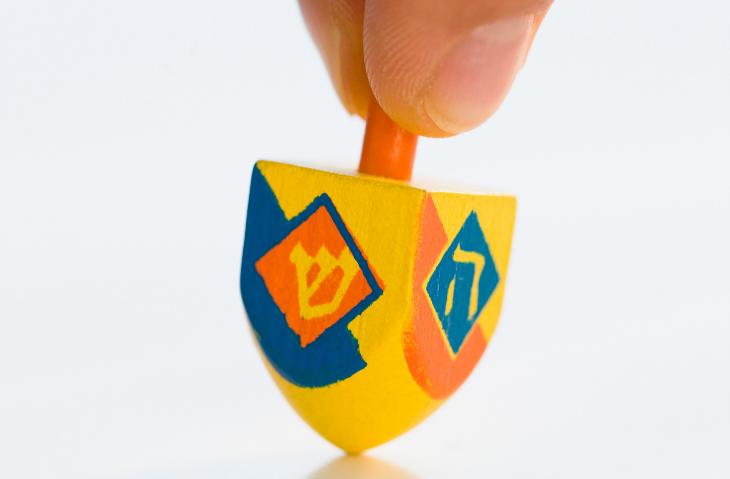
Others contrast the dreidel with the Purim grogger (noisemaker), pointing out that while the grogger is spun from below, the dreidel is spun from above. On Hanukkah, the miracles were due to Divine kindness rather than repentance of the Jews – i.e. spinning from above. On Purim, the Jews fasted and repented, and the miracles resulted from their merit – i.e. spinning from below. 2
The great Chassidic thinker, Rav Zvi Elimelech of Dinov sees the four sides of the dreidel as alluding to four kingdoms that oppressed and exiled the Jewish people: Babylon, Persia, Greece and Rome. The dreidel symbolizes the ultimate fall of each empire, whereas the two constants of the dreidel, the point around which history revolves, the destiny of the Jewish people, and the Hand of God that spins from above, symbolize the future redemption. The opposition forces will be nullified, and the world will unite with the Jewish people in the service of God.3
Many great Rabbis took the custom of spinning the dreidel quite seriously. Rabbi Moshe Sofer of Pressburg (known as the Chasam Sofer) used to specifically spin his own silver dreidel, especially when guests visited, in order to fulfill this beautiful custom and publicize the miracle in a distinguished manner.4 Nowadays Chassidic Rebbes spin dreidels in the presence of their Chassidim after the lighting of the menorah.
Consider the physics behind a dreidel. Gravity tries to topple it by creating an angular force, but when the dreidel spins rapidly around its vertical axis, this spin stabilizes it. As long as it's spinning quickly, gravity's effect is too weak to tip it over—so the dreidel stays upright.5 Based on this idea, Rabbi Shlomo Fischer added another dimension to the dreidel. He explained that like the dreidel, the Jewish people, if left to natural, sociological and historical forces will fall. It is only because we “spin” continuously with the energy and enthusiasm of Torah and mitzvah observance that we are able to stay upright and survive.6
Aside from spinning dreidels, we celebrate Hanukkah in a primarily spiritual fashion – lighting candles and saying special prayers; there is no obligation to have a special meal.7 One reason for this is that the threat of the Hellenists to the Jewish people was primarily spiritual, not physical – assimilation as opposed to annihilation. This is in contrast to Purim where the threat was physical annihilation, and hence the celebration is primarily physical – food, gifts, and wine.8 Having said that, the Jewish people are definitely gastro-centric9 and there are specific customs related to food on Hanukkah.
The earliest mention of a special Hanukkah food is found in a medieval commentary on the Talmud10 where the author writes, “The Greeks decreed that every woman must spend her wedding night with the Greek governor. And the Midrash11 relates that the daughter of Yochanan the High Priest, Yehudit, gave the Greek governor, Holofernes, cheese and wine when she was taken to him on her wedding night, and when he was drunk, she took his sword and killed him. Because of this it has become customary to eat dairy foods on Hanukkah.”
This is one source for a ruling in the Code of Jewish Law, which states that “Some say it is customary to have special meals during Hanukkah to celebrate the dedication of the Temple.… And some say it is customary to eat cheese on Hanukkah to commemorate Yehudit feeding Holofernes cheese before killing him.”12 The act of bravery of Yehudit helped spark the Maccabean revolt and put fear into the hearts of the Greeks.
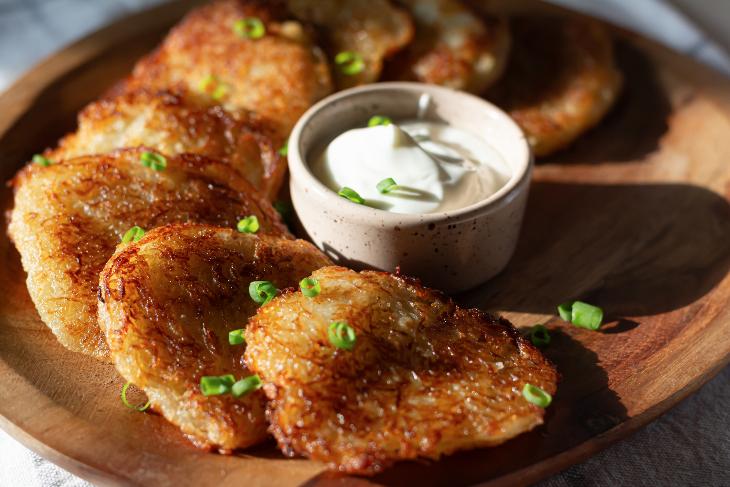
One of the oldest Hanukkah foods, dating back to the 13th century, was the ricotta cheese pancake, fried in olive oil. This food combined two references to Hanukkah, the cheese commemorating Yehudit and her courage, and the olive oil, commemorating the miracle of the Menorah. Jews of Spain, Sephardim, referred to these pancakes as cassola and Italian Jews called them casciola, from the Italian cascio, cheese.
The Yiddish term latke is derived from the Ukrainian word for pancake or fritter, oladka. This word originated from the Greek eladia, meaning “oily things,” related to the Greek elaion, meaning olive oil (which, of course, brings us back to Hanukkah) and from which the English word “oil” derives.
The original European latkes did not use potato but were made of soft cheese fried in olive oil. In Eastern Europe, where olive oil was either not available or extremely expensive, other oils were substituted. The most common oil to fry was schmaltz, animal fat, and therefore the latkes could not be made of cheese. Instead, people used rye batter, buckwheat flour, turnips and other vegetables. Potatoes were first brought to Europe from South America by the Spanish and were originally considered poisonous. They were not widely eaten in Europe until the 18th century, and it was not until the late 19th century that potatoes became acceptable to plant and eat in Eastern Europe.
Once potatoes were introduced, they became a staple of the Eastern European diet and were used by Jews to make latkes, fried in schmaltz. Unfortunately, this evolution of the latke was now missing both references to Hanukkah, not having either cheese or olive oil in the recipe.13
Anyone who has been to Israel knows that already a month before Hanukkah, bakeries all over the country begin selling sufganiyot, fried doughnuts, which come in a staggering variety of flavors and styles. Fillings include the classic jelly, but also halva, chocolate truffles, dulce de leche, crème espresso and mango cream. The Hebrew term sufganiyot is actually a term that is found in the Talmud as sufganin, where their status as matzah is discussed.14 Commentaries15 explain that the word means “like a sponge, sfog” and that it is a type of bread-like food.
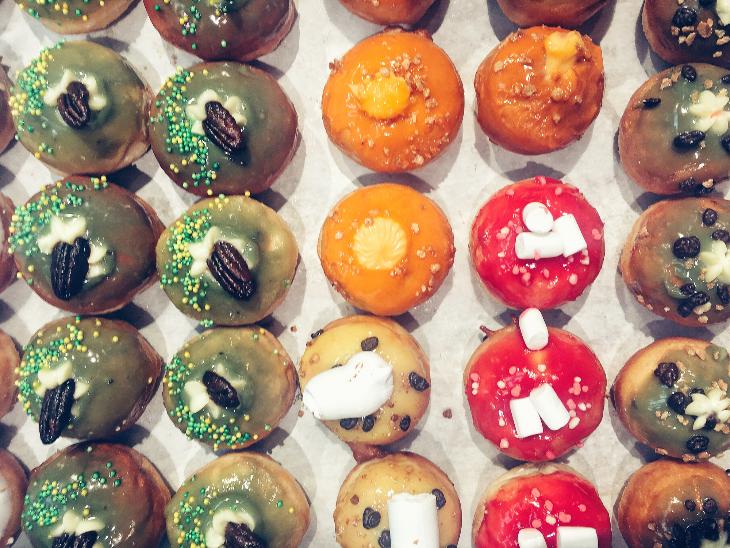
The sufganiyah only really became a Hanukkah food in the 1920s where it was pushed by the Histadrut trade union in Israel in order to provide much needed employment to workers.16 Unlike latkes, which could easily be made at home, sufganiyot were produced in bakeries and hence created an opportunity for employment. However, the fact that it is fried in oil, albeit not olive oil, does make it somewhat of a Hanukkah dish. In fact, Spanish Jews used to make fritters known as bimuelos, which were fried in oil and dipped in honey or sprinkled with cinnamon and sugar for Hanukkah.17
The single most important observance of Hanukkah, one that is actually required by Jewish law, is the lighting of the Hanukkah menorah, the eight-branched candelabra. Every household is obligated to light at least one menorah.18 This is in order to commemorate and publicize the miracle in which the oil burned for eight days even though there was only enough oil for one day, as is well known.19
There is, however, a little bit of a problem with this obligation. The original miracle of the menorah at the time of the Maccabees took place in the holy temple in Jerusalem and therefore one would expect that the primary location for lighting the Hanukkah menorah should be in the synagogue, our quasi-temple.20 Why is it that the obligation is primarily in the home, whereas in the synagogue it is not obligatory but customary?21
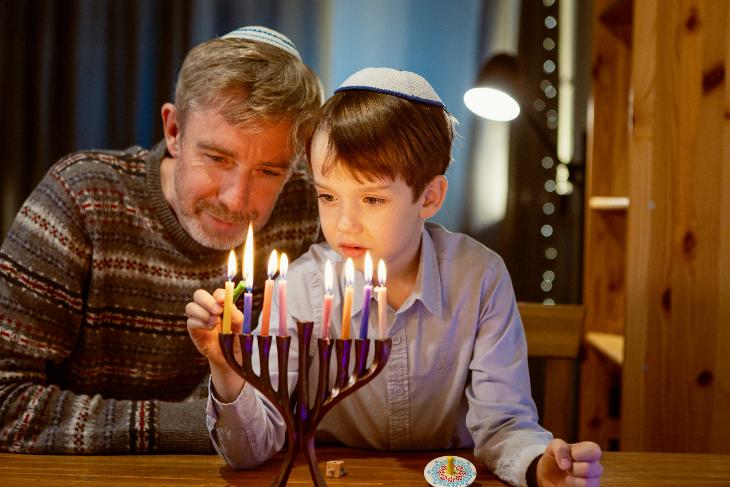
One perspective comes from a previously mentioned story: Yehudit was taken by the Greeks to be defiled on her wedding night. The Talmud explains that this decree was universal, a Hellenist effort to undermine and corrupt the sanctity of the Jewish home and family.22 As a response, we light candles specifically in our homes to symbolize that the holiness of the Jewish home endures.
Another explanation, offered by Rabbi Avraham Yitzhak Kook,23 highlights how the Torah refers to the Jewish people as “a kingdom of priests and a holy nation.”24 According to Rabbi Kook, every Jewish home is considered a temple, and every Jew a priest. Thus, we light the menorah within our own temple—the Jewish home.
I believe that there is another important lesson in the idea of lighting the menorah in our home. Rabbi Samson Raphael Hirsch who lived in Germany in the 19th century was frustrated by the emphasis in the early reform movement where Judaism was almost completely focused in the synagogues and the temples. He believed that the epicenter of Judaism was in fact the home. He even went as far as saying that he would like to close all the synagogues for a month or two just to demonstrate that the primary locus of Jewish holiness, of Torah study, performance of the commandments, and Jewish education was in each person's home not in the communal institutions of the synagogues and schools. By lighting the menorah in our homes, we express this same idea.
Jewish celebrations and festivals are multi-faceted. Food, prayers, rituals and even recreation are ways in which Judaism shares its messages. We celebrate Hanukkah with reminders of our persecution and salvation – the dreidel; our heroism and self-sacrifice – dairy foods; and miracles and holiness – the menorah. Whether you light the menorah, eat donuts or spin the dreidel, you are testifying to the eternity, uniqueness and miraculous nature of Jewish survival.
Happy Hanukkah!




Thank you, Rabbi Becher.
This is a joyful article celebrating the most important aspects of light, family, and home; and, not allowing defeat in the face of evil, and seemingly insurmountable odds.
A most joyful vision in Jerusalem city, where each family's kindled menorah is put on display in individual glass boxes inserted in the home's wall.
Beautiful walk by the way.
Thank you, have a wonderful Chanukah
Thank you Rabbi Becher!
I had the pleasure of attending several of his lectures in the US over the years.
I listen to a Pre-Rosh HaShanah Lecture he gave, a copy of which I purchased at a Gateways Seminar a long time ago (over 20 years) on a yearly basis. It is always relevant!
Thank you, have a wonderful Chanukah