
 What Repentance Really Means in Judaism
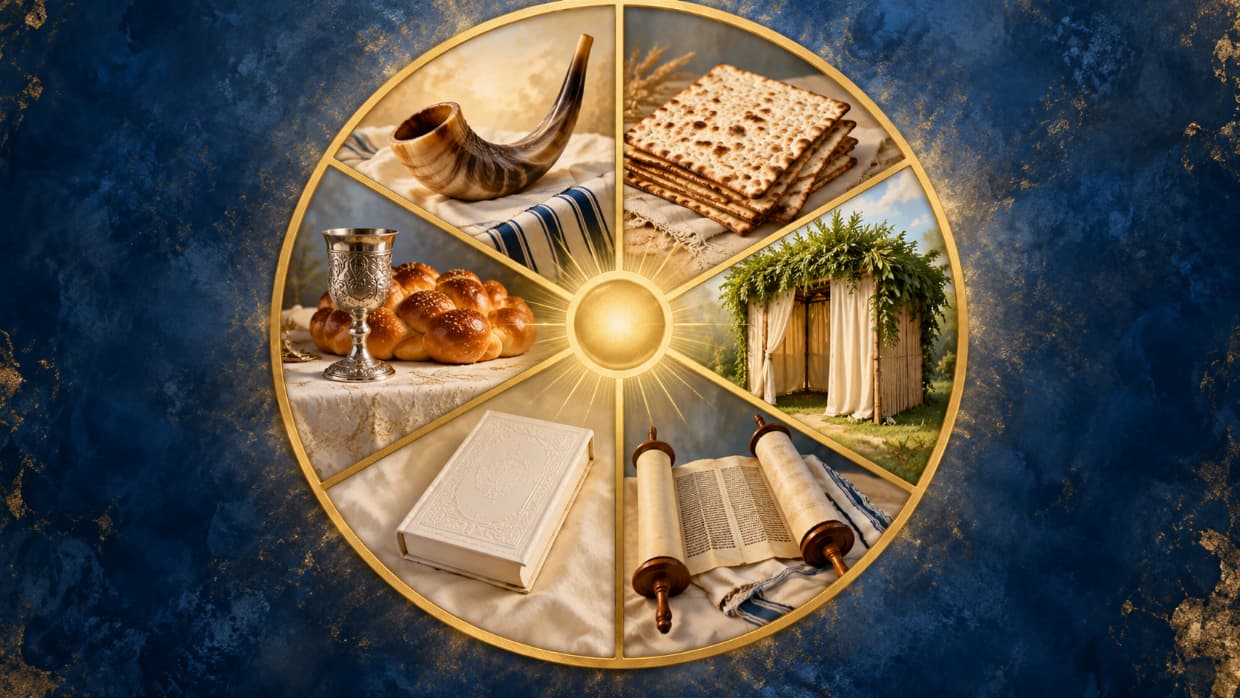






The six commandments that form the foundation of Judaism correspond to six Jewish holidays. Here's the connection most people never notice.
The foundation of Judaism consists of six commandments that Jews are meant to carry at every moment. Think of them less as items on a list of 613 commandments and more as a mindset: six constant attitudes that shape how a Jew moves through life, all day, every day.
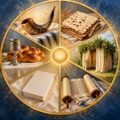
Those six beliefs map directly onto the six major Jewish holidays – Passover, Shavuot, Rosh Hashanah, Yom Kippur, Sukkot and Shemini Atzeret. That's not a coincidence. Judaism is a unified system, and the holidays is a pivotal arena where its core ideas come to life.
Each holiday is rich with its own history, rituals and layers of meaning, so no single idea fully captures it. But look closely and a clear theme emerges in each one, tying back to one of those six beliefs. The holidays turn those big, abstract ideas into something we actually feel and relive year after year.
Here are the six Jewish holidays and how each one corresponds to one of the six constant mitzvot.
The first constant mitzvah is to know that God exists and is the source of everything.
Rosh Hashanah commemorates the creation of the world, and specifically the creation of humanity. On this day, we recognize that the universe isn't accidental and that we don't exist independently. God created us, sustains us, and directs history toward its purpose.
This is also the day we proclaim God as King. Before we can accept His commandments, we first have to recognize the reality of the King. Rosh Hashanah establishes the most fundamental truth religious life rests on: God is real, He created the world, and my life comes from Him.
The second constant mitzvah is not to recognize or grant power to any other god.
Passover is about the destruction of false gods. Egypt wasn't only a place of physical slavery; it represented an entire worldview built on idolatry, human power and limitation. Pharaoh declared himself master of the Nile and owner of the Jewish people. Egyptian society seemed invincible.
Through the Ten Plagues, God systematically shattered that illusion, demonstrating that the Nile, the animals, nature, human beings, and even Pharaoh himself held no independent power.
Leaving Egypt meant more than escaping slavery. It meant leaving behind the false gods of Egypt and the inner limitations they represented. The Jewish people traded servitude to Pharaoh for service to God. Passover teaches us that nothing – not money, power, social pressure, nature, or our own fears – holds ultimate authority. No power exists independent of God.
The third constant mitzvah is to recognize the absolute unity of God.
Sukkot exposes the illusion that the world's many forces operate independently. During the year, we live inside solid homes and imagine our security comes from walls, possessions and carefully laid plans. On Sukkot, we leave that apparent security and enter a fragile sukkah (a temporary hut topped with a roof of branches) open to the sky.
The sukkah teaches us that the material world, for all its apparent permanence, is temporary. Its different forces and events aren't disconnected; everything exists within the all-encompassing unity and providence of God.
The sukkah surrounds the entire person. We don't just think about God's unity, we enter it and live inside it. We recognize that the many circumstances of our lives – pleasant and painful, spiritual and physical – are all expressions of one divine plan. Behind the world's multiplicity stands the absolute oneness of God.
The fourth constant mitzvah is to love God.
After the universal celebration of Sukkot, God asks the Jewish people to stay for one more day. Our sages portray God as saying, "Your departure is difficult for Me. Stay with Me one more day."
Shemini Atzeret has fewer distinctive rituals than the other festivals because its essence is the relationship itself. There's no historical crisis to overcome and no elaborate symbol standing between us. After the work of the previous festivals, God simply invites us to remain alone with Him.
Love means desiring closeness, not just serving God out of obligation, but valuing the relationship and not wanting it to end. Shemini Atzeret is the intimate high point of the festival season: God and His people rejoicing in each other's presence.
The fifth constant mitzvah is to fear God, to stay conscious of His greatness and recognize the seriousness of His will.
At Mount Sinai, the Jewish people encountered a revelation that filled them with awe. There was thunder, lightning, fire and the sound of the shofar. The mountain trembled, and the people themselves stood at a distance, afraid.
Our sages describe God as holding the mountain over them. This image captures the overwhelming, inescapable reality of that divine encounter. Torah isn't just a collection of inspiring ideas we pick and choose from. It's the will of the Creator, carrying absolute authority.
Proper fear doesn't push us away from God. It awakens us to His greatness and gives weight to our choices. Shavuot teaches us to stand before God with reverence and say, "Naaseh venishma" – we will do and we will listen.
The sixth constant mitzvah is not to stray after the desires of the heart and the attractions of the eyes.
All year, physical desire, habit and ego can obscure our deepest values. We start chasing what feels good instead of what's actually meaningful. We become identified with our appetites, our achievements, our image.
On Yom Kippur, we temporarily step back from physical indulgence. We don't eat, drink, or attend to ordinary bodily comforts. Dressed in white, we resemble angels for a day. Not because the body is evil, but because we need to rediscover that the body isn't the master.
Yom Kippur lets us separate our true selves from the desires and failures that have piled up around us. We confess our mistakes, set aside our ego, and realign with what we genuinely want. It teaches us that we have the freedom to say no to distraction and desire, and to return to God.
The six constant mitzvot describe the architecture of a relationship with God:
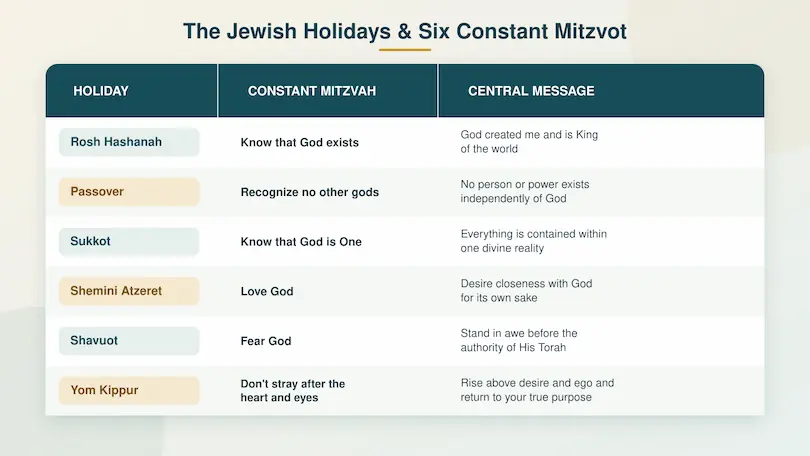
The order of the calendar doesn't necessarily follow the conceptual order of the mitzvot. Each festival lands at the moment in the year when its particular message is needed. Together, though, they form a complete spiritual curriculum.
The six constant mitzvot teach us how to live with God every day. The six holidays make sure those truths don't stay abstract ideas. Each year, we experience them all over again as part of the story of the Jewish people and the personal journey of every Jew.