 AI Built Its Own Social Network. Now It’s Asking If It’s Real




3 min read


The significance, customs and mechanics of counting the Omer.
How to Count the Omer
The Omer is counted every evening after nightfall (approx. 30 minutes after sunset), which is the start of the Jewish 'day', beginning on the second evening of Passover.
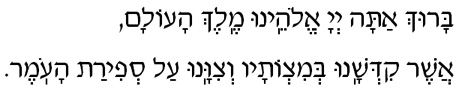
If you have not missed any days of counting and are counting in the evening (as opposed to the following daytime) you stand and say the following blessing before counting:
Baruch ata Adonoy, Eloheinu melech ha-olam, asher kid'shanu be'mitzvo'sav ve-tzivanu al sefiras ha'omer.
Blessed are You, God, King of the Universe, Who made us holy with His commandments, and commanded us on the counting of the Omer.
After completing the blessing, recite the count of the days.
To properly 'count the Omer,' you must say both the number of days and the weeks. For example:
On days 1-6, we say only the number of days. For example:
"Today is 4 days of the Omer."
On days which are complete weeks – e.g. 7, 14, 21 – we say as follows, for example:
"Today is 21 days, which is 3 weeks of the Omer."
On all other days, we say, for example:
"Today is 33 days, which is 4 weeks and 5 days of the Omer."
(Since you must recite the blessing before you count, don't mention the count for that night beforehand.)
The reason is because regarding the Omer, the Torah writes: "Seven weeks, they shall be complete" (Leviticus 23:15). Thus according to many authorities, if one missed counting any day, the 7-week period can no longer be considered 'complete'.
Omer Restrictions
The Talmud tells us that Rabbi Akiva had 24,000 students who tragically died during the Omer period, because they did not treat each other with sufficient respect. Therefore, for the 33 days from Passover until Lag B'Omer, we observe these signs of mourning:
[Note: According to some customs, the 33-day mourning period begins a few weeks later on the first of Iyar, and ends on the third of Sivan.]
In the days of the Holy Temple, the Jewish people would bring a barley offering on the second day of Passover (Leviticus 23:10). This was called the "Omer" (literally, "sheaf") and in practical terms would permit the consumption of recently-harvested grains.
Starting on the second day of Passover, the Torah (Leviticus 23:15) says it is a mitzvah every day to "count the Omer" – the 50 days leading up to Shavuot. This is an important period of growth and introspection, in preparation for the holiday of Shavuot which arrives 50 days later.
Shavuot is the day that the Jewish people stood at Mount Sinai to receive the Torah, and as such required a seven-week preparation period. The commentators say that we were freed from Egypt only in order to receive the Torah and to fulfill it. Thus we were commanded to count from the second day of Pesach until the day that the Torah was given – to show how greatly we desire the Torah.