




 Would You Kill Baby Hitler?



10 min read


In the footsteps of the Temple Menorah from the Middle East, to Europe, and Africa, in search of its most probable location in the world today.
While Jewish tradition suggests that the Ark of the Covenant went underground prior to the destruction of the First Temple some 2500 years ago, historical accounts suggest that the Temple’s golden Menorah was taken out of the country after the destruction of the Second Temple nearly 2000 years ago and made its way across three continents. Let’s follow in the footsteps of the Temple Menorah from the Middle East, to Europe, and Africa, and seek to discover its most probable location in the world today.
According to the Hebrew Bible, the seven-branched Menorah was meant to serve as a candelabrum, a source of illumination inside the Tabernacle in the wilderness that was operated by Aaron (the Jewish people’s first high priest): “Speak to Aaron and say to him: ‘When you light the lamps, the seven lamps shall cast their light toward the face of the menorah’" (Numbers 8:3).
After several centuries inside the Tabernacle, first in the desert, then in multiple locations within ancient Israel, such as Gilgal (near the Jordan River), Shiloh (in Samaria/West Bank), Nov, and Givon, King Solomon built the Temple in Jerusalem and transferred all the original components of the Tabernacle into it, including the Menorah: “And they brought up the Ark of the Lord, and the tabernacle of meeting, and all the holy vessels which (were) in the tabernacle, and the priests and the Levites did bring them up” (1 Kings 8:4).
For centuries, the Menorah remained inside the Temple of Solomon until it was ransacked by the invading Babylonian army in 586 BCE: “And the chief executioner [Nebuzaradan] took the pitchers, the censers, the basins, the pots, the menorah, the spoons, and the frames both of gold and of silver” (Jeremiah 52:19).
All the Temple vessels, with the exception of the Ark of the Covenant, were brought as war booty to Babylon where the Jewish people were forcibly displaced in the aftermath of the Temple’s destruction. Fifty-two years later, after the Persian Empire replaced Babylon as the regional superpower in the Middle East, Cyrus king of Persia issued a decree granting permission for the Jewish nation-in-exile to return to its ancestral homeland. In doing so, he also ordered the return of all the components of the Temple that were removed years earlier by the Babylonians (see Ezra 6:5).
The Menorah remained inside the Temple throughout the Second Temple period only to be seen by Jewish priests, who filled its vessels with olive oil on a daily basis. During the historical period of Hanukkah, the Menorah was temporarily lit in the Temple courtyard where the Jewish masses witnessed the miracle of the oil. It took on a symbolic significance of the Jewish victory against the Greeks and served as a beacon of hope during times of darkness throughout the ages. It’s for this reason that the Menorah became the bonafide Jewish symbol throughout history and today serves as the official emblem for the State of Israel.

The specific style or design of the Menorah depicted in emblem for the State of Israel was based on the Menorah engraved on the Arch of Titus in Rome, which is a testament to its historical fate. The structure, which still stands today, was originally built in 81 C.E. by Emperor Domitian to memorialize the great Roman victory against the Jewish rebellion in Judea led by his younger brother, General Titus. The sculptural reliefs on the arch depict Roman soldiers carrying away the spoils of the Temple including the Menorah, and other sacred objects like the table of showbread, gold trumpets, and fire pans. The obvious question is where was the Menorah taken to after the Second Temple was destroyed by the Romans?
The fate of the Menorah, as we know it, was recorded by the former rebel commander, traitor, and historian Josephus Flavius (Yosef ben Matityahu). After defecting to the Romans, Josephus travelled with the Roman legions as a war correspondent and interpreter as they attacked various Judean rebel strongholds. After witnessing the wholesale demolition of the Temple and destruction of Jerusalem, Josephus was invited to Rome as a royal guest of honor, which turned into a permanent relocation.
As a Roman sanctioned VIP, he would have been an eyewitness to an event known as “The Triumph” in which thousands of Jewish POWs were paraded through the streets of Rome one year after Jerusalem’s destruction in 71 C.E. Artifacts from the Temple were also part of the triumphal parade. According to Josephus, towards the end of the march, the Menorah was placed in the Temple of Peace, which included artwork and war spoils from all over the Roman Empire and beyond. This was like an ancient version of a museum. In any case, it remained there for centuries and was open to the public.
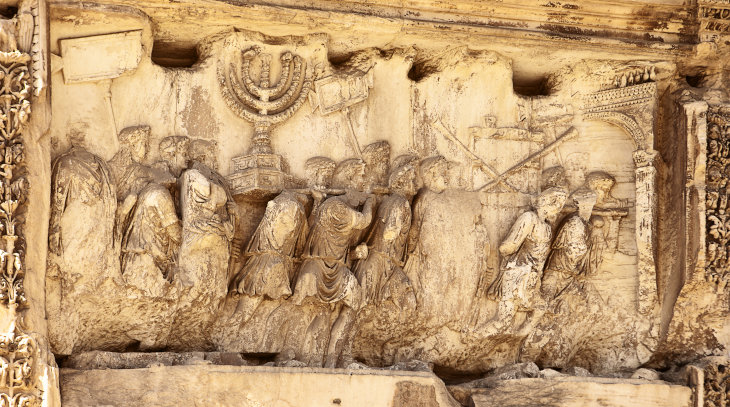 The Arch of Titus
In the second century, in the aftermath of the Bar Kochba revolt in Judea, Emperor Hadrian issued harsh decrees supressing any expression of the Jewish religion. After his death, however, many of the famous rabbis mentioned in the Mishna, such as Rabbi Shimon bar Yochai, Rabbi Eliezer, and Rabbi Yossi sailed to Rome to appeal to the new Caesar (Antoninus Pius) to rescind the anti-Jewish laws. According to the Talmud, while in Rome, Caesar’s daughter fell ill and the rabbis were given permission to try and heal her to which they were successful. As a reward, they were taken on a VIP tour of the Temple of Peace where they saw a number of important artifacts from the destroyed Temple in Jerusalem including the Menorah.
Unfortunately, a number of years later in 192 C.E., the Temple of Peace was destroyed in a severe fire. Although it was rebuilt shortly thereafter, we don’t find any further historical accounts of anyone seeing the Menorah in the Temple of Peace in subsequent centuries.
This begs the question: was the Menorah destroyed in the fire? Was it moved to another more secure location for better safe keeping? Assuming it did survive in some other part of Rome, we know that the city was ransacked in 410 C.E. by the Visigoths and looted of all valuables by the Vandals in 455 C.E. (hence the term “vandalize”) over a two-week period. During that time, large quantities of gold, silver, and works of art were removed from temples, monuments, and public buildings and taken away by the Vandals. Is it possible that one of these ancient Germanic tribes stole the Temple Menorah from Rome in the 5th century? It’s certainly a possibility.
The Vandals who were originally from southern Poland, migrated to the Mediterranean basin in the 5th century and conquered parts of Spain and North Africa from the Romans. The great city of Carthage in what is now modern-day Tunisia became the base of operations for the Vandals and that is where much of the war booty and slaves from Rome ended up. Less than a century later in 533 C.E., a Byzantine general named Belisarius engaged in a military campaign against the Vandals and invaded Carthage. According to the Byzantine historian Procopius, who was a legal advisor to General Belisarius and accompanied him on the battlefield, among the artifacts found in Carthage was the Menorah from the Temple in Jerusalem. Procopius writes that the Menorah was then shipped from Carthage to the Byzantine capital Constantinople in modern day Turkey.
According to his account, the Menorah was paraded through the streets of the city, but apparently Emperor Justinian had his reservations about keeping the Menorah in Constantinople. Since Rome was sacked when the Menorah was there in the 5th century and Carthage was sacked when the Menorah was there in the 6th century, Justinian, being superstitious, feared that the Menorah was cursed and that Constantinople might suffer a similar fate. Following the example of the ancient Philistines who captured the Ark of the Covenant and then sent it back to Jewish territory following an outbreak of hemorrhoids, Justinian reportedly shipped the Menorah back to Jerusalem. At the time, the city was exclusively Christian as Jews had been exiled centuries earlier. The Menorah was therefore placed in the Nea Church located in the vicinity of what is today the Batei Makhse Square in the Old City.
From this point onwards, there are no further historical claims on the location of the Menorah, so all we’re left with is speculation. The Persians who invaded Jerusalem in 614 C.E. were known to have taken holy relics. For example, the True Cross, which Christians believe was the original structure that Jesus was crucified on, was seized in Jerusalem and brought to Persia at that time. Could the Menorah have also been brought to Persia? It is interesting that every 80 years or so between the 5th-7th centuries, a city in which the Menorah allegedly resided in was sacked and the sacred object removed and brought to a different country/continent. Others claim that the Menorah remained in Jerusalem and was taken back to Europe by the Crusaders in the late 13th century and returned to Rome. On the other hand, some legends claim that the Menorah never left Rome in the first place, but rather was hidden by the Church and was deposited into the underground vaults of the Vatican later in history.
The myth that the Vatican has been in possession of the Temple vessels (including the Menorah) for centuries has become popularized in recent decades. This is largely based on accounts of Jewish visitors who were invited into sections of the Vatican’s storerooms that are not open to the public and claim to have seen objects there that resembled the long-lost Temple vessels. None of the accounts have been able to provide detailed descriptions or photographs and so the theory remains conjecture. However, it should be noted that the location of the Temple of Peace and other buildings honoring Vespasian and Titus on Palatine Hill are only less than an hour walking distance from Vatican City on the other side of the Tiber River. Moving the Menorah from one location to the other would not have been a significant challenge if it happened at some point in history.
Regardless of where the Menorah is physically located on Earth, if it’s even still intact, we can always build a new one. In fact, that’s exactly what the Maccabees did in the Hanukkah story. Since the original Temple Menorah had been pillaged by the Greeks, they built a make-shift Menorah made out of their iron spears (normally used as a weapon) that served its purpose until a new golden Menorah could be reconstructed. In modern times, an organization called the Temple Institute has recreated a Menorah built with the same materials and dimensions as outlined in the Book of Exodus. It has been on public display for many years in the Jewish Quarter of Jerusalem’s Old City.
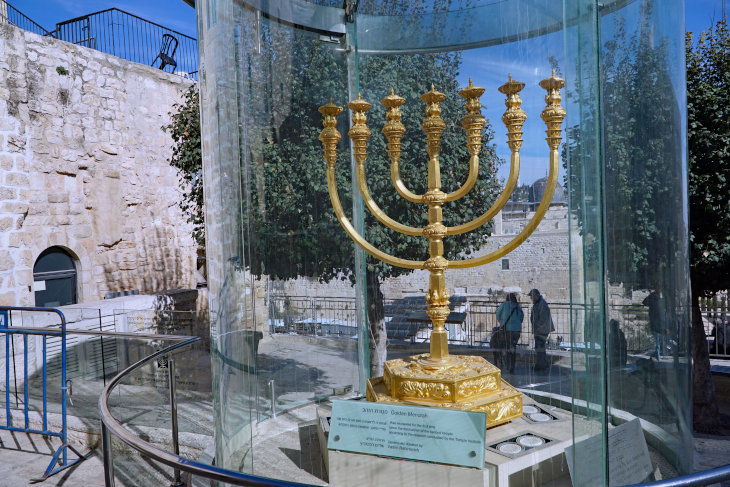
Our journey in search of the Menorah took us through the Middle East, Southern Europe, and North Africa, but perhaps the Menorah we’re looking for is already in Jerusalem waiting for us to kindle. With a rebuilt Third Temple at some point in the future, our Menorah will truly be back where it belongs.
Sources:












You write " The Menorah found in Carthage was the Menorah from the Temple in Jerusalem. Procopius writes that the Menorah was then shipped from Carthage to the Byzantine capital Constantinople in modern day Turkey."
In which Procopius' book is this to be found, please ? Thank you.
Why all the fuss?
This constant wailing and wallowing about Jewish defeats is depressing.
So the Menorah is gone.
So what!
Just make a new one.
It is specified in the book of Divrei Hayamin 2, 4, 7, and again in Melachim 1, 7, 49, that King Salomon added 10 exact copies of the menorah. No reason is given, besides to beutify the temple. Could it be that King Salomon was aware the temple had a limited period of 410 years, and built additional menorath, so the original menorah could be hidden by the kohanim together with the Luchot habrith, oil and mannah. There are no source to support this idea, it is however not likely that the original menorah built by Moses on instruction from Hashem was removed from Jerusalem. It is more likely that a copy made by Solomon arrived in Rome, and the original Menorah is buried in Jerusalem waiting for rebuilding of Beth Hamikdash, together with other items built by Moshe Rabenu. Bimehera bejomenu.
The Menorah was made of pure gold.
It would have been smelted down.
A new Menorah for the Third Temple!
Jews can't find the holy objects from our holy temple, I guess it will be found when the 3rd temple will come down from heaven, and we will also find the lost 10 tribes until then we don't really know what happened to both lost things one holy objects the other the rest of the people of Israel
Professor Steven Fine wrote an entire book about the Menorah. It is well worth reading.
Judaism is history
Great article! I have never before seen anything about the possibility of it’s being in Greece or Turkey. The Orthodox Christian Church was much more powerful and wealthy than the Roman Catholic Church in late antiquity, until it eventually fell to pagan invaders and later to Muslim invaders.
I did speak with a scholar some years ago who thinks the most likely possibility is that whomever had the menorah last probably melted it down.
Unless it turns up and can be verified as original, we will probably never know. Fascinating to wonder about, though.
Indeed it was most likely melted down by the Romans shortly after the triumphal procession (which would have been by victorious Romans, not Jewish prisoners, who would already have been sold into slavery). The gold was too valuable and Rome needed the gold to fund its empire.
What destroyed the Eastern Roman (Byzantine) Empire and the significance of the Eastern Church was the Fourth Crusade in 1204, not pagans or Muslims. It hung around by name for another 2 1/2 centuries but was never a major force again. The Crusaders didn't just kill Jews and Muslims.
in my simple reading of gemrah of we find that in the early days of Bayit Sheni they did not have the golden menorah
Based upon what I learned in the past, a replacement Menorah is valid as long as it is not made from Gold. Menorah made from Gold needs to be made in the same manner as it is written in the Torah. This means that it needs to be hammered from one piece of Gold as it is written in the Torah. This task cannot be duplicated in modern times. The part that is written toward the end of the article: In modern times, an organization called the Temple Institute has recreated a Menorah built with the same materials and dimensions as outlined in the Book of Exodus. It has been on public display for many years in the Jewish Quarter of Jerusalem’s Old City. That menorah on public display in Jerusalem is INVALID.