








 What Two Hebrew Words Reveal About Israeli Democracy







Shrouded in mystery and brilliance, Maria the Jewess was a trailblazing alchemist whose groundbreaking inventions and enigmatic philosophies bridged the gap between science and mysticism.
During the medieval era, Maria the Jewess was a pioneer in the field of alchemy. Her academic study and invention of essential lab equipment, technology, and theoretical innovations played a crucial role in shaping what would become the foundation of modern chemistry.
She is also associated with the "Axiom of Maria," a philosophical principle in alchemy that emphasizes the unity of opposites and how all materials are “one” from a common ancestry.
She theorized that metal possessed two distinct genders, and by uniting these genders, a completely new entity could be formed. She saw similarities between alchemy and sexual reproduction, where “male and female” metals could combine in oxidation and change base metals into gold. The phrase attributed to Mary the Jewess, "Join the male and the female, and you will find what is sought," later resonated within Carl Jung's work.1
Her teachings and inventions were highly influential and she is often regarded as the first true alchemist of the Western world.
Alchemy bridged and intertwined the realms of science, mysticism, and the occult.
The word alchemy comes from the Arabic word al-kīmīā, الكیمیاء . Alchemy was a proto-scientific tradition and medieval philosophy whose goals were to transmute (transform) base metals into gold, uncover a universal remedy for all ailments, and achieve the extension of life. It served as a foundational precursor to both modern chemistry and medicine.
Alchemists believed that all matter was formed from four fundamental elements: earth, air, fire, and water. Alchemy was practiced in China, India, the Muslim world, and Europe, with each region cultivating its own distinct traditions and interpretations of the practice.
 Maria the Jewess - Michael Maier's Symbola aurea mensae, Frankfurt, 1617
Central to alchemy was belief in the existence of a "Philosopher's Stone," a legendary substance thought to have the ability to transform metals, heal illnesses, and bestow immortality through an elixir of eternal youth.
As science progressed, alchemy gradually declined in prominence, yet its influence endures today in art, literature, and popular culture.
The annals of history gave her many names - Mary the Jewess, Miriam the Jewess, Maria Prophetissima, Maria Prophetissa, Mary Prophetissa, Miriam the Prophetess, Maria Hebrea, and Maria the Hebrew.
Her early life and childhood in Hellenistic Egypt are shrouded in mystery, with limited details available about her upbringing. She likely lived between the 1st and 3rd centuries CE (the exact dates of her life remain uncertain) in Alexandria, Egypt. Alexandria stood as a beacon of intellectual brilliance in ancient Egypt, thriving as a vibrant crossroads where Greek, Egyptian, and Jewish traditions intermingled.
Jews played a pivotal role in shaping alchemy in ancient Alexandria, particularly within the city’s Jewish quarter where there was a Jewish temple alongside Greek traditions.
Jewish alchemists operated independently from state-controlled institutions granting them greater freedom to innovate. This freedom gave Jewish alchemical guilds the framework for faster innovation and more widespread dissemination of knowledge.
Maria is one of the earliest alchemists in recorded history and founded an alchemical academy in Alexandria.
Maria is one of the earliest alchemists in recorded history and founded an alchemical academy in Alexandria. Although much of her work has been lost to history, her research is primarily known today through the scholarly works of classical alchemist Zosimos of Panopolis. He was a prominent figure in the history of alchemy and mysticism, and documented and preserved her experiments, inventions and research in his writings during the late 3rd and early 4th centuries. He was impressed by Maria’s work, referring to her as “one of the sages”.2 The Arab world was equally impressed by her academic work and referred to her as the “daughter of Plato”.3
Maria holds the distinction of being the first Jewish woman, outside of mythical contexts, to author and publish works under her own name. According to Zosimos, Maria wrote a volume called Peri kaminon kai organon (On Furnaces and Apparatuses), which makes her the earliest known Jewish woman to have authored a book. 4
Maria used various apparatuses, such as ovens made from clay, metal, and glass in her experiments. To secure the joints between different components, she utilized materials like wax, fat, starch-based paste, and clay mixed with fat. Zosimos noted that she favored glass equipment because it facilitated viewing the reactions without disruption and allowed safer handling of toxic substances like mercury (symbolizing the female force) and sulfurous or arsenical compounds (symbolizing the male force).
Maria believed that all substances in nature shared a fundamental unity, allowing for transformations between metals and even links to human life processes. This idea of unity through division and reunion—a central concept in alchemy—was highly influential. And it was this concept that inspired thinkers like Carl Jung in psychology.
In his writings, Zosimos of Panopolis referred to Maria as “the sister of Moses”.5
“Maria was explicitly called Jewish (as per her name) throughout late Roman and medieval times. Some manuscripts claim that she said, “Do not touch the philosopher’s stone with your hands; you are not of our race, you are not of the race of Abraham.”6 Her monotheistic quotes always touch on the unity of God in the singular.”7
Her story became something of a legend in later Arabic and Christian writings.8
Her theories permeate the texts of Islamic alchemy, resurface during the European Middle Ages, and are immortalized in Michael Mayer's 1617 work Atalanta Fugiens. By the close of the 17th century, Maria the Jewess had already been a central figure in alchemical thought and practice for over 1,500 years and renown unparalleled in the history of alchemy.
Maria's belief in the interconnection between all human and metallic substances is famously summarized in her Axiom - "One becomes two, and by the means of the third and the fourth, achieve unity."
Although ancient science had a more primitive understanding of transmutation, Maria’s belief in the concept was later justified by modern science, as a change in the nucleus of an atom alters the number of protons and results in a different element or isotope. Transmutations can occur naturally through radioactive decay or artificially by bombarding the nucleus with subatomic particles. In fact, “the quest to transmute matter has in fact been fulfilled by physicists using cyclotrons, nuclear reactors, and particle accelerators, who so far have created at least 29 synthetic elements…including Plutonium 239.”9
Her crucial inventions included the kerotakis, an apparatus with a metallic palette inside a vacuum container used to change substances from a solid into a gas through the regulation of heat, and the tribikos, a three-spouted used to separate substances through distillation.
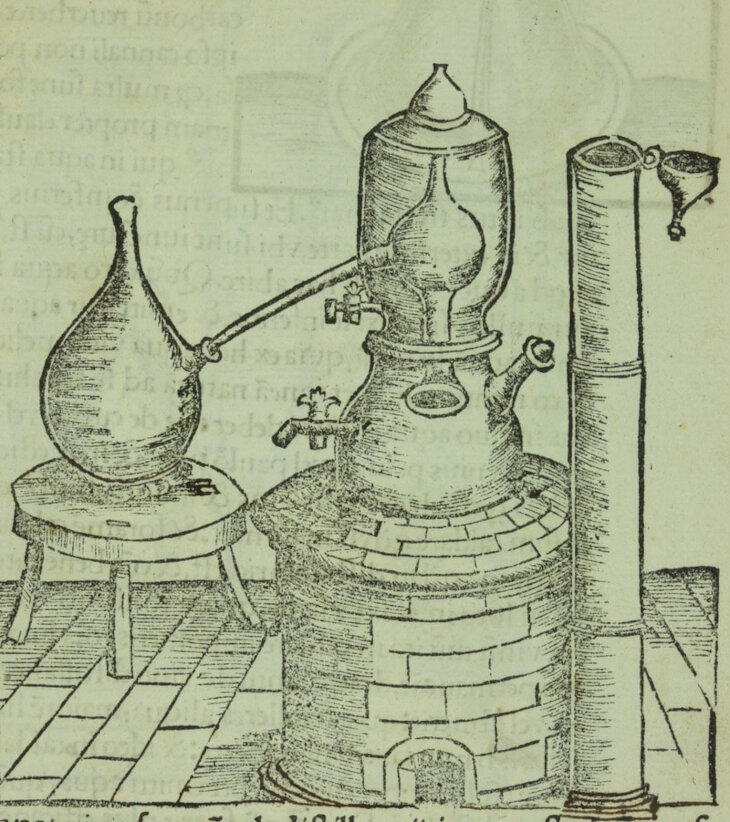 Bain-marie" (Marie’s bath), from Coelum philosophorum, Philip Ulstad, 1528
Her best-known invention was a water bath method that lives on through the term "bain-marie" (Marie’s bath). “It consists of two containers, one outer container and one heated. The water, in turn, slowly heats the material in the inner container”.10 She used the equipment to boil sulfur or mercury at a high temperature and then used the condensed vapors to heat copper or lead in a pan above. The process and equipment are widely utilized in both chemical and culinary practices today, where it’s more commonly known as a double boiler.
Brilliant, yet enigmatic, Maria the Jewess remains one of the most fascinating and mysterious figures in the history of science. She personified the unique blend of practical innovation and mystical philosophy that continues to resonate across disciplines.
Her exceptional understanding of practical chemistry led to inventions that laid foundational groundwork not only for alchemy but for modern laboratory techniques, showcasing her forward-thinking brilliance and her role as a pioneer for women in science and alchemy.
Additional resource: Esoterica - Alchemy: Maria the Jewess and Prophet










I never heard of this remarkable woman before this article, Maria the Jewess was much before Marie Curie, but why did everyone hear about Marie Curie and not this innovative Jewess, that now modern science agrees with her findings, in her time she was considered a genius like in the modern times Albert Einstein, they both had theories that turned out to be true, in modern science in different fields of science
Because one is random hocus pocus and the other science. You know who like Marie—not Maria? Estée Lauder, the first Jewish woman known to have earned a PhD, who used her prowess to invent blonde hair dye.
I did some quick research and saw that the first Jewish woman known to have earned a PhD was Laura Polányi Striker, who achieved this milestone at the University of Budapest in 1909. I also just read that Estée Lauder did not earn a PhD. She was a visionary entrepreneur who co-founded the Estée Lauder Companies, revolutionizing the cosmetics industry with her innovative marketing and product development. Her success stemmed from her business acumen and creativity rather than formal academic achievements.
You’re wrong.
Amazing finding out about this exceptional woman. Thanks for giving us a glimpse.
You are very welcome, thank you for your kind words.
So interesting
Agreed. This was an interesting one to research.
Wow
Most definitely a fascinating woman.