






 The Three Urgent Challenges Jews Need to Confront This Year

12 min read

11 min read


As a Christian teenager in Singapore, Ephrath learned about Judaism on Aish.com to proselytize to Jews. Instead, she found faith and healing and became a Jew herself.
Growing up in a deeply religious Christian family in Singapore, Ephrath Lim studied the Bible and feared God. But looking back, she realizes how unhealthy her upbringing had been. She pictured God as “a man with a big stick who wants to hit you.” Spiritual by nature, Ephrath was consumed with guilt, feelings of unworthiness, and fear of failure. She was terrified of going to Hell. “I was always trying to prove to God that I am worthy of being saved,” she shares.
From an early age, Ephrath felt different from other children. The seventh of nine children, Ephrath was homeschooled together with her siblings. Both large families and homeschooling were unusual in Singapore.
Though Ephrath didn’t know any Jews growing up, her parents raised her with positive feelings towards Jews and Judaism. Until age 10, Ephrath and her family attended a Messianic church where she learned about some Jewish traditions, such as avoiding pork and shellfish. They always spoke about Israel with admiration. (Her family eventually left the Messianic church because of a disagreement.)
Her father served in the military for many years and came in contact with members of the Israeli military who trained the Singapore army. He developed a great respect for Israel and for Jews. Ephrath and her siblings knew that the Bible had originally come from the Jews.
“For the first twelve years of my life, I was really struggling to figure out what God wants from me,” Ephrath recalls. “I lived with a lot of fear, feeling that I’m not good enough, I’m not doing enough.”
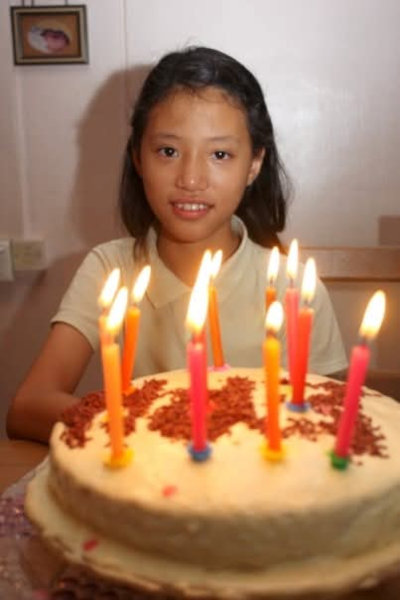
At the same time, she yearned for a genuine relationship with God. “I wanted to reach out to God but was afraid at the same time. What if He doesn’t like me? I feel that God reached back out to me, in a funny kind of way.”
One day, when Ephrath was 13, her father came across Aish.com and found that it had a lot of educational content. “My family was very into character building,” says Ephrath. Her parents thought that the Aish.com educational videos would be a great way to encourage their children to build character.
“My Dad showed us some videos,” Ephrath recalls. “One was about the Holocaust, one was about Purim, and something about the War of Independence in Israel. For some reason, I was very drawn to these videos. I watched them many times.”
Since her parents approved of Aish.com, Ephrath started visiting the website on her own. At first she only watched videos. Then she began reading the articles.
Ephrath admits that her original intention in learning about Judaism was to become a missionary and proselytize to the Jews. “God works in mysterious ways,” she says.
“One day, as I was scrolling the website, I came across this article about why Jews don’t believe in Jesus.” She was surprised. “I thought they did. Or that one day they will come to believe. So I clicked on the article, I read it, and then I kind of just fell down the rabbit hole.”
Ephrath began spending hours on Aish.com without her parents' knowledge.
Through the site Ephrath found out about the counter-missionary work of Rabbi Tovia Singer. She visited his website and began listening to his lectures.
“Slowly, little by little, I began to see why Christianity doesn’t fit anywhere with Torah,” says Ephrath. “It was scary. It took me many years to get over it. When you grow up thinking that you are going to go to Hell if you don’t believe, even if intellectually you can get past it, emotionally, it’s very scary.”
This was a tough time in Ephrath’s life. In search of inspiration, she would read about Holocaust survivors and suicide bombing survivors from the Second Intifada. “I used to think to myself that these people came out of something that was so unthinkable, so painful. They lost everything. And they came out still believing in God, having faith, and rebuilding. I was inspired by the strength of the Jewish people. I got obsessed with Israel, even though I’d never been there. I feel that this was God’s way of reaching out to me and showing me that even though life was very difficult, He’s there, behind the scenes.”
By age 16, Ephrath decided that she wanted to convert to Judaism. Her parents were upset with her decision and tried to dissuade her, but Ephrath persisted. She managed to find the phone number of Singapore’s chief rabbi and called him to speak about conversion.
But the rabbi’s response was discouraging. He told Ephrath that he could not legally convert a minor without her parents’ permission. He recommended waiting until she turned 18.
As soon as Ephrath turned 18, she began calling the rabbi every week. Each time, the rabbi said he was busy and unable to meet with her.
Sometime later, Rabbi Tovia Singer came to speak in Singapore. Ephrath attended his talk and came over to him afterwards, introducing herself and telling him her story. This was her first time meeting a rabbi in person.
Rabbi Singer explained to Ephrath that she didn’t need to convert. She could be a Noahide who observes the Seven Noahide laws the Torah proscribes for all non-Jews and still have a genuine relationship with God.
“I tried that for a couple of months,” says Ephrath, “and it was just – you know when your soul is telling you that it’s not enough. A few months later, I decided I really wanted to convert. Finally, I got into a program and started learning.”
Ephrath spent two years studying for her conversion. Meanwhile, she got a job, rented an apartment near the local synagogue, and became a regular attendee.
As she was learning more about Judaism, Ephrath felt that it was both alien and familiar at the same time. “It was very strange,” she says. “Often, I felt like I already knew this stuff, but I never heard of it in this lifetime. It felt like this was the right thing to do, something I needed to do.”
At times, it was rather difficult and Ephrath felt that maybe Judaism was too much for her. “But I just couldn’t let go of it! I just had to keep moving forward.”
When she was finally ready to convert, Ephrath learned that, unlike other converts, she did not have to choose a different Hebrew name. The name Ephrath – “Efrat” in modern Hebrew – originated in the Hebrew Bible and is a popular name in Israel.
Growing up, she did not appreciate her unusual name. “Nobody could pronounce it, everybody messed up my name,” she says. “I could never find keychains with my name on it.”
But a rabbi who officiated at her conversion gave Ephrath a different perspective on her name. Her parents must have chosen it, he said, because she was meant to become Jewish from the moment she was born.
In learning about Judaism, Ephrath found healing for the guilt and feelings of inadequacy that she harbored as a result of her upbringing.
As a child, Ephrath was taught that God abandoned the Jews as a punishment for their wrongdoings and established a new covenant with Christians. It was a revelation for her that Jews believe that God loves us no matter what.
“There was no new covenant,” she says. “God keeps His word and is never going to break it. Even though the nation of Israel sinned, God didn’t throw us away. We went through a lot of consequences, but God is still with us.”
“I carried so much guilt,” Ephrath recalls. “I had to sit down with good teachers and mentors, who told me, ‘No, God loves you, and that’s not going to change.’ That really helped me to start healing, to start trusting in God and in myself.”
Ephrath also learned that the Jewish concept of Hell is very different from the Christian one. One of her teachers described Hell as a washing machine, where a soul is cleansed of its sins. In Judaism, Hell is a temporary stage to rectify one’s mistakes, not a permanent punishment.
Ephrath realized that she didn’t need to live her life in fear. In Judaism, she says, “You feel hopeful. I used to be afraid that once you fail one time, you’re never going to make it. I learned that every single day that you wake up – in fact, every second – is a new opportunity. That is something I need to remind myself of all the time.”
At first, Ephrath felt angry at God for the way she was raised. “Sometimes I still feel it,” she shares. “Everybody has their good days and bad days. But the truth is, if I hadn’t grown up the way I had, I wouldn’t have converted. I might have lived a successful life, but I would have never fulfilled what my soul wants.”
While going through the conversion process, Ephrath decided to move to Israel. Even though she had never been there before, she was looking forward to joining a much bigger Jewish community than what was available in Singapore.
After converting, Ephrath applied for aliyah. She was hoping to study at Neve Yerushalayim, a religious program for women once she got to Israel. The process of aliyah was taking a while. “It would have taken even longer if God hadn’t intervened,” she says.
Ephrath met a Jewish couple, who told her about an acquaintance of theirs who sponsored flights for girls wanting to go to Israel to study. She got in touch with him, and he bought her a one-way plane ticket to Israel. Ephrath planned to obtain a student visa through her program while she waited for her aliyah application to be processed.
Eagerly anticipating her move, Ephrath was unprepared for her first encounter with the Israeli immigration authorities, which turned out rather traumatic.
At Ben Gurion airport, the clerk noticed that her ticket was one-way and questioned her about it. Ephrath told him that she was in the process of making aliyah. The clerk found it suspicious and sent her to a different room to wait while he verified the story.
“It was a five-hour ordeal,” recalls Ephrath. “I was terrified! I said to God, ‘Look, I left everything in Singapore. I quit my job, I left my apartment, and now these people want to send me back! I have nothing to do there anymore!’”
From the airport, Ephrath got in touch with Neve Yerushalayim. The program’s representatives spoke to the immigration officials. “They argued for a while,” says Ephrath, “and finally, after five hours, they said, ‘Okay, we believe you.’”
When Ephrath finally arrived in her dorm, she felt at home right away. “This is where my soul feels at home,” she says.
As expected, Ephrath encountered some culture shocks, but overall, she loves living in Israel. “People here are very different from where I grew up,” she explains. “I like that people are more outgoing, even though I am introverted myself. People tell you off if you do something wrong, and I like it! You don’t have to sugarcoat stuff. I feel that people are very themselves here. They are not pretending to be somebody else. It’s very refreshing for me to see.”
Ephrath says that though she is used to being different, in Israel she feels that “it’s okay to be different. Everyone is different and comes from different backgrounds.” She also enjoys meeting many other converts.
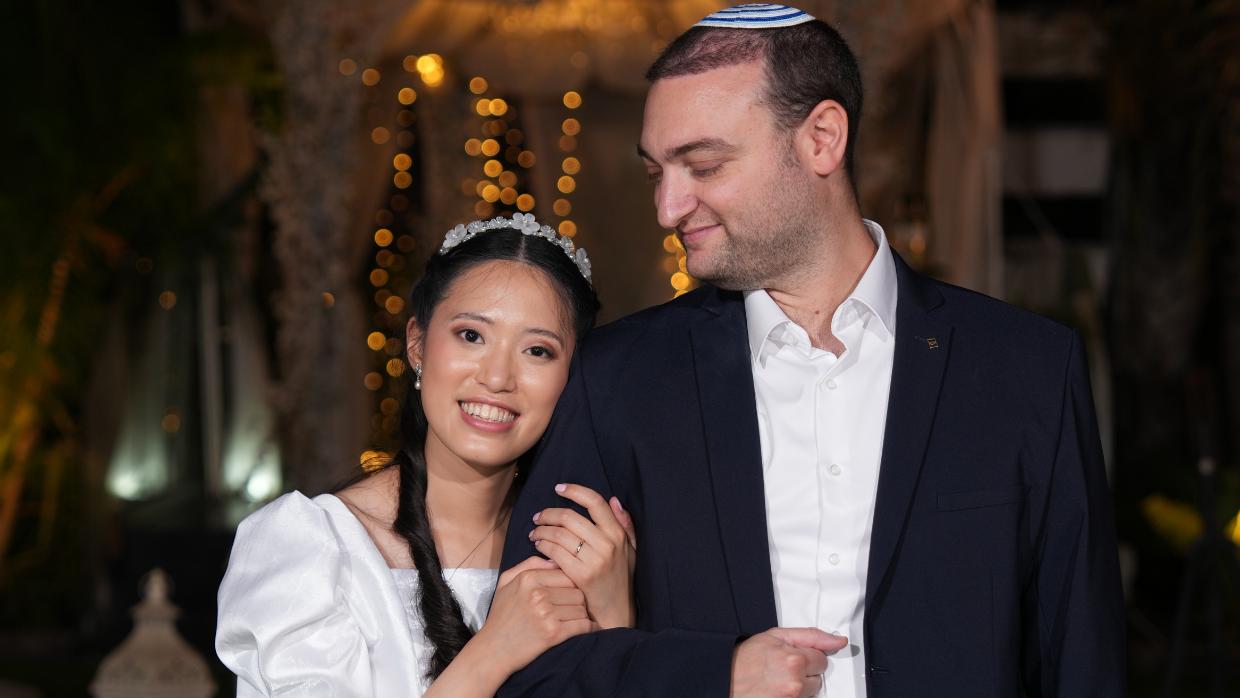
About six months ago, Ephrath married Adiel Skaist, a born-and-bred Israeli. Though they come from very different cultural backgrounds, they share what is most important to them: their religion and their values.
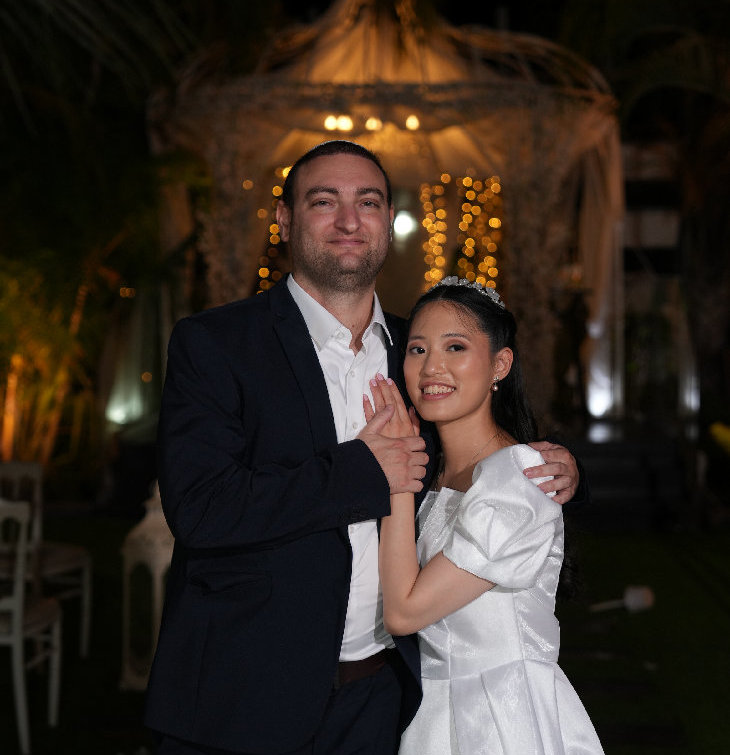
Ephrath met Adiel online on a religious dating app. She says, “I always knew, ever since I converted, that I was going to marry someone from a very different background. We are very different, but we manage, thank God.”
Today, Ephrath lives on a moshav in central Israel with her husband. She works as a dental assistant and plans to go to nursing school.
Ephrath’s in-laws live nearby. They have been very warm and welcoming and often host the young couple for Shabbat.
Ephrath’s family, though initially opposed to her conversion, have now accepted her decision. Her parents attended her wedding and welcomed her husband into the family. The couple is planning on visiting Ephrath’s family in Singapore in the near future.











Another inspiring story from Aish. Can't get enough!
Mazal Tov!
Wonderful journey. Love opens doors.
There are also people born and raised in a christian family who later in life come to the knowledge and faith of the Hebrew Bible.
They break with christian traditions, keep and observe Shabat and other laws and instructions in the way they learn about it.
For reasons -like already being married with a non-Jewish partner, they are not allowed to come to the synagogue and don’t get permission to become Jewish. Then they first should have divorce. But I believe divorce is not according to the principles of Hashem.
So the Holidays, and other meaningful days of reflection and remembrance are spend alone, reading Tenach and books about Judaism, listening Hebrew songs of faith. Being thankful, HaShem, the eternal G’d of Israel, sees their heart.
Ephrath, I’m very proud of you and that you had the strength to move on to get to this point.
I know exactly what you went through because I too had gone through the same situation.
I am Indian from India and I have been converted to an Orthodox Jew over 40 years ago and I also visited Israel a few times, it’s a very beautiful place, I hope someday I too would make Aliyah.
Just to give you heads up, you may end up having a lot of Jewish people looking at you and not accepting you as a Jew but I want you to know that you are as Jewish as much as they are even more so, so don’t let these people make you feel uncomfortable.
Hashem should give you the strength and the courage to keep going.
All the best to you and your husband. 😊👍
Such an inspiring and beautiful story.
No telling where a Jewish soul will or will not land. Looks like this is a happy landing.
Peace and blessings for her.
Wonderful article! What an amazing young woman!! Such courage and perseverance!!
Well done!!! You are very welcomed!!!
Now that's the outcome all Christian missionary activity should have!!
Mazal tov and glad to read this wonderful story!