





 Meet the Jews Behind Iconic Fashion Brands



5 min read


In a daring operation on Christmas Eve 1969, Israel spirited five warships out of a NATO port, vanishing into winter storms during a covert intelligence gamble that stunned Europe.
Throughout history, audacious heists have altered the course of wars. Bank robberies grab headlines. Art thefts inspire movies. But on Christmas Eve, 1969, Israel carried out something unprecedented: it quietly stole five warships from a NATO country and sailed them 2,000 miles home through winter storms.
The story begins with a nightmare every military fears—falling behind an enemy armed with superior weapons and technology. In October 1967, that dread became reality when an Egyptian missile boat sank the Israeli destroyer INS Eilat, the first warship ever destroyed by anti-ship missiles. Israel’s navy was still relying on World War II–era equipment, while its enemies fielded Soviet missile boats capable of killing from beyond the horizon.
Israel knew exactly where to look. France was building Sa’ar-class missile boats in Cherbourg and was willing to sell them. The deal was for 12 boats. Seven reached Israel—then politics intervened. After Israel struck Beirut airport in December 1968, President de Gaulle imposed a total arms embargo. The remaining five boats were locked down under armed guard, even though Israel had already paid for them.
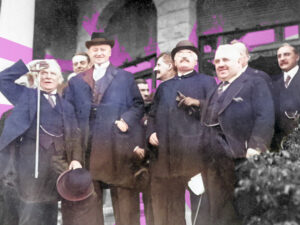
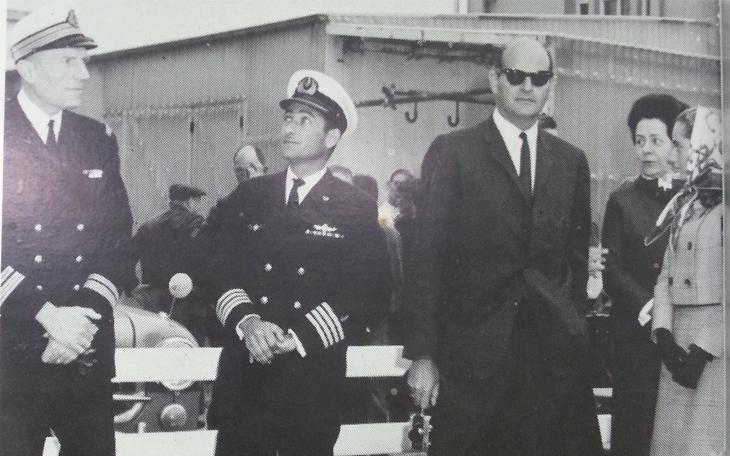 Hadar Kimche, center, and Mordecai Limon, right, pictured in Cherbourg. (Wikimeda commons/Clandestine Immigration and Naval Museum)
Diplomacy went nowhere. For eight months the boats sat idle in Cherbourg while negotiations stalled. So Israeli intelligence did what it does best: it devised a plan so audacious it just might work. They called it Operation Noa, and they assigned their best man in France to carry it out.
The man running the operation was Admiral Mordechai Limon, head of Israel’s military purchasing mission in Paris. Limon was no ordinary naval officer. He had spent years in France, understood how the system worked, and cultivated relationships in both business and government. Most importantly, he understood one critical rule: if the boats were going to get out, it couldn’t look like a military operation. It had to look like a dull commercial transaction—something no one would bother to scrutinize.
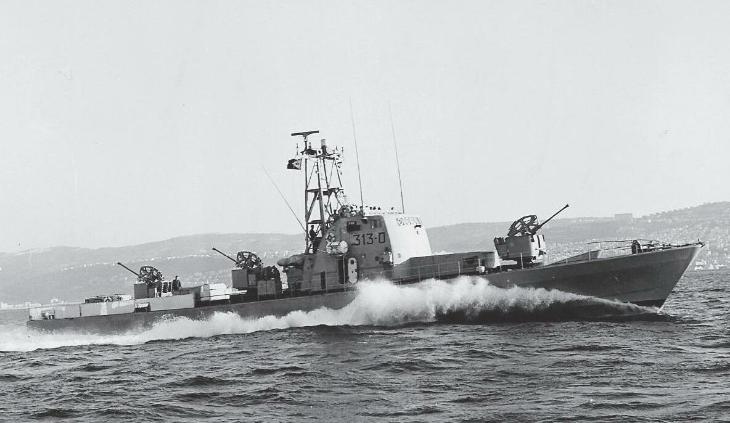 Preparation on 24th December at Cherbourg port. Images copyright Clandestine Immigration and Naval Museum, Haifa.
So Admiral Limon created a fake Norwegian oil company called Starboat. The vessels were legally transferred to the company, making it appear that Norway had purchased them for offshore drilling operations. The paperwork was clean enough that French authorities signed off without objection.
While this was underway, Israeli maintenance crews were already in Cherbourg, quietly preparing the boats. They had been there for months—running engines at odd hours, taking test runs into the Atlantic, and slowly stockpiling fuel and supplies so nothing seemed unusual. The locals grew accustomed to seeing the boats come and go. Everything looked normal. Everything looked boring. And that was exactly the point.
By mid-December, the escape crews began to arrive. Nearly a hundred Israeli naval officers slipped into Cherbourg in groups of two or three over several days. They entered through different European airports, stayed in different hotels, and kept a deliberately low profile. This was the most dangerous phase: if even one French policeman wondered why so many Israelis were appearing just before Christmas, the entire operation could unravel.
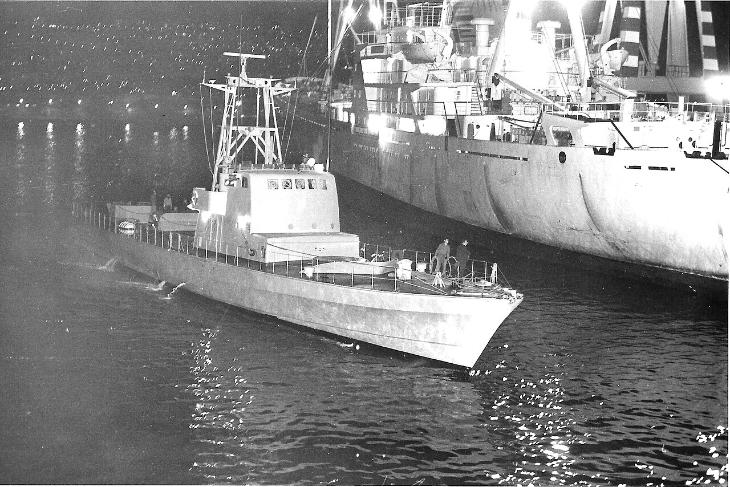 One of the boats arriving in Haifa
Christmas Eve was chosen for a reason. Most French officials would be home with their families, and the port would be running on a skeleton staff. Fewer eyes. Fewer questions. But the North Atlantic had other plans.
A massive storm slammed the Bay of Biscay with Force 9 winds. The scheduled departure time—8:30 p.m.—came and went. Then 10:30. Then midnight. Each update from the meteorologist delivered the same verdict: too dangerous.
Then, just after midnight, a BBC weather report suggested the storm would ease within hours. Waiting any longer meant risking discovery. At 2:30 a.m. on Christmas morning, Captain Hadar Kimhi made the call. One by one, the boats started their engines and slipped out of the harbor.
The French didn’t realize anything was wrong until the next day, when a BBC reporter visited the port, noticed empty berths, and reported it. That’s how the French government learned that five warships had vanished from their harbor.
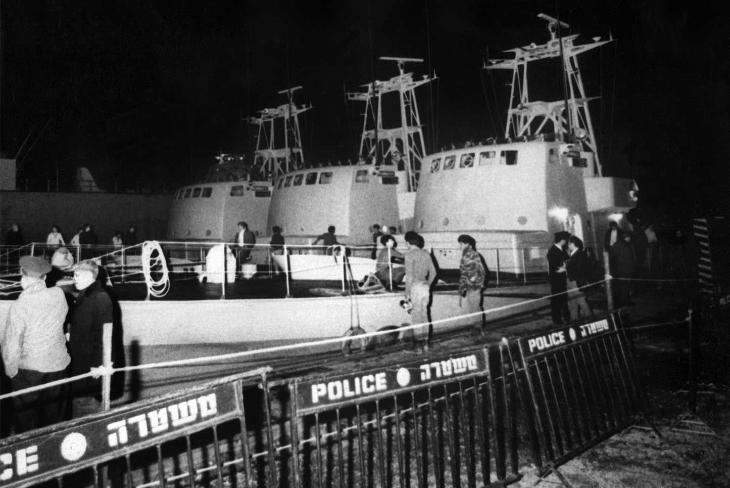 Three of five French missile boats arriving in the port of Haifa on the night of Jan. 1, 1970.
By then, the boats were already hundreds of miles away. The escape itself was brutal. Storm-driven waves slammed the vessels so hard that some officers had to tie themselves to their seats. One boat lacked proper navigation equipment and simply followed the lights of the ship ahead through the darkness.
The flotilla reached Haifa on December 31, just in time for the New Year. Israel immediately armed the boats with Gabriel anti-ship missiles and its most advanced electronic warfare systems. Four years later, during the Yom Kippur War, those same vessels fought in the Battle of Latakia against Syrian missile boats—the first missile-to-missile naval battle in history. Israel didn’t lose a single ship.
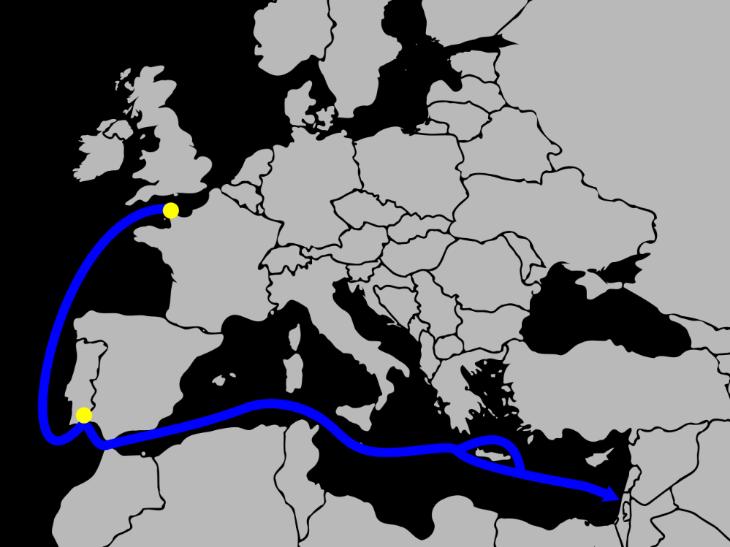 The route of the boats from Cherbourg to Israel (Created by Benherz, Wikipedia Commons)
In the years between, Israel had developed new tactics and technologies: jamming enemy radars, defeating incoming missiles, and striking first. The Syrian and Egyptian navies were devastated. Modern naval warfare was born in those battles—and it happened because Israel refused to accept that five ships it had already paid for belonged to anyone else.
Operation Noa shows what happens when a nation decides survival comes first—and rules come second. The boats made it home and Israel’s navy survived the next war. Israel got what it needed, when it needed it, and the diplomatic consequences were ones it could live with.
This was a fusion of intelligence work, precise timing, nerves of steel, and the kind of desperate courage that emerges when a country’s survival is on the line.













De Gaulle had ze gall to impose an arms embargo on Israel. Yiddish kop, monsieur general.
Loved it all and so Israel and God taking care of His own taking initiative. God bless Israel.
When the flotilla came through the straits at Gibraltar, the guard at the point put two and two together, recognised them and wished them luck!
Lateral thinking is obviously a Jewish concept.
The story should become a movie.
Shalom
Awesome!! ♥️♥️
Interesting the author's name writing this story! GREAT job Israel...
עם ישראל -
There's a fabulous non fiction book called The Boats of Cherbourg by Abraham Rabinovich, revised in 2019. I had the original hardcover and read it in one sitting. Don't miss it.
Israel did not steal the warships, they picked up Israeli property. Israel had paid for them. France was withholding them. Don't mess with Israel.
OMG ... A few years ago I read about this operation in a novel and I thought it was fictional! In Talia Carner's novel, "The Boy with the Star Tattoo", Operation Noa---with all its details---was woven into the plot! I remember thinking it sounded a little far-fetched. Hahaha ... I'm surprised to learn that it really happened!
They also had Hashem on their side. That storm was no accident.
An INCREDIBLE STORY!!!! It was a call to act with courage and determination!!! The Israeli Army is a force to be reckoned with. Let’s continue the journey towards peace.
Brilliant again. Am Yisrael Chai